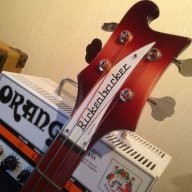
So Mark soldiered on and started on the next mod, setting up for the "minimum neck pick up route".
The inward tension of the strings pulls the head stock and bridge toward each other. The tail piece lift that my bass has is a result of that. The neck gets affected as well, resulting in a forward bow that no amount of truss rod adjument will fix. Over time, this can cause the neck to be pulled forward and separate from the body wings. The theory is that this is due in part to the location of the massive neck pick up route, which is bolstered on either side by the body wings, creating a weak point at the truss rod pocket. The neck (which is actually the center section of the body at this point) is very thin here, and yet has to deal with trying to keep the bass from folding in half. Look at how little wood there is at this location:

Step one is to remove the finish in the truss rod pocket, and glue in these three maple blocks. The idea is to provide as much support for the neck as possible.

The "step" in the fore and aft section of the pick up cavity or routed out, leaving a clean and square opening.

A clean block of solid maple is then epoxied in. The epoxy is stronger than the wood itself, and now the neck has the maximum support possible. This will be allowed to set up overnight, and then a less invasive route for the toaster can be done.

The inward tension of the strings pulls the head stock and bridge toward each other. The tail piece lift that my bass has is a result of that. The neck gets affected as well, resulting in a forward bow that no amount of truss rod adjument will fix. Over time, this can cause the neck to be pulled forward and separate from the body wings. The theory is that this is due in part to the location of the massive neck pick up route, which is bolstered on either side by the body wings, creating a weak point at the truss rod pocket. The neck (which is actually the center section of the body at this point) is very thin here, and yet has to deal with trying to keep the bass from folding in half. Look at how little wood there is at this location:
Step one is to remove the finish in the truss rod pocket, and glue in these three maple blocks. The idea is to provide as much support for the neck as possible.
The "step" in the fore and aft section of the pick up cavity or routed out, leaving a clean and square opening.
A clean block of solid maple is then epoxied in. The epoxy is stronger than the wood itself, and now the neck has the maximum support possible. This will be allowed to set up overnight, and then a less invasive route for the toaster can be done.