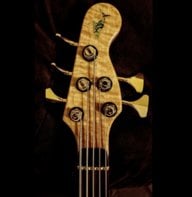
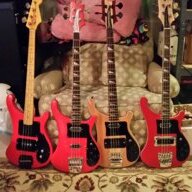
I recently purchased my first Ric, a new 4003 Maple Glo built in 2014.
After a complete set-up by my tech I can honestly say that I really like it.
I don't really find anything "sucky" about the bridge but know that the majority of Ric players prefer to change them out. e.g. Hipshots.
Since this mod appears to be very popular and comments from owners regarding their bridges are by-in-large negative, I was curious as to Rickenbacker's comments/position on this perception.
I would have thought if they are so disliked that the company would at least somewhat address this with an updated version of their bridge.
I'm hoping that a rep from Ric may see this post and offer to comment.
Thanks,
I just bought my first (and probably last) Ric (purchased here on TB). It's an essentially brand new 2016 4003S that was either never played or
very babied. It is absolutely gorgeous, and sounds pretty good. The action is fantastic - I really love the way the neck feels. It's very smooth and comfortable - I could play it all day. It was already set up pretty nice when I got it, but I dialed in the truss rods to get the action even a hair lower, and even across the strings, and now it's
perfect.
So why am I posting here? THE BRIDGE! First of all, the floating bridge - the piece with the saddles attached to it - looks like a cheap piece of Chinese potmetal on the underside. The top looks beautiful, but underneath, you can tell it's a fairly cheap casting. How do I know this? Why did I take it off? Because I could not play the bass unplugged because the vibrations in the bridge were driving me NUTS. Even with the bass plugged in, unless I really crank the amp way up, the buzzing vibration sounds was extremely audible and highly annoying. It sounded like a spring vibrating. It took a while to figure it out, but I finally realized that it was the saddles moving around on the A and D strings. The issue is that the saddles are flat on the bottom, and they are "high-centered" on the bridge. So they are making contact with the bridge only in the very center of the saddle, and not on the edges. Therefore, they are free to rock back and forth like a see-saw. Once I realized that was what was happening, I called Ric to discuss the issue.
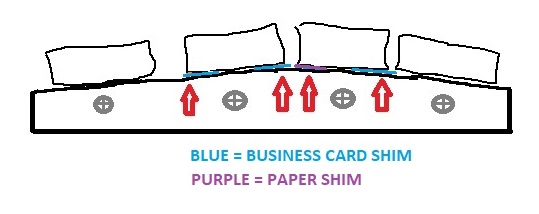
The gentleman who answered the phone was extremely nice and professional and said he knew right away what the problem was. He said the saddle had come off the intonation screw and I needed to turn the screw one way or the other to get it back on. I said I highly doubted that was it since the screw was doing its job setting the intonation so it seemed connected but he swore that was it. He said if that didn't fix it, I could send the entire bass back in for a warranty repair. (Yes, it has to be the entire bass.) He told me how to take the bridge off and look under there. So after I got off the phone with him, I did that. The saddles were all installed just fine onto their screws. The issue is strictly due to having a flatbottomed saddle sitting on top of a curved surface. Of course it's going to rock around. How could it not? I tried my best using Microsoft Paint to create a crude drawing showing the issue. The big gaps between the bottom of the saddles and the top of the bridge are shown by the four red arrows. Those are the places where I put some shims.
Thankfully, I was able to fix the issue - two ways.
Method 1: I did a temporary fix by cutting some 3/16" wide strips of a heavy, thick glossy business card and slipping two strips under the A string saddle, one on each side, and one strip under the D string saddle on one side. The issue on the D string wasn't as bad, so I couldn't fit the business card under the other side. But a sheet of office paper did still fit under there, so I stuck the paper under there. Voila - problem solved!! The vibration is gone, and now the bass is a pleasure to play. What did this do to my tone? I don't know. The bass has flatwounds on it, so it's not super lively anyway. But my instincts say that having paper between the saddle and bridge might dampen some resonance that would otherwise transfer through from the string to the body. Then again, the paper took the place of air, which wasn't transmitting any resonance either!
Method 2: I spotted an ad for a Hipshot bridge (and Drop D tuner) here on the TB classifieds, and immediately jumped on it. So the permanent fix will be installed next week. Hopefully I have good luck with the new bridge.
The stock bridge
looks very cool. I found it perfectly serviceable to intonate the bass. I'm not sure if it was a design flaw or a manufacturing flaw that caused mine to vibrate so much. Either way, the problem turned out to be easy enough to fix by slipping the shims under the side of the saddles. But for the kind of money these things sell for, it doesn't seem like this sort of a workaround should be needed.
I do like the bass a lot. I've wanted one for about 40 years, so it's nice to fulfill that dream. I look forward to putting some roundwound strings on it to hear what it can really do. I don't predict I'll be getting another one though. Unless maybe it's an older one in really great condition that doesn't have any such issues. In hindsight, if I had gotten a chance to play this one in person before buying it, I probably wouldn't have bought it, because the buzzing would have been a showstopper for me since I didn't know what it was caused by.