• TalkBass has been independent since 1998. Add your voice.
    Create a free account to reply to discussions, view embedded media, and browse with fewer display ads.
    Join freeLog in
    Want zero display ads or expanded classifieds tools? Compare plans.

Roasted maple necks. Tuning stability?

I'm about to order a neck from Warmoth and considering roasted maple for the shaft.

I know roasted is said to be more stable when it comes to truss rod adjustments.
All of my maple necks are extremely stable in this regard.

Much more important to me, I never hear referenced how well they stay in tune.

All 3 of my basses with unroasted maple necks need to be retuned every day and or after about 3hrs. of playing and go flat or sharp with a 2 or 3 degree Fahrenheit change.

The wenge necked bass I have needs to be tuned about every other day or after about 5hrs. of playing.
It also has stiffening rods and none of the maples are reinforced

So I'm wondering if roasted maple with stiffening rods is more likely to hold tune more like my wenge neck or the other maples?

 
I'm about to order a neck from Warmoth and considering roasted maple for the shaft.

I know roasted is said to be more stable when it comes to truss rod adjustments.
All of my maple necks are extremely stable in this regard.

Much more important to me, I never hear referenced how well they stay in tune.

All 3 of my basses with unroasted maple necks need to be retuned every day and or after about 3hrs. of playing and go flat or sharp with a 2 or 3 degree Fahrenheit change.

The wenge necked bass I have needs to be tuned about every other day or after about 5hrs. of playing.
It also has stiffening rods and none of the maples are reinforced

So I'm wondering if roasted maple with stiffening rods is more likely to hold tune more like my wenge neck or the other maples?
Anytime I play a bass out, I tune it before performing and tweak the intonation as needed. Both my Lakland 55-94 have Quarter Sawn Maple necks that are very stable after nearly 25 years of performing in St. Louis where the humidity is brutal in the spring and summer. Roasted Maple just get's you closer to a 25 year old neck like mine. As someone once " It ain't the temperature, it's the humidity" for the most part that's true.
 
Anytime I play a bass out, I tune it before performing and tweak the intonation as needed. Both my Lakland 55-94 have Quarter Sawn Maple necks that are very stable after nearly 25 years of performing in St. Louis where the humidity is brutal in the spring and summer. Roasted Maple just get's you closer to a 25 year old neck like mine. As someone once " It ain't the temperature, it's the humidity" for the most part that's true.
Or as we say in South Florida, "it ain't the heat, it's the stupidity"
 
I'm about to order a neck from Warmoth and considering roasted maple for the shaft.

I know roasted is said to be more stable when it comes to truss rod adjustments.
All of my maple necks are extremely stable in this regard.

Much more important to me, I never hear referenced how well they stay in tune.

All 3 of my basses with unroasted maple necks need to be retuned every day and or after about 3hrs. of playing and go flat or sharp with a 2 or 3 degree Fahrenheit change.

The wenge necked bass I have needs to be tuned about every other day or after about 5hrs. of playing.
It also has stiffening rods and none of the maples are reinforced

So I'm wondering if roasted maple with stiffening rods is more likely to hold tune more like my wenge neck or the other maples?
I own two Bacchus bass and Charvel pro mod PJ with roasted maple neck .

Both Bacchus are entry level model BJB1RSM and BJB1RSM, just a one piece J neck. Both neck are unexpected rock steady, some serious humid and temperature change , they has very small degrees of pitch change, mostly I just leave it.

Charvel roasted neck has reinforced rod inside, the neck has same performance as both Bacchus neck. But the price difference quite huge. $999 Vs $230/250.
 
  • Like
Reactions: ninjatanzen
It's all wood;) IME multilaminate construction is more likely to help stability than roasting. That said, for stability, carbon is king ;)
Carbon fiber is very stable over temperature. Trouble is, that’s not ideal. If you want tuning stability, you want a neck with the same thermal coefficient as the string core material. A steel neck would easily beat a graphite one….for tuning stability. Neck dive eould be an issue, though.

My basses all have roasted msple necks (with graphite rods). There’s an additional detail that matters w.r.t. stability. The most stable necks I have have roasted maple fretboards as well. If the fretboard is another wood, the difference in moisture expansion makes neck bows - a tiny bit, but if you want the most stable neck, roasted maple neck and fretboard is what you want. I tune my basses.. on the weekend at the gig. They don’t need to be tuned, unless someone messes with it, or a tuner gets turned in transit. I always check just in case.
 
Last edited:
It's all wood;) IME multilaminate construction is more likely to help stability than roasting. That said, for stability, carbon is king ;)

Laminating a neck, if done properly, helps the neck maintain its shape by using stresses in different pieces of wood against esch other. It reduces the effects of stresses. Roasting completely removes those stresses. Neither changes the thermal coefficient of expansion. Both help with shape stability; roasting is more effective. Neither gives you perfect tuning stability.
 
  • Like
Reactions: Frank Kreber
My $0.02 is that I have 2 similar warmoth necks:
1. Maple with ebony fretless board and steel rods.
2. Roasted Maple with ebony fretless and graphite rods
They are both too similar for me to have noticed any difference in stability. The 'fancy' one is way lighter and that bass balances way better. It also has the lighter tuners. For my $$, I'm going 'fancy' from now on (meaning both roasted maple and graphite).
 
IME, neck stability (on any quality bass at least) should have nothing to do with short term tuning. Between gigs, or between playing, the strings will shrink and go maybe a 1/2 step sharp. Then after playing the first set, I will have to tune again as the strings stretch out. Tuning is just part of life as metal strings expand and contract with playing and even minor changes in temperature.

I check my necks (Roasted Maple, Ebony and Graphite) once a year, and they're always pretty close, if not dead on (the Steinberger is always rock solid). When I had a regular Maple with a Rosewood fretboard (MM Sterling) it really wasn't THAT much worse over an entire year. There's been years when I've not found it necessary to adjust at all.

What kills a bass neck is rapid, extreme changes in temperature and humidity. Perhaps roasting the maple might be more stable in the long term, however short term you shouldn't notice a difference. Unless you store your basses in the trunk of your car during winter. Don't do that and you'll be fine. If you're adjusting the neck every week, I think you may need a new bass.
 
If you’re obsessive about tuning stability, you need a bass that uses double-ball strings. That gives you the absolute minimum extra string length, which means less stretching when new and less susceptibility to temperature-induced expansion and contraction.

Second-best is high-quality locking tuners. For the same reason.

Third-best is high-quality non-locking tuners with a minimum of wraps on the post. 2 is enough.

Neck stability is not the most important thing here.
 
  • Like
Reactions: Keither
IME, neck stability (on any quality bass at least) should have nothing to do with short term tuning. Between gigs, or between playing, the strings will shrink and go maybe a 1/2 step sharp. Then after playing the first set, I will have to tune again as the strings stretch out.
My basses are a lot more stable tuning wise than your description. I suspect I'm not alone in this. What kind of basses do you have that they go half a step sharp between gigs, or have to be tuned after a set of music?
 
Neck stability is not the most important thing here.
There are other concerns, but if the neck is moving, you won't stay in tune, no matter how well the other things are attended to. My basses have regular tuners. Once a string settles in, the changes are either from a tuner getting turned, or wild swings in temperature and or humidity. If the weather isn't changing, my basses stay right on pitch.

Neck stability also helps a bass hold a setup - that is where I see the biggest advantage of roasted necks.
 
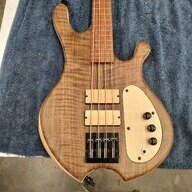
Warmoth roasted neck, graphite rods, ebony board, I play it unfinished. My only roasted maple neck experience. This neck is more stable than any of my other maple neck basses.

20251015_111326.jpg
 
  • Like
Reactions: SharpCat
Or as we say in South Florida, "it ain't the heat, it's the stupidity"
Hey, I resemble that remark! 🤣

What I can add is that I had a regular maple neck stingray that needed constant truss rod adjustment, had bad fret sprout, and had a horrible dead spot.

I recently got a StingRay special with a roasted neck, and those issues have been eliminated.

Regarding tuning, I don't see any difference. They both stayed in tune well.
 
  • Like
Reactions: murphy
Anytime I play a bass out, I tune it before performing and tweak the intonation as needed. Both my Lakland 55-94 have Quarter Sawn Maple necks that are very stable after nearly 25 years of performing in St. Louis where the humidity is brutal in the spring and summer. Roasted Maple just get's you closer to a 25 year old neck like mine. As someone once " It ain't the temperature, it's the humidity" for the most part that's true.
My maple necks are all over 30yrs. old now. I'm from St. Louis.
If roasted is more like older maple necks thats a big point for roasted.
 
Warmoth roasted neck, graphite rods, ebony board, I play it unfinished. My only roasted maple neck experience. This neck is more stable than any of my other maple neck basses.

View attachment 7416310
Warmoth roasted neck, graphite rods, ebony board, I play it unfinished. My only roasted maple neck experience. This neck is more stable than any of my other maple neck basses.
That actually is what I'm building. A frettless J bass.
 
  • Like
Reactions: thefaceofbass

Latest posts