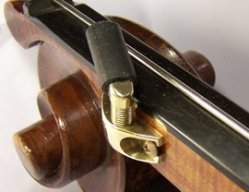
As some of you know, I recently had NYC luthier Bill Merchant install an extension my bass. I have always wanted one of Bill's extensions and I'm extremely happy with mine - both the functionality and the improvement in sound. I've always found Bill's extension design to be really elegant and I think a lot of that is due to the machined capos he uses.
I was reminded of their advantages recently when I was playing someone else's bass and using the gates on their extension. It had big wooden gates which were ornately carved - very pretty. I personally don't care for that kind of ornate stuff on a bass but that's my personal taste. As far as the size goes, I personally like a more integrated look to the extension that doesn't draw so much attention. What was interesting was that I found the bigger gates cumbersome to navigate. You'd think bigger gates would be quicker to locate and dis/en-gage but I don't find that to be the case.
I think there are some luthiers using smaller wooden gates but I've only seen one or two. When I was inquiring around about extensions I noticed that Bill's cost for each additional gate on the extension was about half that of most others. I think that may also be due to the use of these machined capos.
I've just found out that these capos are generally available and thought others may want to know. They are made by bassist Rob Anzellotti and he has a website. Perhaps this means we'll see other luthiers using these and perhaps also for bassists, a slight reduction in price for extensions.
I was reminded of their advantages recently when I was playing someone else's bass and using the gates on their extension. It had big wooden gates which were ornately carved - very pretty. I personally don't care for that kind of ornate stuff on a bass but that's my personal taste. As far as the size goes, I personally like a more integrated look to the extension that doesn't draw so much attention. What was interesting was that I found the bigger gates cumbersome to navigate. You'd think bigger gates would be quicker to locate and dis/en-gage but I don't find that to be the case.
I think there are some luthiers using smaller wooden gates but I've only seen one or two. When I was inquiring around about extensions I noticed that Bill's cost for each additional gate on the extension was about half that of most others. I think that may also be due to the use of these machined capos.
I've just found out that these capos are generally available and thought others may want to know. They are made by bassist Rob Anzellotti and he has a website. Perhaps this means we'll see other luthiers using these and perhaps also for bassists, a slight reduction in price for extensions.