• TalkBass has been independent since 1998. Add your voice.
    Create a free account to reply to discussions, view embedded media, and browse with fewer display ads.
    Join freeLog in
    Want zero display ads or expanded classifieds tools? Compare plans.

Roscoe Club

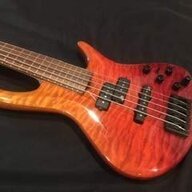
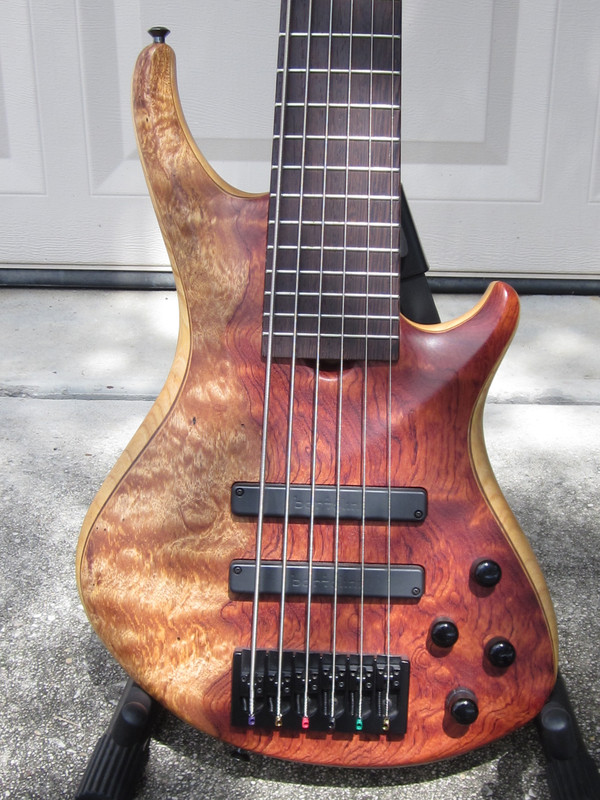
It's been too quiet in here... So I'll post some preliminary pics of my Koa Century 6. There was a little mix up with them installing Barts instead of Aguilar, but that's been fixed and the bass will be heading my way in a day or two.

View attachment 5027355 View attachment 5027356 View attachment 5027357 View attachment 5027358
these pics made the Bass Musician Mag instagram pics of the month I believe. It's well deserved. Such a amazing offering. That bookmatched back with the Wenge Board is killer.
 
Sadowsky does it too, guessing it’s all the same thing for their best tops (and to charge you more ;)).

My Century has an “exhibition grade” koa top, which is probably another name for that
View attachment 5044645
I’ve seen 5A often referred to as Exhibition Grade. That what my Century 5 has too, at least according to the video.
 
First rehearsal today with the new Koa Century 6.

I'd already put in about 4 hours of solo practice with it, so I was getting pretty comfortable, but you never really know until you play in the room with the rest of the band.

One issue I ran into moving from the Roscoe Classic 20 fret bass to the 24 fret Century, is everything felt "tighter" to my right hand. I hadn't really thought about how much farther from the bridge I'd gotten used to plucking on the 20 fret Classic. Especially since I have that oddball "double P" configuration. I guess my normal playing position is similar to anchoring your thumb on the neck pickup of a jazz bass. So I'm used to a "soft" feel in the strings, and a lot of deep, round bass response. (I'm very much the opposite type of player to those who pluck over the bridge pickup.) Anyway, I realized all this just in time for rehearsal, and adjusted on a few songs to anchor my thumb at the end of the fretboard instead of the neck pickup. That gave me the tone and feel I needed on those tunes where I want a more "dubby" vibe.

Other than that subtle adjustment, everything was great. The Aguilar DCB soapbars have a nice tone, with a bit more definition than the P pickups I've gotten used to, but still plenty of warmth.

I was wondering if the rather hefty 11 lbs, 5 oz of the 6 string would be too tiring for a 3 hour gig or rehearsal -- but apparently I just don't feel much difference between 9 or 11 lbs. I always bring my featherweight Dingwall AB-II as a backup bass, so if it did start to bother me, that's the solution. I haven't weighed that bass, but with the chambered body, it feels like nothing at all. Might be as low as 7 lbs.

We had a gig drop in our laps for this Saturday (literally got the offer via email during the rehearsal), so I'll get to see how it works on the gig very soon.
 
First rehearsal today with the new Koa Century 6.

I'd already put in about 4 hours of solo practice with it, so I was getting pretty comfortable, but you never really know until you play in the room with the rest of the band.

One issue I ran into moving from the Roscoe Classic 20 fret bass to the 24 fret Century, is everything felt "tighter" to my right hand. I hadn't really thought about how much farther from the bridge I'd gotten used to plucking on the 20 fret Classic. Especially since I have that oddball "double P" configuration. I guess my normal playing position is similar to anchoring your thumb on the neck pickup of a jazz bass. So I'm used to a "soft" feel in the strings, and a lot of deep, round bass response. (I'm very much the opposite type of player to those who pluck over the bridge pickup.) Anyway, I realized all this just in time for rehearsal, and adjusted on a few songs to anchor my thumb at the end of the fretboard instead of the neck pickup. That gave me the tone and feel I needed on those tunes where I want a more "dubby" vibe.

Other than that subtle adjustment, everything was great. The Aguilar DCB soapbars have a nice tone, with a bit more definition than the P pickups I've gotten used to, but still plenty of warmth.

I was wondering if the rather hefty 11 lbs, 5 oz of the 6 string would be too tiring for a 3 hour gig or rehearsal -- but apparently I just don't feel much difference between 9 or 11 lbs. I always bring my featherweight Dingwall AB-II as a backup bass, so if it did start to bother me, that's the solution. I haven't weighed that bass, but with the chambered body, it feels like nothing at all. Might be as low as 7 lbs.

We had a gig drop in our laps for this Saturday (literally got the offer via email during the rehearsal), so I'll get to see how it works on the gig very soon.


I have to say, weight was never a thing for me. In fact, I can remember when honking heavy basses were sought out for their "epically long sustain."

I didn't know that the weight of a bass mattered in that a heavy bass was a negative until I joined TalkBass. I just thought that a bass is a bass and if it sounds good it is good. Probably the same with neck dive. But I like a bass to rest is my left hand just a bit but not too much- so perhaps it was a feature that I could feel yet didn't know what to call it.

For all of the benefits this forum has given me, I think that weight suddenly becoming important is a minus.
 
I have to say, weight was never a thing for me. In fact, I can remember when honking heavy basses were sought out for their "epically long sustain."

I didn't know that the weight of a bass mattered in that a heavy bass was a negative until I joined TalkBass. I just thought that a bass is a bass and if it sounds good it is good. Probably the same with neck dive. But I like a bass to rest is my left hand just a bit but not too much- so perhaps it was a feature that I could feel yet didn't know what to call it.

For all of the benefits this forum has given me, I think that weight suddenly becoming important is a minus.
I hear you. I'd have just accepted this bass as "maybe a little hefty?" If It weren't for reading the discussions on here.

When it comes to neck dive, I played a bass for many years with terrible neck dive that caused me some issues with my left thumb from supporting the neck. Like you, I didn't even know there was a term for it until learning from Talkbass. But now that I know, that's a thing I don't put up with anymore. I'm not weight sensitive, but I'm burned out on neck dive and won't tolerate it. Given that experience, I can understand other players having their own deal-breaker preferences.
 
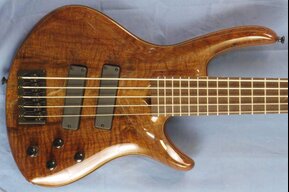
I haven't seen many (any?) Roscoes with walnut tops, which is a shame as this one is gorgeous... only "exhibition grade" though ;)

IMG_3701.jpg


Roscoe SKB3005 Signature Fretless: Exhibition Clara Walnut Top, Wenge/Maple Neck
 
Last edited:
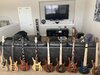
So I took a family picture yesterday of all my basses. A couple are Roscoes so hopefully no one will get offended with me posting the picture. I think a lot of us Roscoeheads have basses other than Roscoes for a variety of reasons.
The headstocks aren’t visible so you’re going to have to guess what brand they are.

9CC8769A-29CB-45BE-AFDD-6EDFBF3BA3A1.jpeg
 
I have to say, weight was never a thing for me.. I didn't know that the weight of a bass mattered in that a heavy bass was a negative until I joined TalkBass. I just thought that a bass is a bass and if it sounds good it is good.
Although some basses are touted for light weight, they are not constructed of the types and quality woods Roscoe uses.

It's fairly common to find Roscoes with solid tops that are 3/4" thick. I've played Roscoes with thick tops of Bubinga, Maple, Myrtle, etc. Wenge wedge necks are fairly common in Roscoes, too, being offered in basses for over 10 years. Many Roscoe bodies are 1-piece as well. And, until recently, Roscoe has not offered "weight relieved" bodies.

If I'm looking for a 7-8 lb 35" scale (5 or 6 string) bass, I'd expect it to be made of Basswood, Empress, or Pine. Solid Swamp Ash, Alder, or Mahogany? Most likely weight relieved, like a famous maker in NYC (and owners of those basses debate whether weight-relieved or solid sounds best). Thick, tone-contributing ornamental top? Nope. Most likely a tonally benign thin veneer. Wenge wedge neck? Most likely 1-piece maple. Definitely not a Roscoe bass with those specs. Not interested.

So I took a family picture yesterday of all my basses. .
Great pic of beautiful basses, Joe. Nice photo work, too. The Bee's Wing Bubinga fretless is my favorite of the bunch. It's such a visually and (and likely tonally) stunning bass.
 
Last edited:
  • Like
Reactions: JOME77
So I took a family picture yesterday of all my basses. A couple are Roscoes so hopefully no one will get offended with me posting the picture. I think a lot of us Roscoeheads have basses other than Roscoes for a variety of reasons.
The headstocks aren’t visible so you’re going to have to guess what brand they are.

View attachment 5049317
Joe, I thought you were thinning the herd, I was aspiring to be like you... ;)

And while I am a steadfast <9.5lbs bass person, people can do whatever they want. I'm happy with the tone I'm able to get out of most of the lightweight basses I have (always a problem child or two), but with hearing protection and the rest of the band, I don't know how much of that even matters. While I am not in the primo bass playing condition, it's nice to end a 3 hour practice/gig (total, not straight through) without any shoulder/back pain. There's numerous variables in my signal chain, and I prefer to play standing, so I'm comfortable with my weight limits.
 
Last edited:
  • Like
Reactions: Nightman and JOME77