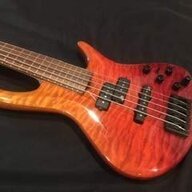
So I've had a couple weeks to get use to the Roscoe STD Plus 6. Oddly, even though it's been 8 years since I owned a 6 string bass, I adjusted quite quickly. I guess it is kind of like "riding a bike".
I can certainly say "been done that" with a 6 string but I'm approaching this one a bit differently. I'm approaching it like I approach a 5 string bass. Ona 5 string bass, I usually only play the B string when I need a note below the open E string. Outside of that I play a 5 like it's a 4 string bass.
So, with that mind set, I'm only using the C string when I need a note above the G string at the 24th fret or when I need a high note in a riff that I'm playing in position (that's easier to play while executing the riff). Basically, if the note is going to be held for more than a beat a beat or 2, I go up on the G string to play it (because IMO until you get above the 10th or 11th fret the notes sound better on the G). It's been a while since I've heard a Roscoe Bart/Bart pre combo and it's kind of a nice throaty warm tone (in contrast to my fretted Roscoe V with 4 band Pope pre and Roscoe Barts (which is a bit more open sounding). Similar but different.
Without a doubt, a 6 string is probably the best instrument that Keith makes (maybe along with his fretless basses). I hope that I can really make this one stick around a while.

Here's a bass orchestra tune that I recorded (Reason 9) all of the fretted parts (9 tracks) using the Roscoe STD Plus 6. I did very little EQ'ing on the solos. The difference in tones is primarily using a slightly different blend or playing in different positions on the neck. The strings are DR Pure Blues nickel RW's. The fretless part is one of my former Roscoe fretless basses.
I guess even if I don't use the high C at church much, it's nice having it on a bass for when I record the Bass Orchestra tunes.