
I've owned several Sadowsky basses and the Metro's are nowhere near as good as the NYC and I find them to be way too expensive.
Can you elaborate? I own a Metro and it's fantastic. I tried a NYC and it didn't strike me as any better.

TalkBass has been independent since 1998. Add your voice.
Create a free account to reply to discussions, view embedded media, and browse with fewer display ads.
Join free Log in
Want zero display ads or expanded classifieds tools? Compare plans.
I've owned several Sadowsky basses and the Metro's are nowhere near as good as the NYC and I find them to be way too expensive.
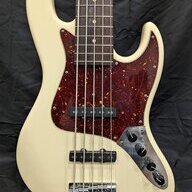
Can you elaborate? I own a Metro and it's fantastic. I tried a NYC and it didn't strike me as any better.
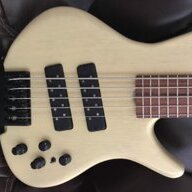
Hey Joe, I think I can answer this one fairly succinctly. I don't have that bass anymore but have enough experience with the preamps and pickups in question, including the Bartolinis.Hey Jeff.
I know that this post is a few years old but I wanted to pick your brain a bit on the Darkglass preamp.
I was going through some of my older recordings and I came across some sound clips of my former Zon fretless with the Darkglass pre verses the Bart 3-Band pre (Zon Bart SB P/U's).
I've always used the Bart 3-band in my fretless basses so after trying out the Darkglass for a few months I replaced the Darkglass pre with a Bart 3-band. It was a combination of trying to adjust to a Vol/Vol (verses the blend) and 2 mid bands (no treble).
The Bart sounded good in the bass but I was never able to cop the tones that I could dial in on the Darkglass pre. It was so warm and organic and not harsh at all. It wasn't as plug and play as the Bart but it sure could dial in some great fretless tones.
I know that you have (or had) the single Nord pickup installed (and I have the Bart hum-free jazz) but what value pot did you go with for vol?
I've really been thinking about getting a Darkglass for my Roscoe STD JB fretless and going with a stacked Vol/Vol 250K (I want to stay with a 4 knob configuration). Darkglass skirts around the pot value issue by stating to reference your pickup manual for the best pot value to use. Of course Bart pre's use a 25K volume but I suspect that's more due to their preamp design. I'm pretty sure that the Darkglass that I pulled from the Zon had 250K pots (although I seem to remember the buyer of the preamp asking why one vol control was 250K and the other 500K; strange).
Any other Roscoeheads that have installed a Darkglass pre please chime in ......
My figure-of-merit on _any_ used item is 50% MSRP. (Most items do not sell new at MSRP, but at some discounted 'street price.') A 'like-new' pre-owned bass may be indistinguishable from new - but so is a car after a one-mile drive from the dealership... Is new gear over-priced, or are used items under-valued? I donno. Theoretically, a new item comes with some sort of dealer/maker support in the event of post-sale issues, which should be worth something......Emperor Standard Classic with matching headstock that I think sells new for $6100. I've seen a few sell used for $4000-4500. That's quite a loss if I wanted to sell.
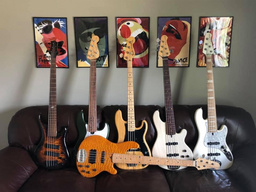
Hey Joe, I think I can answer this one fairly succinctly. I don't have that bass anymore but have enough experience with the preamps and pickups in question, including the Bartolinis.
Essentially the reason the Bart preamp uses a 25k volume is that it follows the preamp output, rather than falling between the pickups and preamp input like on most preamps. That's why the blend is still 250k. If you want active/passive switching you can swap to a 250k volume on a Bartolini preamp and it works fine - I've done this before.
With the Darkglass, and others that work like it (Aguilar for another example) you pick your pot values and vol/vol or vol/blend setup exactly like a passive bass, and then the preamp goes between the volume(s) and the jack on the bass. With the Bartolini J pickups on your fretless the stacked 250k vol/vol should be good.
My figure-of-merit on _any_ used item is 50% MSRP. (Most items do not sell new at MSRP, but at some discounted 'street price.') A 'like-new' pre-owned bass may be indistinguishable from new - but so is a car after a one-mile drive from the dealership... Is new gear over-priced, or are used items under-valued? I donno. Theoretically, a new item comes with some sort of dealer/maker support in the event of post-sale issues, which should be worth something...

As I was getting into boutiques, I compared and played Roscoes and Foderas at Bass Central. I went with Roscoe for feel, tone and weight. $ was not an issue. I still believe Roscoe has the best wood, and craftsmanship of any bass out there.
Can't speak for any one else...So why do we(I) spend big money on the big names?
The Fender copies seem to be ill-advised not well thought out. I'm not surprised to see so many used ones up for sale.
Question: how does your Fender Elite compare to a Sadowsky NYC?I agree that Roscoe build quality is equal to anybody out there but this not really part of the discussion. With that said, I believe build quality is either very overrated or very underrated these days. I say that to ask what does build quality mean? It probably means something different to each of us. If you take one of my Fender Elite Jazz 5 string basses, you would be hard pressed to find any build quality issues. The finish is perfect, the neck pocket is tight, the fretwork is perfect, it plays and sounds great and the neck is very stable. I'm not sure what more anyone can ask for. There are plenty of cheap foreign instruments that for all purposes are without flaw. With the advent of CNC build quality is pretty consistent. I don't find the quality of the wood being used to be that big of deal these days either. It's just not hard to find a good playing, good sounding bass that is likely to last a lifetime. So why do we(I) spend big money on the big names?
Hmmmm, sounds subjective I.e. all about feel. The NYC I played was a 5 string but I didn’t like the neck anymore than my 5 string Metro.Yes. As it relates to the 5 string necks, every NYC had a much better, thinner profile than the Metros. The overall feel of the Metro just seemed cheap to me. The NYC's I've played felt like a boutique whereas the Metros felt like a Chinese made instrument, not to the level of a Sire similar but in that ballpark.
Question: how does your Fender Elite compare to a Sadowsky NYC?
Hmmmm, sounds subjective I.e. all about feel. The NYC I played was a 5 string but I didn’t like the neck anymore than my 5 string Metro.
There are plenty of cheap foreign instruments that for all purposes are without flaw. With the advent of CNC build quality is pretty consistent. I don't find the quality of the wood being used to be that big of deal these days either. It's just not hard to find a good playing, good sounding bass that is likely to last a lifetime. So why do we(I) spend big money on the big names?
Can't speak for any one else...
Roscoe has figured out how to make a neck that fits my hand.
No one else I've tried has.
Your Hand May Vary...
6) Follow moral value principal of keeping production onshore


