• TalkBass has been independent since 1998. Add your voice.
    Create a free account to reply to discussions, view embedded media, and browse with fewer display ads.
    Join freeLog in
    Want zero display ads or expanded classifieds tools? Compare plans.

SBMM Stingray Short scale

Just to add my 2 cents:
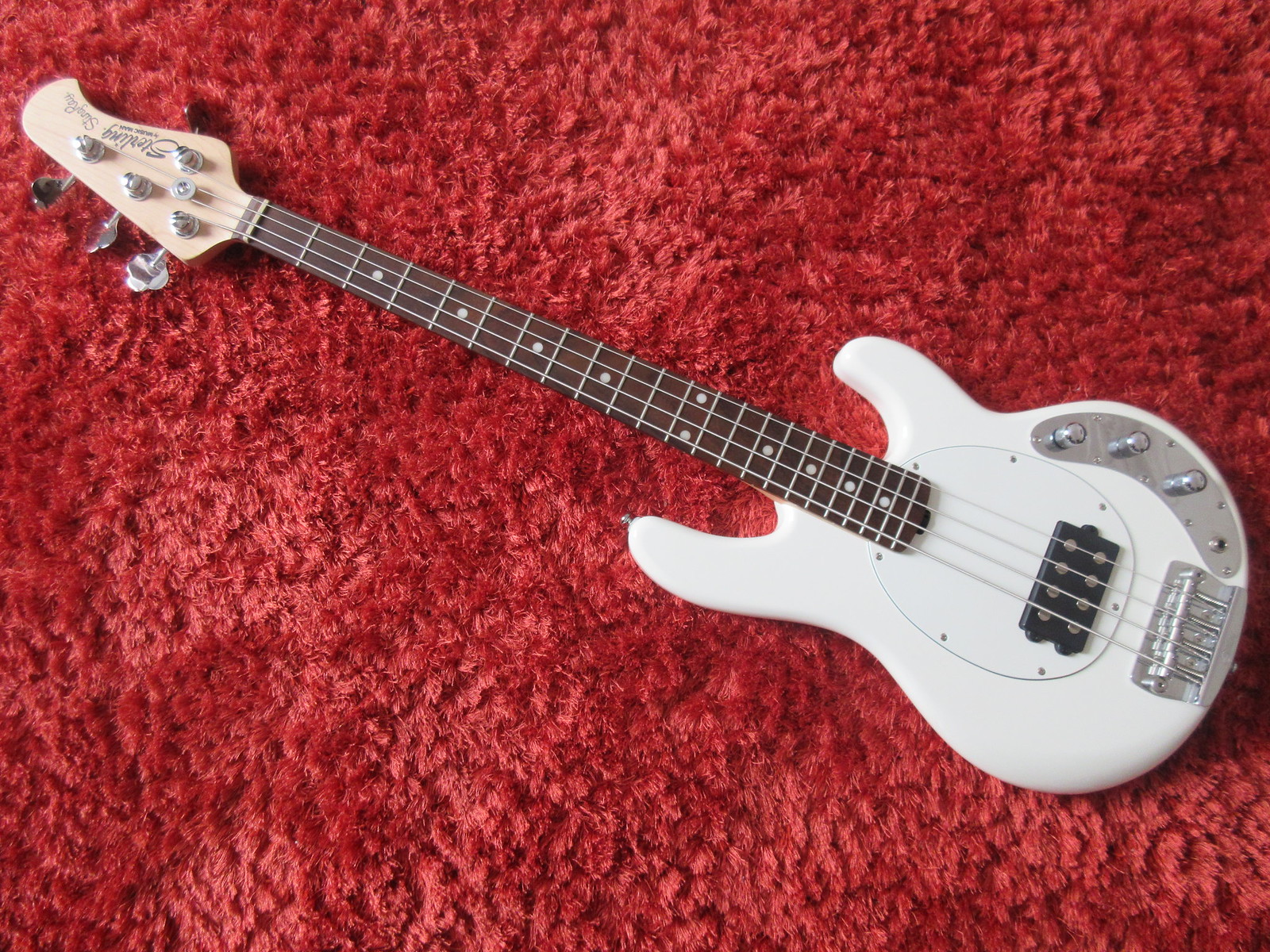
I thought I wouldn’t like the white in white but as I prefer rosewood I had no real choice. I was going to swap the pick guard but I actually really like it now.

Just ordered the GHS balanced Nickel strings. Once here I’ll do a full set up. It came pretty well setup but it can be improved.

Any gig bag recommendations?
I got a deal on a Mono guitar gig bag (forgot the model) that accommodates my shortie Sterling (43" tall) perfectly. It is a very well built and good looking bag. Though spendy, it will last forever.
 
  • Like
Reactions: Yonni and RodRy
I just put the GHS Balanced Nickels on (44-106). I think my bass had been hanging around the shops for a while as the board was dry when I bought it. So maybe the strings were pretty dead and boomy but the GHS give me a lot more, er, something (meat? grit? grunt?). Really nice slap tone on the E, clear and present. Doesn’t seem as floppy as the original E string either. This really is turning into the first bass I pick up to practice with.

Thanks for the heads up on the strings Keto, RodRy and SunByrne.
 
Some early thoughts on the short SBMM Stingray, after a bit of home practice and 2 sets in praise & worship band.

Firstly, whilst I expected this with the Ray being in a different price range, it just seems like a real quality bass, and a big step up from the only other 2 short scale basses I'd tried when this arrived (Squier VM Jaguar & Squier VM Mustang), and feels like it will be a lot of FUN to play. Let me say that at this moment in time I am considering going short scale more out of necessity than actually wanting to. . . as much as I love my P bass, my back always aches after playing & carting it about, and my left hand aches going from G# to F. So the lighter weight (I mean both playing and load in/out too), lesser stretch, and fun factor of short scale is starting to appeal more and more. The Stingray weighs in on my digital luggage scales at a manageable 3.3Kg / 7lbs 8oz, almost a pound lighter than my Player P bass (which itself is light-ish for a P, at 3.9Kg / 8lbs 6oz). Always nice to get a sub 8 pounds bass.

I've never had a Stingray before but own a fair bit of music that features one, so have always been curious. I've had it in my head that they are heavy and expensive, also I prefer a passive bass and to my knowledge they are generally active. So I've always passed on them, until now. I wanted to try another shorty for the above reasons, so getting a short Stingray was a 2 birds with 1 stone thing. Visually it's quite a departure for someone who is more used to Fenders. I still need to get used to the sight of the huge banana control plate. I guess this is just part of the quirky nature of a Ray, speaking of which I quite like the 3+1 headstock. I've only ever had 4 inline tuners before, and I like this headstock more than I thought I would. Also the string tree notches are a nice touch, never seen those before.

It feels well balanced, and the very cool looking quality bridge is very close to the end of the body, the 1st fret does not feel far away at all. The body doesn't feel particularly small resting on my knee, but it does look it in the mirror when standing. The cutaway seems to offer decent reach to the upper frets, though I doubt I'll be going above the 15th anyway. Not sure I've ever had 2 full octaves before - the shortest bass ever but with the most frets! It's a real joy to play on my lap, and nice to have a good body contour, which I missed when trying a Mustang.

I must say that white on white isn't my first choice of colours, but the creamy white finish is very nice indeed. For sure looks better in person than in photos. Also I like that white doesn't show up every scratch, finger print & bit of dust that black does. I had a custom made pickguard made in the UK, as I wanted a splash of colour against the white body, without being too loud. I will post photos shortly.

I'm normally a maple guy, but when I saw this, GAS got the better of me. It's a lovely dark rosewood board, a world away from the indian laurel board that was on the short Jaguar I had briefly, and the 'dry cardboard' Pau Ferro boards I've seen. I like the big dot inlays too. The neck is an absolute delight - fast, smooth, looks & feels great. It's a tad chunkier than what I'm used to (far from the really chunky baseball bat JMJ neck I tried since buying the Ray), but the slim nut & obviously shorter finger stretches make it so easy and fun to play. It came to me with Ernie Ball Super Slinky 40-100 nickel rounds on, which I've since replaced with D'Addario EXL160S (50-105). I don't think I will be fiddling about with setup - there's no buzz or rattle, it just feels great.

It came with a well padded matching gig bag, which was a lot better than I'd expected. From what I've read, it seems pot luck whether a gig bag was sent out with these, so I guess it's good to have one anyway, especially if I want to shed even more load in/out weight. But I'd already ordered a Gator ELEC XL hard case, which is awesome, and a perfect fit for the short Ray. The combined weight of bass & case is 1.5Kg down from the cased P bass. A bonus is that the hard case fits in the boot of the car, a long scale case never did.

It's so much fun to play acoustically on my lap, but plugged in, I still need to get my head around the controls. Am I right in thinking that the somewhat bizarre push/push volume boost/cut knob should be pushed in for Series mode, then pushed out for Parallel & Single Coil modes? So far I've mainly gone for what I believe is 'the' Stingray sound - parallel, with button out. It takes some getting used to as a P player, I quite liked it whilst playing, but wasn't too sure when I watched/heard the recording back through good IEMs. I didn't like the hum of the middle single coil mode, so I guess I will try series mode next (button in?). I'm normally a tone wide open guy, but I've read where some roll this off a little to take a touch of the zing / brightness off if needed. Interested in thoughts on what modes y'all enjoy this in.

After a couple of times playing this, I went back to my Player P on Sunday. As much as I love playing a P bass, I can't deny that having played the short Ray, the P is starting to feel heavy, bulky, cumbersome & unwieldy. Yet I love the tone I get from it (CS62 pickups, upgraded pots & wiring loom). But I feel the reduced strain on my back, shoulders & left hand of a shorty is before long gonna make me move over to short scale fully. So, whilst I'm not fully sold on the Stingray sound, this is a huge amount of fun to play, and for sure makes me want to read into more short scale options (I believe Sandberg Lionel is a good option for P fans, just expensive).
 
Last edited:
Some early thoughts on the short SBMM Stingray, after a bit of home practice and 2 sets in praise & worship band.

Firstly, whilst I expected this with the Ray being in a different price range, it just seems like a real quality bass, and a big step up from the only other 2 short scale basses I'd tried when this arrived (Squier VM Jaguar & Squier VM Mustang), and feels like it will be a lot of FUN to play. Let me say that at this moment in time I am considering going short scale more out of necessity than actually wanting to. . . as much as I love my P bass, my back always aches after playing & carting it about, and my left hand aches going from G# to F. So the lighter weight (I mean both playing and load in/out too), lesser stretch, and fun factor of short scale is starting to appeal more and more. The Stingray weighs in on my digital luggage scales at a manageable 3.3Kg / 7lbs 8oz, almost a pound lighter than my Player P bass (which itself is light-ish for a P, at 3.9Kg / 8lbs 6oz). Always nice to get a sub 8 pounds bass.

I've never had a Stingray before but own a fair bit of music that features one, so have always been curious. I've had it in my head that they are heavy and expensive, also I prefer a passive bass and to my knowledge they are generally active. So I've always passed on them, until now. I wanted to try another shorty for the above reasons, so getting a short Stingray was a 2 birds with 1 stone thing. Visually it's quite a departure for someone who is more used to Fenders. I still need to get used to the sight of the huge banana control plate. I guess this is just part of the quirky nature of a Ray, speaking of which I quite like the 3+1 headstock. I've only ever had 4 inline tuners before, and I like this headstock more than I thought I would. Also the string tree notches are a nice touch, never seen those before.

It feels well balanced, and the very cool looking quality bridge is very close to the end of the body, the 1st fret does not feel far away at all. The body doesn't feel particularly small resting on my knee, but it does look it in the mirror when standing. The cutaway seems to offer decent reach to the upper frets, though I doubt I'll be going above the 15th anyway. Not sure I've ever had 2 full octaves before - the shortest bass ever but with the most frets! It's a real joy to play on my lap, and nice to have a good body contour, which I missed when trying a Mustang.

I must say that white on white isn't my first choice of colours, but the creamy white finish is very nice indeed. For sure looks better in person than in photos. Also I like that white doesn't show up every scratch, finger print & bit of dust that black does. I had a custom made pickguard made in the UK, as I wanted a splash of colour against the white body, without being too loud. I will post photos shortly.

I'm normally a maple guy, but when I saw this, GAS got the better of me. It's a lovely dark rosewood board, a world away from the indian laurel board that was on the short Jaguar I had briefly, and the 'dry cardboard' Pau Ferro boards I've seen. I like the big dot inlays too. The neck is an absolute delight - fast, smooth, looks & feels great. It's a tad chunkier than what I'm used to (far from the really chunky baseball bat JMJ neck I tried since buying the Ray), but the slim nut & obviously shorter finger stretches make it so easy and fun to play. It came to me with Ernie Ball Super Slinky 40-100 nickel rounds on, which I've since replaced with D'Addario EXL160S (50-105). I don't think I will be fiddling about with setup - there's no buzz or rattle, it just feels great.

It came with a well padded matching gig bag, which was a lot better than I'd expected. From what I've read, it seems pot luck whether a gig bag was sent out with these, so I guess it's good to have one anyway, especially if I want to shed even more load in/out weight. But I'd already ordered a Gator ELEC XL hard case, which is awesome, and a perfect fit for the short Ray. The combined weight of bass & case is 1.5Kg down from the cased P bass. A bonus is that the hard case fits in the boot of the car, a long scale case never did.

It's so much fun to play acoustically on my lap, but plugged in, I still need to get my head around the controls. Am I right in thinking that the somewhat bizarre push/push volume boost/cut knob should be pushed in for Series mode, then pushed out for Parallel & Single Coil modes? So far I've mainly gone for what I believe is 'the' Stingray sound - parallel, with button out. It takes some getting used to as a P player, I quite liked it whilst playing, but wasn't too sure when I watched/heard the recording back through good IEMs. I didn't like the hum of the middle single coil mode, so I guess I will try series mode next (button in?). I'm normally a tone wide open guy, but I've read where some roll this off a little to take a touch of the zing / brightness off if needed. Interested in thoughts on what modes y'all enjoy this in.

After a couple of times playing this, I went back to my Player P on Sunday. As much as I love playing a P bass, I can't deny that having played the short Ray, the P is starting to feel heavy, bulky, cumbersome & unwieldy. Yet I love the tone I get from it (CS62 pickups, upgraded pots & wiring loom). But I feel the reduced strain on my back, shoulders & left hand of a shorty is before long gonna make me move over to short scale fully. So, whilst I'm not fully sold on the Stingray sound, this is a huge amount of fun to play, and for sure makes me want to read into more short scale options (I believe Sandberg Lionel is a good option for P fans, just expensive).
If you are gigging, check under the hood. There may be loose wires due to poorly done soldering, as it was with my bass. You don't want to dico that when you are ready to go on. I am not big on maple boards unless they have a nice vintage tint finish, but I admit this one makes me happy. So we are kind of approaching happiness from opposite directions.

How are the tuners on yours? On mine they are functional, but not very satisfying. Though, they hold the tuning well enough they need a lot of fiddling to get it right on.
 
Some early thoughts on the short SBMM Stingray, after a bit of home practice and 2 sets in praise & worship band.

Firstly, whilst I expected this with the Ray being in a different price range, it just seems like a real quality bass, and a big step up from the only other 2 short scale basses I'd tried when this arrived (Squier VM Jaguar & Squier VM Mustang), and feels like it will be a lot of FUN to play. Let me say that at this moment in time I am considering going short scale more out of necessity than actually wanting to. . . as much as I love my P bass, my back always aches after playing & carting it about, and my left hand aches going from G# to F. So the lighter weight (I mean both playing and load in/out too), lesser stretch, and fun factor of short scale is starting to appeal more and more. The Stingray weighs in on my digital luggage scales at a manageable 3.3Kg / 7lbs 8oz, almost a pound lighter than my Player P bass (which itself is light-ish for a P, at 3.9Kg / 8lbs 6oz). Always nice to get a sub 8 pounds bass.

I've never had a Stingray before but own a fair bit of music that features one, so have always been curious. I've had it in my head that they are heavy and expensive, also I prefer a passive bass and to my knowledge they are generally active. So I've always passed on them, until now. I wanted to try another shorty for the above reasons, so getting a short Stingray was a 2 birds with 1 stone thing. Visually it's quite a departure for someone who is more used to Fenders. I still need to get used to the sight of the huge banana control plate. I guess this is just part of the quirky nature of a Ray, speaking of which I quite like the 3+1 headstock. I've only ever had 4 inline tuners before, and I like this headstock more than I thought I would. Also the string tree notches are a nice touch, never seen those before.

It feels well balanced, and the very cool looking quality bridge is very close to the end of the body, the 1st fret does not feel far away at all. The body doesn't feel particularly small resting on my knee, but it does look it in the mirror when standing. The cutaway seems to offer decent reach to the upper frets, though I doubt I'll be going above the 15th anyway. Not sure I've ever had 2 full octaves before - the shortest bass ever but with the most frets! It's a real joy to play on my lap, and nice to have a good body contour, which I missed when trying a Mustang.

I must say that white on white isn't my first choice of colours, but the creamy white finish is very nice indeed. For sure looks better in person than in photos. Also I like that white doesn't show up every scratch, finger print & bit of dust that black does. I had a custom made pickguard made in the UK, as I wanted a splash of colour against the white body, without being too loud. I will post photos shortly.

I'm normally a maple guy, but when I saw this, GAS got the better of me. It's a lovely dark rosewood board, a world away from the indian laurel board that was on the short Jaguar I had briefly, and the 'dry cardboard' Pau Ferro boards I've seen. I like the big dot inlays too. The neck is an absolute delight - fast, smooth, looks & feels great. It's a tad chunkier than what I'm used to (far from the really chunky baseball bat JMJ neck I tried since buying the Ray), but the slim nut & obviously shorter finger stretches make it so easy and fun to play. It came to me with Ernie Ball Super Slinky 40-100 nickel rounds on, which I've since replaced with D'Addario EXL160S (50-105). I don't think I will be fiddling about with setup - there's no buzz or rattle, it just feels great.

It came with a well padded matching gig bag, which was a lot better than I'd expected. From what I've read, it seems pot luck whether a gig bag was sent out with these, so I guess it's good to have one anyway, especially if I want to shed even more load in/out weight. But I'd already ordered a Gator ELEC XL hard case, which is awesome, and a perfect fit for the short Ray. The combined weight of bass & case is 1.5Kg down from the cased P bass. A bonus is that the hard case fits in the boot of the car, a long scale case never did.

It's so much fun to play acoustically on my lap, but plugged in, I still need to get my head around the controls. Am I right in thinking that the somewhat bizarre push/push volume boost/cut knob should be pushed in for Series mode, then pushed out for Parallel & Single Coil modes? So far I've mainly gone for what I believe is 'the' Stingray sound - parallel, with button out. It takes some getting used to as a P player, I quite liked it whilst playing, but wasn't too sure when I watched/heard the recording back through good IEMs. I didn't like the hum of the middle single coil mode, so I guess I will try series mode next (button in?). I'm normally a tone wide open guy, but I've read where some roll this off a little to take a touch of the zing / brightness off if needed. Interested in thoughts on what modes y'all enjoy this in.

After a couple of times playing this, I went back to my Player P on Sunday. As much as I love playing a P bass, I can't deny that having played the short Ray, the P is starting to feel heavy, bulky, cumbersome & unwieldy. Yet I love the tone I get from it (CS62 pickups, upgraded pots & wiring loom). But I feel the reduced strain on my back, shoulders & left hand of a shorty is before long gonna make me move over to short scale fully. So, whilst I'm not fully sold on the Stingray sound, this is a huge amount of fun to play, and for sure makes me want to read into more short scale options (I believe Sandberg Lionel is a good option for P fans, just expensive).

I personally like position 3 (Series - all the way clockwise) the best for punch and I like the position 1 (parallel) 2nd best. I really don't use the middle one much and don't use the boost at all (or haven't thought to yet).
 
Some early thoughts on the short SBMM Stingray, after a bit of home practice and 2 sets in praise & worship band.

Firstly, whilst I expected this with the Ray being in a different price range, it just seems like a real quality bass, and a big step up from the only other 2 short scale basses I'd tried when this arrived (Squier VM Jaguar & Squier VM Mustang), and feels like it will be a lot of FUN to play. Let me say that at this moment in time I am considering going short scale more out of necessity than actually wanting to. . . as much as I love my P bass, my back always aches after playing & carting it about, and my left hand aches going from G# to F. So the lighter weight (I mean both playing and load in/out too), lesser stretch, and fun factor of short scale is starting to appeal more and more. The Stingray weighs in on my digital luggage scales at a manageable 3.3Kg / 7lbs 8oz, almost a pound lighter than my Player P bass (which itself is light-ish for a P, at 3.9Kg / 8lbs 6oz). Always nice to get a sub 8 pounds bass.

I've never had a Stingray before but own a fair bit of music that features one, so have always been curious. I've had it in my head that they are heavy and expensive, also I prefer a passive bass and to my knowledge they are generally active. So I've always passed on them, until now. I wanted to try another shorty for the above reasons, so getting a short Stingray was a 2 birds with 1 stone thing. Visually it's quite a departure for someone who is more used to Fenders. I still need to get used to the sight of the huge banana control plate. I guess this is just part of the quirky nature of a Ray, speaking of which I quite like the 3+1 headstock. I've only ever had 4 inline tuners before, and I like this headstock more than I thought I would. Also the string tree notches are a nice touch, never seen those before.

It feels well balanced, and the very cool looking quality bridge is very close to the end of the body, the 1st fret does not feel far away at all. The body doesn't feel particularly small resting on my knee, but it does look it in the mirror when standing. The cutaway seems to offer decent reach to the upper frets, though I doubt I'll be going above the 15th anyway. Not sure I've ever had 2 full octaves before - the shortest bass ever but with the most frets! It's a real joy to play on my lap, and nice to have a good body contour, which I missed when trying a Mustang.

I must say that white on white isn't my first choice of colours, but the creamy white finish is very nice indeed. For sure looks better in person than in photos. Also I like that white doesn't show up every scratch, finger print & bit of dust that black does. I had a custom made pickguard made in the UK, as I wanted a splash of colour against the white body, without being too loud. I will post photos shortly.

I'm normally a maple guy, but when I saw this, GAS got the better of me. It's a lovely dark rosewood board, a world away from the indian laurel board that was on the short Jaguar I had briefly, and the 'dry cardboard' Pau Ferro boards I've seen. I like the big dot inlays too. The neck is an absolute delight - fast, smooth, looks & feels great. It's a tad chunkier than what I'm used to (far from the really chunky baseball bat JMJ neck I tried since buying the Ray), but the slim nut & obviously shorter finger stretches make it so easy and fun to play. It came to me with Ernie Ball Super Slinky 40-100 nickel rounds on, which I've since replaced with D'Addario EXL160S (50-105). I don't think I will be fiddling about with setup - there's no buzz or rattle, it just feels great.

It came with a well padded matching gig bag, which was a lot better than I'd expected. From what I've read, it seems pot luck whether a gig bag was sent out with these, so I guess it's good to have one anyway, especially if I want to shed even more load in/out weight. But I'd already ordered a Gator ELEC XL hard case, which is awesome, and a perfect fit for the short Ray. The combined weight of bass & case is 1.5Kg down from the cased P bass. A bonus is that the hard case fits in the boot of the car, a long scale case never did.

It's so much fun to play acoustically on my lap, but plugged in, I still need to get my head around the controls. Am I right in thinking that the somewhat bizarre push/push volume boost/cut knob should be pushed in for Series mode, then pushed out for Parallel & Single Coil modes? So far I've mainly gone for what I believe is 'the' Stingray sound - parallel, with button out. It takes some getting used to as a P player, I quite liked it whilst playing, but wasn't too sure when I watched/heard the recording back through good IEMs. I didn't like the hum of the middle single coil mode, so I guess I will try series mode next (button in?). I'm normally a tone wide open guy, but I've read where some roll this off a little to take a touch of the zing / brightness off if needed. Interested in thoughts on what modes y'all enjoy this in.

After a couple of times playing this, I went back to my Player P on Sunday. As much as I love playing a P bass, I can't deny that having played the short Ray, the P is starting to feel heavy, bulky, cumbersome & unwieldy. Yet I love the tone I get from it (CS62 pickups, upgraded pots & wiring loom). But I feel the reduced strain on my back, shoulders & left hand of a shorty is before long gonna make me move over to short scale fully. So, whilst I'm not fully sold on the Stingray sound, this is a huge amount of fun to play, and for sure makes me want to read into more short scale options (I believe Sandberg Lionel is a good option for P fans, just expensive).
Welcome to the SS Stingray clan!

You're on target when you say that the traditional Stingray is active. There are those who say the short scales are not real Stingrays since they're all passive (except for the one model of Tim Commerford). The SS doesn't sound exactly like a 34 inch scale one anyway as the shorter scale impacts the overtone series in a significant way, making them a bit rounder and less bright.

To the controls - the push/push volume has nothing to do with parallel/single/series. It is advertised as a passive boost control. What I expect it does is that when pushed in, it engages some kind of resistor or capacitor which is then removed when it is out... or visa versa. In either case, you get a slight volume boost when out. Pulling the control panel would give an answer to what is going on. I've never felt the need to do so. 95% of the time, I leave mine in on both my SBMM and EBMM SSs.

Most of the time, both of mine are in series mode - the middle rotary knob fully clockwise. Parallel - fully counter clockwise - will be a bit brighter, and single coil in the middle of the rotary knob, the brightest yet with the possibility of a bit of single coil noise. Having the volume control out will just boost the volume of whichever mode you're in.

As for the tone control, prior to my SS Stingray, I was a tone all the way on guy too. With this bass, I use the tone control a lot. I would not be happy with a Joe Dart model :roflmao:

There are a couple of other options for a P like short scale - the Sire U5 is a PJ but you can always just ignore the J and Harley Benton has released a Mustang bass with a PJ and body contours. On that bass, the pups are both always on but a little soldering could remove the J. And the Sandberg does look very sweet. I've had GAS for one for a long time and I am decidedly not a P person.

And if you decide you really are a short scale person, you owe it to yourself to check out the Ernie Ball model. Not to slam the Sterling in any way - they are extremely cool basses - but the EBMM is a serious step up. Every component is higher quality. The neck on the Ernie Ball is, IMHO, the best I've ever played. My experience with the SBMM is that QC can be hit or miss. My experience with EBMM is that it is top notch. They do sound very similar though. Only you can judge whether the significant price jump is worth it or even possible for you. For my #1, it was/is for me. For the one I had defretted, it was not and I happily went with an SBMM. FWIW, I only pay short scales now and don't ever see myself going back to a 34 inch scale for many of the same reasons you're considering that jump.
 
Welcome to the SS Stingray clan!

You're on target when you say that the traditional Stingray is active. There are those who say the short scales are not real Stingrays since they're all passive (except for the one model of Tim Commerford). The SS doesn't sound exactly like a 34 inch scale one anyway as the shorter scale impacts the overtone series in a significant way, making them a bit rounder and less bright.

To the controls - the push/push volume has nothing to do with parallel/single/series. It is advertised as a passive boost control. What I expect it does is that when pushed in, it engages some kind of resistor or capacitor which is then removed when it is out... or visa versa. In either case, you get a slight volume boost when out. Pulling the control panel would give an answer to what is going on. I've never felt the need to do so. 95% of the time, I leave mine in on both my SBMM and EBMM SSs.

Most of the time, both of mine are in series mode - the middle rotary knob fully clockwise. Parallel - fully counter clockwise - will be a bit brighter, and single coil in the middle of the rotary knob, the brightest yet with the possibility of a bit of single coil noise. Having the volume control out will just boost the volume of whichever mode you're in.

As for the tone control, prior to my SS Stingray, I was a tone all the way on guy too. With this bass, I use the tone control a lot. I would not be happy with a Joe Dart model :roflmao:

There are a couple of other options for a P like short scale - the Sire U5 is a PJ but you can always just ignore the J and Harley Benton has released a Mustang bass with a PJ and body contours. On that bass, the pups are both always on but a little soldering could remove the J. And the Sandberg does look very sweet. I've had GAS for one for a long time and I am decidedly not a P person.

And if you decide you really are a short scale person, you owe it to yourself to check out the Ernie Ball model. Not to slam the Sterling in any way - they are extremely cool basses - but the EBMM is a serious step up. Every component is higher quality. The neck on the Ernie Ball is, IMHO, the best I've ever played. My experience with the SBMM is that QC can be hit or miss. My experience with EBMM is that it is top notch. They do sound very similar though. Only you can judge whether the significant price jump is worth it or even possible for you. For my #1, it was/is for me. For the one I had defretted, it was not and I happily went with an SBMM. FWIW, I only pay short scales now and don't ever see myself going back to a 34 inch scale for many of the same reasons you're considering that jump.
I see you have the Starry Night finish. I have the same. It is a beautiful instrument, very light and yet no neck dive.
 
I see you have the Starry Night finish. I have the same. It is a beautiful instrument, very light and yet no neck dive.
Yes. I love mine!

And I have a white SBMM that I had defretted. I ordered a sunburst SBMM once when Guitar Center had them on sale but it had a number of QC issues. I returned it and didn't replace it. I wish I had either kept it and addressed the issues or tried a replacement and put flatwounds on it. Oh well. I may yet pick up one as a backup for my Starry Night
 
I modified the passive circuit of my SBMM Stingray short scale a bit.

As I found myself only using the boost mode I replaced the volume pot with a simple pot without switch and rewired it for boost mode only. I also replaced the tone blend by a 12-pos. rotary switch and 11 different caps. The 1st position is open without any cap. The last position is a 100nF cap resulting in a very deep sound with no highs and muted mids. The remaining caps are mainly with half the value of the previous one.

The cap switch helps enhancing the mids in each position, even with highs cut. It also provides repeatability of sounds.

The last thing to do is replace the cap switch knob with a chicken head knob. Is there a chrome chicken head style knob existing ? Otherwise I may have to replace all knobs with black ones.
 
Last edited:
I modified the passive circuit of my SBMM Stingray short scale a bit.

As I found myself only using the boost mode I replaced the volume pot with a simple pot without switch and rewired it for boost mode only. I also replaced the tone blend by a 12-pos. rotary switch and 11 different caps. The 1st position is open without any cap. The last position is a 100nF cap resulting in a very deep sound with no highs and muted mids. The remaining caps are mainly with half the value of the previous one.

The cap switch helps enhancing the mids in each position, even with highs cut. It also provides repeatability of sounds.

The last thing to do is replace the cap switch knob with a chicken head knob. Is there a chrome chicken head style knob existing ? Otherwise I may have to replace all knobs with black ones.
cool. I've thought of both mods.
tell us what the simple volume entails. are there any caps or resistors involved or just a simple volume pot? Of what value(s)?
Did you wire the tone pot yourself or purchase an available varitone pot? If purchased, which one?
 
  • Like
Reactions: RodRy
cool. I've thought of both mods.
tell us what the simple volume entails. are there any caps or resistors involved or just a simple volume pot? Of what value(s)?
Just a simple volume pot. The "boost" is in fact just the normal volume. "Non-boost" just switches a resistor and a parallel cap in series to the volume pot and reduces the normal volume. No rocket science.
Did you wire the tone pot yourself or purchase an available varitone pot? If purchased, which one?
I did my own. Just a 12-pos rotary switch and a couple of ceramic capacitors. Take out the tone pot including the cap and wire the rotary switch instead. That's it.
 
I modified the passive circuit of my SBMM Stingray short scale a bit.

As I found myself only using the boost mode I replaced the volume pot with a simple pot without switch and rewired it for boost mode only. I also replaced the tone blend by a 12-pos. rotary switch and 11 different caps. The 1st position is open without any cap. The last position is a 100nF cap resulting in a very deep sound with no highs and muted mids. The remaining caps are mainly with half the value of the previous one.

The cap switch helps enhancing the mids in each position, even with highs cut. It also provides repeatability of sounds.

The last thing to do is replace the cap switch knob with a chicken head knob. Is there a chrome chicken head style knob existing ? Otherwise I may have to replace all knobs with black ones.
Cool mods! And in answer to your question:

[Invalid or Expired Link Removed]

Can't wait to see the finished product!
:thumbsup:
 
  • Like
Reactions: TN WOODMAN
I should have posted this here!
This Tusq XL nut has made the quality of the stock tuners on my SBMM Short Scale Stingray almost a non issue. There is a world of difference and I urge everyone with this bass to replace the nut on theirs with a Tusq XL (I have no affiliation in any way with the manufacturer). You WILL be MUCH happier with the instrument - from tuning to staying in tune!
Great idea. I'll have to see mu luthier on how much $...
 
  • Like
Reactions: TN WOODMAN
Several pages back is a vinyl pg sticker in b&w paisley, that my wife designed and my daughter printed. I was given its replacement tonight, and am thrilled. The orange is a hair brighter in life.
IMG_4553.jpeg
IMG_4554.jpeg
IMG_2248.jpeg
 
I should have posted this here!
This Tusq XL nut has made the quality of the stock tuners on my SBMM Short Scale Stingray almost a non issue. There is a world of difference and I urge everyone with this bass to replace the nut on theirs with a Tusq XL (I have no affiliation in any way with the manufacturer). You WILL be MUCH happier with the instrument - from tuning to staying in tune!
Do you remember which Tusq nut model # you purchased?