• TalkBass has been independent since 1998. Add your voice.
    Create a free account to reply to discussions, view embedded media, and browse with fewer display ads.
    Join freeLog in
    Want zero display ads or expanded classifieds tools? Compare plans.

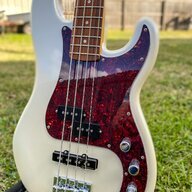
SBMM Stingray Short scale

Always the experimenter, I've had a bunch of different strings on my American short scale Stingray, both round and flat. But I'd never tried stainless steel rounds. Last week I decided to put a set of D'Addario Prosteel stainless steels on my new SBMM short scale Stingray.

It is a fairly dramatic change in flavor. It definitely gives a sound that is closer to its big sister, my long scale Stingray--closer to that active Stingray sound. A bit more crunchy treble, more deep bass, and less midrange. It didn't lose it's character, though. It's just sort of a different side of that character. I tried it at a band rehearsal and a couple of jams, and it worked really well--especially having that tone knob to roll treble off for songs where I don't need it. I also got a chance to dig in with some pretty intense slap bass... sounded great for that. Then the next jam was mostly country; rolled the tone back and check on that one... sounded great, too. It sat in the mix really well and was very clear and un-muddy (of course, it wasn't muddy before, either). So for now, it is going to be wearing Prosteels. I've used them a lot in the past on various basses and they last a very long time before dying.

These SBMM short scales are really great basses. Of all the short scales I've had over the years, this is the only one (along with the American version) that I'm completely happy with the sound and variation possible for any kind of music I want to throw at it. It really does it all (at least anything I do). Love that coil switch.
This is good to hear you’ve tried a few
I have a as well
Glad you are enjoying those
I ordered a set of DR Sunbeams Short Scale strings Rounds
I checked length and the wrap was very close to post .

I emailed DR
Thinking they sent wrong strings
His response was our SS strings are 33 inches
He said when putting on E string wind it slow if it breaks he will send me another E string .
I just always heard the wrap should be below the key post .
Wondered if you had any experience with that .

The DR strings should be called Medium
Scale Strings
He also claimed with larger keys there is normally not a issue!
 
Always the experimenter, I've had a bunch of different strings on my American short scale Stingray, both round and flat. But I'd never tried stainless steel rounds. Last week I decided to put a set of D'Addario Prosteel stainless steels on my new SBMM short scale Stingray.

It is a fairly dramatic change in flavor. It definitely gives a sound that is closer to its big sister, my long scale Stingray--closer to that active Stingray sound. A bit more crunchy treble, more deep bass, and less midrange. It didn't lose it's character, though. It's just sort of a different side of that character. I tried it at a band rehearsal and a couple of jams, and it worked really well--especially having that tone knob to roll treble off for songs where I don't need it. I also got a chance to dig in with some pretty intense slap bass... sounded great for that. Then the next jam was mostly country; rolled the tone back and check on that one... sounded great, too. It sat in the mix really well and was very clear and un-muddy (of course, it wasn't muddy before, either). So for now, it is going to be wearing Prosteels. I've used them a lot in the past on various basses and they last a very long time before dying.

These SBMM short scales are really great basses. Of all the short scales I've had over the years, this is the only one (along with the American version) that I'm completely happy with the sound and variation possible for any kind of music I want to throw at it. It really does it all (at least anything I do). Love that coil switch.

Oh... AND, being a huge, huge fan of Sade and Paul Denman's bass work, I can get my short scale Stingray to pretty much nail that tone he had on his Stingray--on songs like Never as Good as the First Time, and Keep Looking, and Cherry Pie. Yummy. Love it.
What would be the difference between those strings and labella flats?
 
This is good to hear you’ve tried a few
I have a as well
Glad you are enjoying those
I ordered a set of DR Sunbeams Short Scale strings Rounds
I checked length and the wrap was very close to post .

I emailed DR
Thinking they sent wrong strings
His response was our SS strings are 33 inches
He said when putting on E string wind it slow if it breaks he will send me another E string .
I just always heard the wrap should be below the key post .
Wondered if you had any experience with that .

The DR strings should be called Medium
Scale Strings
He also claimed with larger keys there is normally not a issue!

Yes, I've definitely had that issue with various "short scale" strings. GHS comes to mind. It is annoying, especially when the beginning of the outer wrap ends up being right on the barrel when tuned up to pitch. But the good news is that it is not as big an issue as some say. As long as you are careful when tuning it up and doing the wraps, it works fine. I've only had one string with that issue (it was actually a long scale string) snap because of that--but to be fair, I'd actually had the string on and off the bass a couple of times.

You can even use long scale strings if you are careful tuning it up. Just don't clip it into the outer wrap. The strings I just put on were a new set of long scales I've had lying around for awhile. Next time, of course, I will be getting the short scale version for it because they just go on so much easier.

This whole issue of where a short scale string should have that outer wrap end came about because of short scale basses with string through body bridges (like the Fender Mustangs and I think Danelectro's kind of weird bridge), which require slightly longer outer wraps. Unfortunately, string manufacturers often don't make it clear which way they go with their short scale strings. I know D'Addario is right for standard bridge, and DR is not, and GHS is not (unless something has changed). I think Labella makes both and also makes it clear which is which--kudos to them.

Ultimately, they will all work if you're careful, though. It's just a bit annoying.
 
Last edited:
What would be the difference between those strings and labella flats?

The flats will give a bump in the lower midrange, mellower high end (especially once they are broken in), and a "looser" low end (you'll often hear that called "warmer"). Stainless steel rounds vary a lot from brand to brand. Some are REALLY harsh on the high end treble. But the D'Addarios, I would describe as having (compared to say Labella flats) a tighter or more focused low end (not less, just emphasizing a different frequency), definitely less low mids and less mids in general, and a snappier high end (but I don't find D'Addarios harsh on top at all). I guess I would also describe it as a "drier" sound than the flats (if that makes any sense). Also, stainless steel rounds are definitely rougher feeling than nickel rounds (and obviously rougher than flats). Some folks can't get used to that. That dry, rough feel does go away a bit as the strings break in, though.

They both definitely have their place. One is really not better than the other IMO; just different sounds for different applications. It also depends to a huge degree on the player's technique.
 
The flats will give a bump in the lower midrange, mellower high end (especially once they are broken in), and a "looser" low end (you'll often hear that called "warmer"). Stainless steel rounds vary a lot from brand to brand. Some are REALLY harsh on the high end treble. But the D'Addarios, I would describe as having (compared to say Labella flats) a tighter or more focused low end (not less, just emphasizing a different frequency), definitely less low mids and less mids in general, and a snappier nigh end (but I don't find D'Addarios harsh on top at all). I guess I would also describe it as a "drier" sound than the flats (if that makes any sense). Also, stainless steel rounds are definitely rougher feeling than nickel rounds (and obviously rougher than flats). Some folks can't get used to that. That dry, rough feel does go away a bit as the strings break in, though.

They both definitely have their place. One is really not better than the other IMO; just different sounds for different applications. It also depends to a huge degree on the player's technique.
I thought you originally said stainless flats. Oops :banghead: But yeah I thought the stock strings were kind of harsh, maybe I should try them again idk. I have the same strings as stock on my SS jag and I love how that sounds. It is all very complex and I’m too tired to figure it all out

 
I thought you originally said stainless flats. Oops :banghead: But yeah I thought the stock strings were kind of harsh, maybe I should try them again idk. I have the same strings as stock on my SS jag and I love how that sounds. It is all very complex and I’m too tired to figure it all out

Yeah, I think most flats are actually stainless steel wrap as well--I believe Labellas and DA Chromes are. The only flatwound I know of with significantly different construction would be Thomastik-Infeld, which are nickel ribbon wrap over a sort of fabric/silk ribbon over the core. They have a pretty unique sound and feel.
 
Yeah, I think most flats are actually stainless steel wrap as well--I believe Labellas and DA Chromes are. The only flatwound I know of with significantly different construction would be Thomastik-Infeld, which are nickel ribbon wrap over a sort of fabric ribbon over the core. They have a pretty unique sound and feel.
That does sound very different and very not stingray-ish
 
  • Like
Reactions: Christcr
Yes, I've definitely had that issue with various "short scale" strings. GHS comes to mind. It is annoying, especially when the beginning of the outer wrap ends up being right on the barrel when tuned up to pitch. But the good news is that it is not as big an issue as some say. As long as you are careful when tuning it up and doing the wraps, it works fine. I've only had one string with that issue (it was actually a long scale string) snap because of that--but to be fair, I'd actually had the string on and off the bass a couple of times.

You can even use long scale strings if you are careful tuning it up. Just don't clip it into the outer wrap. The strings I just put on were a new set of long scales I've had lying around for awhile. Next time, of course, I will be getting the short scale version for it because they just go on so much easier.

This whole issue of where a short scale string should have that outer wrap end came about because of short scale basses with string through body bridges (like the Fender Mustangs and I think Danelectro's kind of weird bridge), which require slightly longer outer wraps. Unfortunately, string manufacturers often don't make it clear which way they go with their short scale strings. I know D'Addario is right for standard bridge, and DR is not, and GHS is not (unless something has changed). I think Labella makes both and also makes it clear which is which--kudos to them.

Ultimately, they will all work if you're careful, though. It's just a bit annoying.
Good deal
I may give them a shot .
I wish there were more clear on lengths

I know some aren’t and some are
Thanks for the response ‘!
 
  • Like
Reactions: Christcr
Just to add to this ... I would "think" stainless steel rounds, such as D'Addario Pro Steels, would have a much longer life expectancy than nickel rounds as well.

I recently purchased a set of D'Addario stainless steel short scale strings (SSSSS?! :eek:), but have yet to install them. I'm not sure the SBMM StingRay would be a good candidate for them.
 
Yeah, I think most flats are actually stainless steel wrap as well--I believe Labellas and DA Chromes are.
As are Dunlops. I have them installed on my SS Squier Jag.

I like the Dunlops quite a bit, but it seems the price has skyrocketed recently. I bought mine for $32 on FretNation.


dunlop_dbfs45105s_thumbnail.jpg
 
That does sound very different and very not stingray-ish
Sure, they don't fit the zingy, slappy Stingray caricature, but I know a pro player who won't use anything other than TI flats on his 1978 Stringray, and it sounds fabulous and very much like a classic/vintage Stingray (which is to say simultaneously fat and clear).

For some reason, Stingrays can get pigeonholed when it comes to strings, when in fact they're very versatile basses that sound good with all sorts of strings, depending on the vibe one's after. (I've read they originally shipped with GHS Precision Flats in the '70s.)
 
  • Like
Reactions: tonym and Voyevoda
New guy here. I’m a guitar/bass player but I’m mainly a producer and engineer. I’ve been doing that for 30 years now. Over the years I’ve built up a stable of instruments and amps and a couple drum kits to get most of your standard prescribed sounds. I don’t currently have a Stingray and was looking for one when I saw the Sterling SS. I was smitten and bought it immediately. I won’t receive it for a week or so. I’m really looking forward because I really have great luck with the short scale basses I have (Jerry Jones Longhorn 4 and a 6, two Gretsch jet juniors; one with rounds the other with flats, a Japanese Mustang and an Ampeg AMB-1. My “secret weapon “ in the studio is a 26” kick drum with a SS bass and single coil guitars. In addition to Fenders, I like the sound and growl of P-90s over humbuckers in Gibsons and DeArmonds over Gretsch Filtertrons. You can get a great mix where everything sits in there perfectly. You can not only keep all the low-end on the kick, you don’t have to hack that big hole peaking at 150Hz or so out of the kick like you sometimes have to do with a long scale P or J. The short scale bass will sit perfectly on top of that 26” kick. The single coil guitars don’t step on the mids in the bass. I’m picturing how this thing is going to sound and I can’t wait to get this thing. Haven’t been this stoked for a new piece of gear in a while in case you didn’t notice. I’m gonna try my new ACME Motown DI (which sounds Killer BTW) into a vintage API 312 mic pre and API 550A eq into a vintage UREI 1176 into an Apogee Ensemble interface. I might try my Rupert Neve Designs mic pre which I also love on bass. It’s got a circuit that lets you dial in the sound of overdriving the transformers that really showcases the mid growl of a Stingray. If I like the bass as much as I think I will, I’m going to buy another with the rosewood FB and string it with some flats.
 
New guy here. I’m a guitar/bass player but I’m mainly a producer and engineer. I’ve been doing that for 30 years now. Over the years I’ve built up a stable of instruments and amps and a couple drum kits to get most of your standard prescribed sounds. I don’t currently have a Stingray and was looking for one when I saw the Sterling SS. I was smitten and bought it immediately. I won’t receive it for a week or so. I’m really looking forward because I really have great luck with the short scale basses I have (Jerry Jones Longhorn 4 and a 6, two Gretsch jet juniors; one with rounds the other with flats, a Japanese Mustang and an Ampeg AMB-1. My “secret weapon “ in the studio is a 26” kick drum with a SS bass and single coil guitars. In addition to Fenders, I like the sound and growl of P-90s over humbuckers in Gibsons and DeArmonds over Gretsch Filtertrons. You can get a great mix where everything sits in there perfectly. You can not only keep all the low-end on the kick, you don’t have to hack that big hole peaking at 150Hz or so out of the kick like you sometimes have to do with a long scale P or J. The short scale bass will sit perfectly on top of that 26” kick. The single coil guitars don’t step on the mids in the bass. I’m picturing how this thing is going to sound and I can’t wait to get this thing. Haven’t been this stoked for a new piece of gear in a while in case you didn’t notice. I’m gonna try my new ACME Motown DI (which sounds Killer BTW) into a vintage API 312 mic pre and API 550A eq into a vintage UREI 1176 into an Apogee Ensemble interface. I might try my Rupert Neve Designs mic pre which I also love on bass. It’s got a circuit that lets you dial in the sound of overdriving the transformers that really showcases the mid growl of a Stingray. If I like the bass as much as I think I will, I’m going to buy another with the rosewood FB and string it with some flats.
I have flats on mine and I’ve been playing the crap out of mine while in quarantine. It’s such a comfy bass to sit and play with I love it
 
I have flats on mine and I’ve been playing the crap out of mine while in quarantine. It’s such a comfy bass to sit and play with I love it
I think flatwounds on a Stingray is a very underrated sound. That Stingray punch and character is still there and one trick I use once in a while usually sounds great with flats (or rounds too). Copy your bass track so you have 2 of the same track. Put a gate inline on one channel set to be keyed (triggered) by the kick drum. So what you end up with is your regular bassline with the other track which is silent until the kick drum hits and opens the gate on the second bass track which you can compress or EQ differently if you want. It’s a great technique that really sounds tight. Think of the song “Suck My Kiss” off the Bloodsugarsexmajic RHCP record.
 
I think flatwounds on a Stingray is a very underrated sound. That Stingray punch and character is still there and one trick I use once in a while usually sounds great with flats (or rounds too). Copy your bass track so you have 2 of the same track. Put a gate inline on one channel set to be keyed (triggered) by the kick drum. So what you end up with is your regular bassline with the other track which is silent until the kick drum hits and opens the gate on the second bass track which you can compress or EQ differently if you want. It’s a great technique that really sounds tight. Think of the song “Suck My Kiss” off the Bloodsugarsexmajic RHCP record.
Damn that’s a cool technique. If I don’t get furloughed I will probably buy some recording equipment sometime soon
 
Damn that’s a cool technique. If I don’t get furloughed I will probably buy some recording equipment sometime soon
You don’t have to use outboard equipment to do what I was talking about. You have gates and compressors etc. in your recording software like GarageBand and Logic. Look for “dynamics” in the pull-down menu and the gate and comp. are there. Adjust the attack and release of the gate to a pretty fast setting and go from there.
 
  • Like
Reactions: Voyevoda
You don’t have to use outboard equipment to do what I was talking about. You have gates and compressors etc. in your recording software like GarageBand and Logic. Look for “dynamics” in the pull-down menu and the gate and comp. are there. Adjust the attack and release of the gate to a pretty fast setting and go from there.
I mean I don’t have microphones or an audio interface lol
 
Also like any millennial I also want to make podcasts which I can also use the interface for. I guess I would need to find a vocal/guitar microphone then too o_O
If I were on a desert island and could only have one mic for everything, it would be a Shure SM-57 for $89 or so. Record guitar/vocals/bass then use it hammer nails after that. You can’t hurt a 57. Haha.
 

Latest posts