• TalkBass has been independent since 1998. Add your voice.
    Create a free account to reply to discussions, view embedded media, and browse with fewer display ads.
    Join freeLog in
    Want zero display ads or expanded classifieds tools? Compare plans.

SBMM Stingray Short scale

Sorry, no audio before/after. Maybe I'll make some from the new pickup.
And yes, my original pickup has these removable magnetic discs. I only noticed them when the Delano was already installed. These are very strong little magnets, so I suspect they could significantly affect the sound.
 
  • Like
Reactions: RodRy
Been thinking about these magnetic discs. If I had continued to use the original pickup, then I would have tested the following: The pickup completely without these additional magnets.
And another test to see whether the volume differences between the E and G strings could be compensated for. Without any loss of sound. To do this, I would remove the magnets on the E and A strings.
 
  • Like
Reactions: RodRy
I still have a few neck pickups lying around and thought I would give them a try. Costs nothing except time.

The result is quite surprising. Now there's a Seymour Duncan Apollo in the neck position, which sounds fantastic. At home. The next rehearsal will reveal the truth.
I have an Apollo pair in a Jazz Bass for a long time and I'm very satisfied. Guess that was worth the try. We will see.
 
I still have a few neck pickups lying around and thought I would give them a try. Costs nothing except time.

The result is quite surprising. Now there's a Seymour Duncan Apollo in the neck position, which sounds fantastic. At home. The next rehearsal will reveal the truth.
I have an Apollo pair in a Jazz Bass for a long time and I'm very satisfied. Guess that was worth the try. We will see.
I am following your experiments with great interest.
Thanks for sharing your experiences.
 
Does anyone here use the passive boost feature? If so, what do you find it useful for? I’m thinking of just wiring a normal volume pot in there.
I do occasionally when I'm switching to single coil from series to keep the two levels more even or less often when I need a small boost for a bit of emphasis in a song. Otherwise I keep the pot pushed in.
 
  • Like
Reactions: RodRy and Oig
Does anyone here use the passive boost feature? If so, what do you find it useful for? I’m thinking of just wiring a normal volume pot in there.
The "boost" is in fact the normal level. Without boost there is an RC combination in the signal path cutting mids and bass by approx. 6dB. Because I found no use for this feature I removed it. I also replaced the tone blend by an 12-pos. rotary C-switch. Works better for me.
 
The "boost" is in fact the normal level. Without boost there is an RC combination in the signal path cutting mids and bass by approx. 6dB. Because I found no use for this feature I removed it. I also replaced the tone blend by an 12-pos. rotary C-switch. Works better for me.

Yeah, I know it should more accurately be called a volume cut if anything - I was using the official nomenclature so as not to be confusing lol :thumbsup:

I find the difference to be subtle and I’m struggling to find a use for it. I guess I can see in theory why it’s a good idea though. How does the 12 position switch work? 12 different shades of tone?
 
  • Like
Reactions: RodRy
The "boost" is in fact the normal level. Without boost there is an RC combination in the signal path cutting mids and bass by approx. 6dB. Because I found no use for this feature I removed it. I also replaced the tone blend by an 12-pos. rotary C-switch. Works better for me.

On mine, the cut is pretty dramatic. I don't see a use for that, so I always have the switch up (no cut).
 
How does the 12 position switch work? 12 different shades of tone?
Instead of a tone pot followed by a cap the C-switch eliminates the pot and directly switches different capacitors. Mine uses 12 positions from 0pF to 100nF. 0pF equals an open tone blend. With 100nF the tone becomes deep and dark but still has that "last degrees mid resonance" when you close the tone blend. With different caps you keep that mid resonance but at different frequencies. In summary you get more mids while "closing" the tone blend with higher capacitance values.
 
SBMM = HORRIBLE CUSTOMER SERVICE
My Short Scale got damaged in the pit, during a show, an accident.
It fell off the stand as the pit was raising and it got hung, cracked the headstock, damaged the wood and destroyed the hipshot D tuning machine.
I sent SBMM the photo of the damage and inquired about a replacement because the theatre will cover the cost of a new one.
SBMM will not sell a replacement one, even with verified damage.
They essentially told me to take hike or find an aftermarket one, which they know don't exist. I just want the bass to be like it was before the mishap and restore it's value. So, right now I have a worthless body with an EMG pickup, active tone control and no neck. I have a guy looking at the damage but it's pretty chewed up and if it can be glued it will look like crap.
I'm going to escalate this to the Ernie Ball Co, since SBMM is run by a company called Praxis. I wonder what EBMM will say.
 
SBMM = HORRIBLE CUSTOMER SERVICE
My Short Scale got damaged in the pit, during a show, an accident.
It fell off the stand as the pit was raising and it got hung, cracked the headstock, damaged the wood and destroyed the hipshot D tuning machine.
I sent SBMM the photo of the damage and inquired about a replacement because the theatre will cover the cost of a new one.
SBMM will not sell a replacement one, even with verified damage.
They essentially told me to take hike or find an aftermarket one, which they know don't exist. I just want the bass to be like it was before the mishap and restore it's value. So, right now I have a worthless body with an EMG pickup, active tone control and no neck. I have a guy looking at the damage but it's pretty chewed up and if it can be glued it will look like crap.
I'm going to escalate this to the Ernie Ball Co, since SBMM is run by a company called Praxis. I wonder what EBMM will say.
How about a letter from a qualified Luthier, stating that the bass is a total loss and should be replaced as the repair cost would be far in excess of the original cost of the instrument. Unfortunately you’d still have to put all your upgrades back in there, but a fresh start from the way you’ve described the damage seems like the best thing to do IMO. I wouldn’t waste my time with any of these corporate people as this sounds like an insurance claim for a total loss. Still have the photos?
 
How about a letter from a qualified Luthier, stating that the bass is a total loss and should be replaced as the repair cost would be far in excess of the original cost of the instrument. Unfortunately you’d still have to put all your upgrades back in there, but a fresh start from the way you’ve described the damage seems like the best thing to do IMO. I wouldn’t waste my time with any of these corporate people as this sounds like an insurance claim for a total loss. Still have the photos?

Yes, I have the photos but discarding a perfectly good body is just insane to me...
 
I still have a few neck pickups lying around and thought I would give them a try. Costs nothing except time.

The result is quite surprising. Now there's a Seymour Duncan Apollo in the neck position, which sounds fantastic. At home. The next rehearsal will reveal the truth.
I have an Apollo pair in a Jazz Bass for a long time and I'm very satisfied. Guess that was worth the try. We will see.

After an initial test in the last band rehearsal, I would now describe the changes as a complete success.
The Delano MM pickup is not quite as loud and therefore fits better with my other basses. So I don't have to adjust the volume every time I change. I also like the sound of the Delano much better, it sounds more open, 'airy'. The way it has to be. And as expected, the two single coils no longer make any noise. This swap alone would be a very significant improvement because it would allow the sound spectrum to be expanded and fully usable.

The SD Apollo in the neck position is terrific. The DM Model-J went clearly in the direction of a P-Bass and if you want to go in that direction, it is very good for that. To me, the SD Alpha sounds exactly like the Fender CS 60 (I have it too), just without the hum/noise. A very good vintage jazz bass tone, with a little bit more punch. More open, airy, almost 'three-dimensional', I can't think of a better term. I would say this SD Apollo fits the Delano absolutely perfect.

My preferred settings are SD Neck solo, SD Neck with MM Bridge coil, MM Neck solo, MM parallel and SD Neck with MM Neck coil.
For this tonal variety you usually need at least two basses.
 
After an initial test in the last band rehearsal, I would now describe the changes as a complete success.
The Delano MM pickup is not quite as loud and therefore fits better with my other basses. So I don't have to adjust the volume every time I change. I also like the sound of the Delano much better, it sounds more open, 'airy'. The way it has to be. And as expected, the two single coils no longer make any noise. This swap alone would be a very significant improvement because it would allow the sound spectrum to be expanded and fully usable.

The SD Apollo in the neck position is terrific. The DM Model-J went clearly in the direction of a P-Bass and if you want to go in that direction, it is very good for that. To me, the SD Alpha sounds exactly like the Fender CS 60 (I have it too), just without the hum/noise. A very good vintage jazz bass tone, with a little bit more punch. More open, airy, almost 'three-dimensional', I can't think of a better term. I would say this SD Apollo fits the Delano absolutely perfect.

My preferred settings are SD Neck solo, SD Neck with MM Bridge coil, MM Neck solo, MM parallel and SD Neck with MM Neck coil.
For this tonal variety you usually need at least two basses.
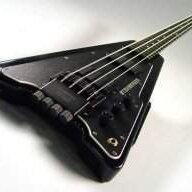
Pics are needed. Which Delano did you put in it? I've got a ferrite on the way for mine.
 
Different band rehearsal yesterday, different crime scene.
A very good jazz bass and the small Stingray at the start. My modified Stingray offers a much greater variety of sounds. It's also interesting that the Stingray's overtones don't drop off compared to the Jazz. The spectrum is different, but by no means worse or lacking anything.
The Stingray doesn't really produce a sound that is the typical jazz sound when both pickups deliver 50:50. And neither do the fine nuances with slight shifts on the jazz bass (55:45).
But still - the neck pickup with the bridge coil from the Delano is already recognizably in the direction of a jazz bass.
I find the sound of the Jazz neck pickup on the Stingray with the SD Apollo absolutely convincing. The Delano bridge coil alone can make the little Stingray growl in a way that makes any jazz bass look pale.
The fact that you can't get the typical jazz tone certainly has something to do with the MM bridge coil not being in the right position. And the MM pickups generally have a different sound.
A real jazz tone could perhaps be achieved by placing a jazz bridge pickup without the 'ears' directly behind the MM pickup. I don't know if that would fit in terms of position, you'd have to measure it.
To summarize, I would say that the effort for the conversion is high, but I am extremely satisfied with the result.