

Enjoy the benefits of a premium membership!
Upgrade Account
-
TalkBass has been independent since 1998. Add your voice.
Create a free account to reply to discussions, view embedded media, and browse with fewer display ads.
Join free Log in
Want zero display ads or expanded classifieds tools? Compare plans.
You are using an out of date browser. It may not display this or other websites correctly.
You should upgrade or use an alternative browser.
You should upgrade or use an alternative browser.
Scary Neck Repairs: Two Wal Necks
- Thread starter Bruce Johnson
- Start date
More options
Who Replied?
To close out this project, I did finally finish up Alex's Wal. Lots of interruptions and distractions in December, January and February.....But I found a few hours and finished up the fretwork details. Level, crown, polish, same as I did on Mike's neck. I leveled the frets with my long stone bar, and the truss rod tightened to about 40%. As planned. The truss rod works fine. It will easily take the neck to flat and a little bit of backbow without straining itself. Overall, the neck is fixed and back to almost exactly Wal specs.
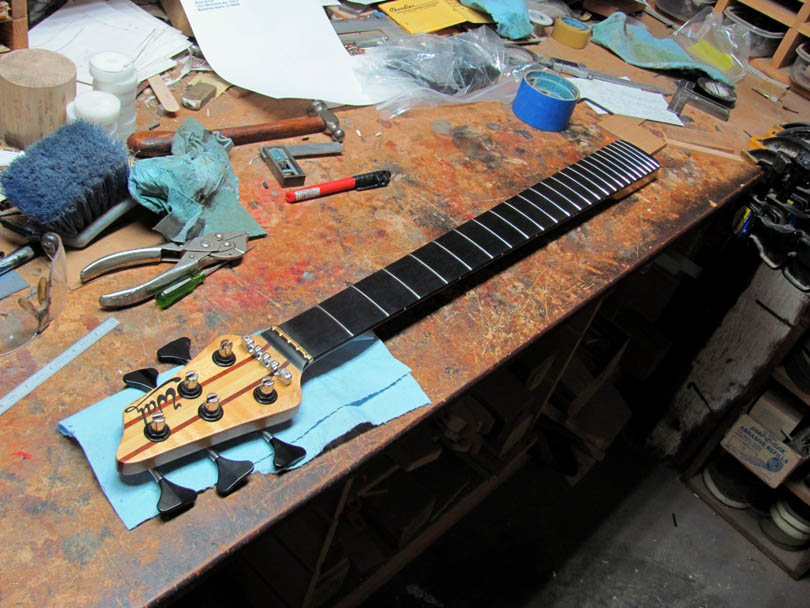
Here's the hardware back on the neck. I was able to re-use the brass nut that was on it, but I did add a tiny brass shim under the treble side.
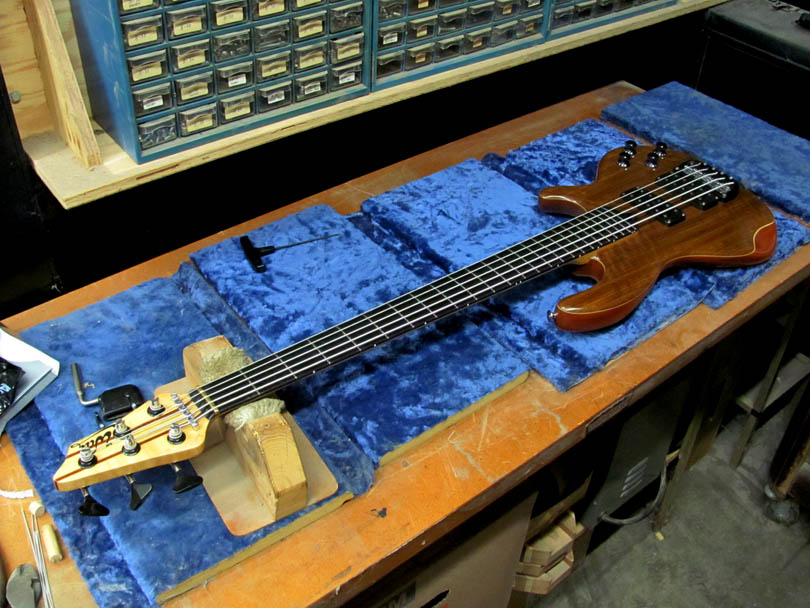
Assembled & strung up. It's making those beautiful sounds again. Super bright, with new Dunlop Stainless rounds on there.
I'll be playing around with the setup a little more tomorrow, and then a friend of Alex's is going to be picking it up this weekend.
If you are wondering what it cost: I charged Alex $700 even, no shipping. I clocked 14.5 hours of labor at $45/hour, plus the materials cost of the ebony fingerboard and the stainless frets.
Of course, it's rather disgusting that it took me a year to do a 14.5 hour job......But that's the way life is for me right now.....Sorry.
Here's the hardware back on the neck. I was able to re-use the brass nut that was on it, but I did add a tiny brass shim under the treble side.
Assembled & strung up. It's making those beautiful sounds again. Super bright, with new Dunlop Stainless rounds on there.
I'll be playing around with the setup a little more tomorrow, and then a friend of Alex's is going to be picking it up this weekend.
If you are wondering what it cost: I charged Alex $700 even, no shipping. I clocked 14.5 hours of labor at $45/hour, plus the materials cost of the ebony fingerboard and the stainless frets.
Of course, it's rather disgusting that it took me a year to do a 14.5 hour job......But that's the way life is for me right now.....Sorry.


Of course, it's rather disgusting that it took me a year to do a 14.5 hour job......But that's the way life is for me right now.....Sorry.
We know you are conscientious luthier with a great reputation. We also know that you have a full time job making your own bass stuff; so when you accept a project, we know that it could take awhile. That's just part of the costs of getting a top notch luthier working on your broken instrument.
Meh, takes Wal several years to make one for you (and a whole lot more $$$) so really not too bad if we're grading on that curve 

More times than I can count -
Customer: How long will this project take?
Me: About 10 hours.
Customer: When can I expect it?
Me: In about 6 weeks, maybe more.
Customer: WHAT!!!?
Maybe you've seen those threads, where I've written about the finances and business operation of being an independent Luthier? Billable hours per week vs Overhead hours vs Composite Hourly Rate.
If you wanted me to do a 10 hour job, and have it done in a few days, I'd have to charge you $100+ per hour. Like almost any auto repair shop. And I seriously doubt you'd be willing to pay that.
Me taking a year to do this job is unacceptable, but that's just the way it is. My own life circumstances. Most working pro Luthiers would take a month to do this job. That's a reasonable amount of time to expect.
By the way, here's a Pro Trick for filing the nut slots in a brass nut in an expensive bass.....
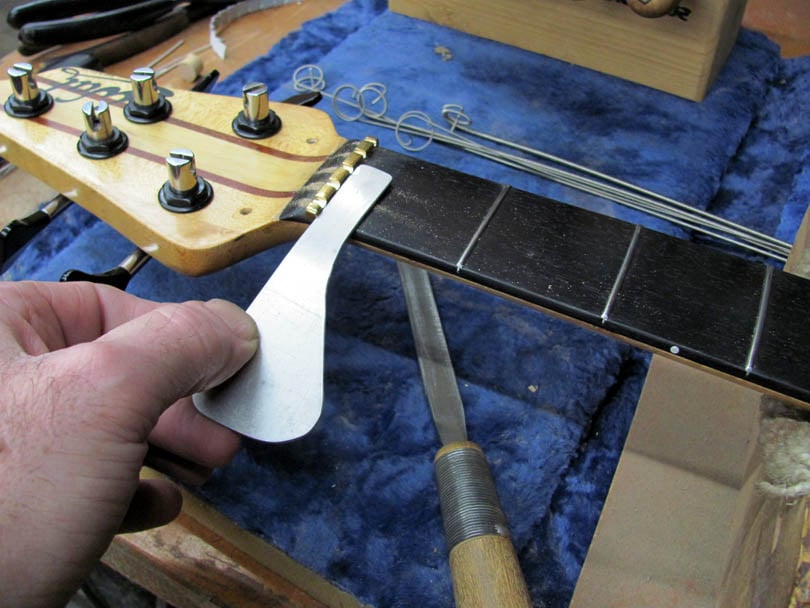
A homemade tool, made up in a couple of minutes. That's a a scrap of 0.040" aluminum plate, quickly bandsawn out and the edges deburred. The 1st fret, after leveling, measures 0.032" high off the fingerboard. The idea is to pick a piece of aluminum that's about 0.010" thicker than the height of the fret. It protects the fingerboard and sets the depth of the slots. The shape has a handle off to the side of the neck.
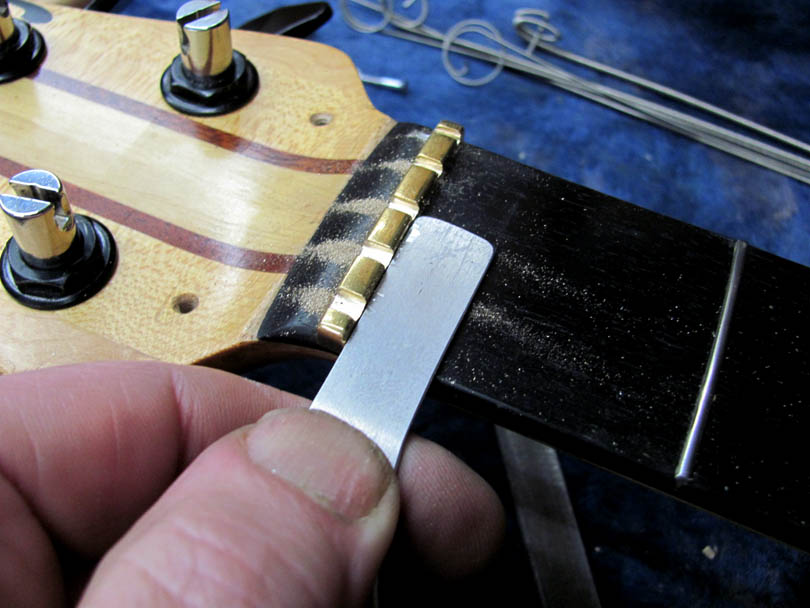
I hold the aluminum strip like this, up against the front face of the nut, and file the slot with the right size nut slotting file. Angling it about 5 degrees down toward the headstock. File the slot down until the file just starts nicking the aluminum. Stop right there. That's the correct depth of the slot.
A homemade tool, made up in a couple of minutes. That's a a scrap of 0.040" aluminum plate, quickly bandsawn out and the edges deburred. The 1st fret, after leveling, measures 0.032" high off the fingerboard. The idea is to pick a piece of aluminum that's about 0.010" thicker than the height of the fret. It protects the fingerboard and sets the depth of the slots. The shape has a handle off to the side of the neck.
I hold the aluminum strip like this, up against the front face of the nut, and file the slot with the right size nut slotting file. Angling it about 5 degrees down toward the headstock. File the slot down until the file just starts nicking the aluminum. Stop right there. That's the correct depth of the slot.

Luthiers are sort of like bass whisperers to me.... can make a big difference in the perceived quality of an instrument. Had a bit of work done on a few of my basses that significantly improved playability. Those little details can make a huge difference!

but that's just the way it is. My own life circumstances.
And with all that I for one really appreciate the extra time you took to photograph and explain your procedures and tips along the way.
Thank you!
WB
For fretless basses I use the exact same procedure but with a matchbook cover. As soon as the file starts to scrape the shiny coating off the cover it's right.By the way, here's a Pro Trick for filing the nut slots in a brass nut in an expensive bass.....
View attachment 5370985
A homemade tool, made up in a couple of minutes. That's a a scrap of 0.040" aluminum plate, quickly bandsawn out and the edges deburred. The 1st fret, after leveling, measures 0.032" high off the fingerboard. The idea is to pick a piece of aluminum that's about 0.010" thicker than the height of the fret. It protects the fingerboard and sets the depth of the slots. The shape has a handle off to the side of the neck.
View attachment 5370984
I hold the aluminum strip like this, up against the front face of the nut, and file the slot with the right size nut slotting file. Angling it about 5 degrees down toward the headstock. File the slot down until the file just starts nicking the aluminum. Stop right there. That's the correct depth of the slot.


