• TalkBass has been independent since 1998. Add your voice.
    Create a free account to reply to discussions, view embedded media, and browse with fewer display ads.
    Join freeLog in
    Want zero display ads or expanded classifieds tools? Compare plans.

School me on P basses

That's my entire point.


You underestimate the problems inherent to passive V/V/T wiring of P/Js.

"Mixing" is frequently stone, 100% impossible, and never very good.

The "V/V/T Syndrome" has been discussed to death, and it's at its worst in some P/Js.

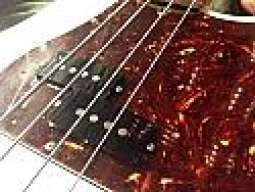
I'm wondering if replacing the J pickup with a split-coil design like the Super 55 would help with that problem:

Invalid Link Removed

Best regards,
Lou
 
To the Original Post,

My analogy regarding Precioson basses is this: What if GMC never stopped making '57 Chevy's? Sure some minor upgrades, but none you could see from the outside...

Is it ever gonna be a Caddy? NO..A Ferarri? NO...

But it will always be in high demand; classic design. IF IT AIN'T BROKE..DON'T FIX IT.
 
I can vouch for the pickup volumes being extremely well balanced on the Tony Franklins. There is little to no volume difference when switching from one pickup to the other, or when blending the two. Another feature I truly love about these basses is that the J pickup has adjustable hex poles, which allows you to customize the individual volume of each string based on your playing style and tonal preferences. Not to mention that the build quality is superb on the ones I own. I see you live in Montreal. If you find yourself in Toronto anytime soon, feel free to PM me and I'll let you try them out. All the best!
 
With all this talk about pickup configurations, I'm surprised no one has mentioned the chunkier neck (than a J-bass or other modern bass). Some love it, some hate it, but it's definitely an attribute of the Precision. It and the associated heavier strings contribute to the massive punch.
 
yes, I know there are some p basses with Jazz necks, could someone share.
some people believes that chunkier neck = bigger tone.
did anyone owned both and noticed a difference?

[Invalid or Expired Link Removed]
Invalid Link Removed

I hear a difference. I like the tone of the thicker neck, I find thin necks a little uncomfortable anyway.
 
Neck thickness has little effect on tone IMO. Neck stiffness does. In trad builds thicker necks was a way to get a stiffer neck cheaply. That is why I like the graphite re-bars in the American std series. I believe it makes for a stiffer neck. Just my opinion.
 
If neck thickness affects tone, then it's not something I have ever noticed. I've always attributed neck tone to fretboard wood (i.e. rosewood, maple, ebony, etc.), degree or quality of reinforcement (i.e. steel truss rod, graphite truss rod, full out carbon fiber or graphite neck, etc.), and/or quality of fretwork.

P-basses definitely have chunkier necks, though. I've got big hands, so it's never been a problem for me, but having started on an Ibanez SR bass, I definitely notice the difference when I pick up a Fender Precision. If you're a devoted player, then you'll probably adapt before you know it and it won't be an issue. And if you have small hands, you can always do stretches to see if you are able to eventually play it comfortably. The latter technique worked for me with respect to a broad-necked 6-string that I first though was too big even for my hands.
 
I know that there are some that consider Fender to be the only name in P basses. Understood, however IME the Yamaha P/J basses, especially the new BB series are pretty hard to beat. In that case of P "style" options, the P/J most certainly gives you all of the P and more. Also, they utilize the three-way toggle control, as opposed to the V-V-T configuration.

I've been trying to love my P Bass long time but my BB1025X always sounds better to me :bawl:

Inquiry: I haven't played a P Bass live in 12 years so I don't really remember how it sounds. I always read on these forums that The P sounds great live. What about the PJ? Note, I'm talking about the sound *in person* as opposed to some crappy Youtube recording.
 
Good info guys. Thank u.
Ok this might be another stupid question, but what so special about the 62?

I believe it is just because Jamerson played a '62. It has all the features that make it the quintessential P bass: split P pickups, 1 3/4" nut, rosewood fretboard, sunburst.

Not that any other combos are wrong, it is just that that is the stereotypical P bass.
 
Back in the day (yeah, I'm a geezer) the biggest difference was the P had a MUCH fatter neck than the J. That's not as true as it once was. With one PU, the P is limited to that one sound. But it's a perfectly legitimate sound. If you're looking to build an arsenal of basses, it's not one to be ignored. If it's to be your daily player, you have to go hands on and figure it out on your own. Nothing less will get it for you.
 
well, it's got a neck that usually has frets, a body, some tuners, a bridge, four strings, one pickup, and two knobs - one knob makes your bass sound louder, the other knob determines how much of the treble you want to cut out of the signal. You can play the bass by pressing the strings down on the neck onto the frets, and then plucking them with either your fingers or a plectrum. Do you need to know anything else?

You Sir! Are a liar!! My P has 5 strings lol
 
[Invalid or Expired Link Removed]
Invalid Link Removed

I hear a difference. I like the tone of the thicker neck, I find thin necks a little uncomfortable anyway.

From these samples, to my ears, the slap tone example shows the biggest difference (although I didn't listen to them all). The open E sounds tighter and more controlled to me on the standard P neck than on the J neck.

You have to admit that when it comes to pure physics, a more massive neck will react differently when the string collides with the fretboard. Stiffness matters of course when it comes to the neck's reaction to the collision, but there will be less net force exerted on the neck due to the collision in the first place if it has more mass relative to the string.

How much of a difference does this make to the tone? Difficult to quantify. But I'm sure it's perceptible as a secondary factor, behind primary factors like pickup configuration and string selection.
 
to me there is not so much doubt that a fat onepiece maple neck is more resonant than a not so fat two piece rosewood/maple neck. But again it depends on the wood of courese.
Is the body and the neck in tune? thats an important question.
i have on of each and the RW is the most resonant and loadest when played accustic. its also a bit richer sounding to me. I guess using matching neck and bodies is impåortant.
not so sure thats always a priorety on cheaper instruments. some are very nice some are not. Of course a Pbass has a very distinct tone, but i suppose the real art is to form the tone by touch feeling etc..im sure antony jackson , phil lesh, etc could make a squire bronco sound fabulous..
 
I went to the store yesterday and played one and while the neck was chunky; it did not bothered me. I find the neck of my G&L to be chunky but I'm ok with it.
The I
Only thing I don't think I could ever at is a 6 strings bass, specially the patitucci model.