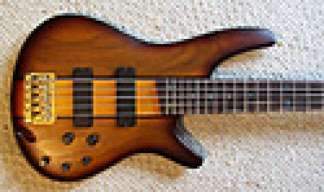
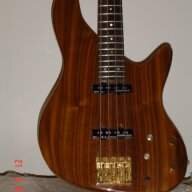
Thanks everyone for the comments.
there was a question about the depth of the neck pocket. On this bass the pocket is a little over 3/4 inch deep as the heel is 7/8 inch thick from the fretboard to the bottom of the heel. I started out making this a bolt on so I only had a heel thickness of 3/4 inch. When I decided to do a set neck I had to add a heel block on the bottom of the heel to add some girth and I had to route the pocket deeper. The reason for that is to add surface area for glueing. Also the neck looked kind of doofy without a thicker neck joint. A standard Fender P-bass has a pocket of about 5/8 inch deep for the 3/4 inch thick heel. Fine for bolt on necks but not much glueing surface for a set neck.
As for the question about the reasons for the set necks. Some possible reasons are:
1. To be able to have a blended neck heel joint like a thru-neck but without having to fight the neck during the build. That is why I dislike building thru-styles as drilling, routing, and carving are all hampered by the neck being in the way. This way, you can finish both parts and only join them after the work is done.
2. As on instruments like the PRS guitars, the fretboard starts right at the edge of the body so the heel is a bit short and not much room for the bolts to do their job. On those instruments, the heel is glued way back into the neck pickup cavity. No hardware is showing on the back and the joint is strong.
3. Because Gibson did it. It has always seemed to me that the reason that a lot of guitar companies and builders do what they do is because Fender or Gibson did it. For example,34 inch scales have become the norm because Leo Fender used it on the first P-bass. They did not have much material to read up on or Talkbass to run ideas through back then so they just worked with what worked for them. Because they did it the way they did, many think that it is the only way to do it. Same with set necks.
4. Some may feel that the set neck has more sustain and etc...I have some thoughts about set necks vs. thru necks vs. bolt on necks as to sustain and tone. If you want you can read back in this thread where I soapbox a bit about that stuff. Basically I feel that any of the three can have similar sustain or tone if the pocket is tight and without voids and gaps around the neck. Lose pockets sound bad but with a tight well fit pocket, any bolt on can sound like a set or thru style.
For this bass,
I did the set neck on this bass as it was inspired by the guild Starfire basses, which had set necks, and I thought I would stick with the basic design. I do not do many necks like this one so I thought I would do one this time around. I like to try something new or find a new way to do an old technique on these builds as I get bored doing the same stuff over and over again. Also, 4 screws would seem to be a little tight for that size of pocket. If I made the pocket deeper (closer to the neck pickup) then I would not be able to reach the highest frets because of the body shape. Why have them if you can use them? The 20th thru the 22nd frets are hard enough to reach on this bass.
Sorry for the long post. As promised...the glam shots.