I'm surprised this exotic beast did not excite more curiosity. Love the creativity here and bold aesthetics. Any chance you could say a little more about the history of this wondrous creature and the kinds of sounds it makes? It may be easier to tell us the sounds it does not make!
Hi Bassobrutto, thank you for your kind note!
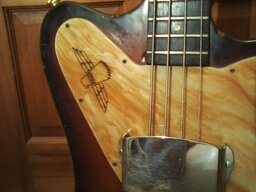
It's a magnificent machine indeed and the tone options on tap are virtually endless. Naturally it offends the dickens out of purists, but alas we can't please everyone. I should also note that when the bass came to me, it already had an aftermarket bridge position mini-bucker installed, a poorly aligned and crooked "BadAss" bridge screwed on, as well as a professionally done headstock/neck repair. So no need to worry about me having ravaged a collector's dream closet-classic.
In regard to wood removed, the middle pickup's cavity is barely large enough for the pickup to sit in it. Furthermore, both bridge and middle cavity are only as deep as they need to be, which is not deep at all given how high the strings are off of the face of the bass and how shallow the bobbins of the pickups are (most of the bobbins of both pickups sit at or above the face of the body). The big wenge wood plate/surround doesn't cover a giant swimming pool cavity, but rather just serves to tie the aesthetic together. Again though, people have colorful imaginations and will judge and run with their first thoughts on any given matter.
In any case, for interested parties who haven't already dismissed my bass upon first sight of a photo, here is the way it's wired:
(Neck pickup --> resonant filter & 3 position Q-boost switch --> volume)
(Middle & Bridge pickups --> 3-position pickup selector --> resonant filter & 3 position Q-boost switch --> volume)
Then both of these circuits are summed up to a master variable mid control stack; top knob is boost/cut and bottom knob is frequency sweep. Then off the output jack!
All powered by a single 9 volt battery that seemingly lasts forever and nestles snugly between the two resonant filter controls (so no extra routing required for any of the preamp).
The resonant filters are modeled after the classic Alembic preamp technology and let you completely change the character of any pickup, so you can dial it to just about anything you want, as long as the pickup itself has a broad frequency response. Then the possibilities get even more vast once you start blending. That said, when soloed and dialed in to a more or less neutral setting, the bridge pickup does an excellent Rickenbacker bridge pickup sound, the middle pickup does an excellent precision bass tone, etc.
In terms of resonance and sustain, this bass does it just as well as you'd expect with the Hipshot Supertone replacement bridge. Also worth noting, the Sperzel tuners mostly eliminated the headstock dive effect. Both great hardware upgrades that I'd recommend to anyone who's not afraid of improving their instrument!