• TalkBass has been independent since 1998. Add your voice.
    Create a free account to reply to discussions, view embedded media, and browse with fewer display ads.
    Join freeLog in
    Want zero display ads or expanded classifieds tools? Compare plans.

Short Scale Journey Didn't Last Long

Sharing this to see if anyone else had a journey similar to my "love the one you're with" story.

In my head, I wanted a short-scale for long gigs. Never had one. Easy to play, light weight; what's not to love, right? Went to the music store to pick up a repair and, concerned about neck dive, decided to try on each short-scale bass with a strap. Results:
  • 2 Gibson SG basses - horrible neck dive
  • 2 Gibson LP2-style basses - horrible neck dive
  • Epiphone Allen Woody and Violin basses - good balance, but the bodies are thicker than I'm used to, so it would take some re-learning for my right arm/hand/wrist
  • 2 Fender Mustang PJ basses - horrible neck dive
  • 2 American Fender Mustang basses - neck goes to about parallel with the floor. I guess I could live with that. But as I'm jamming on the first 7 frets, I notice my left elbow touching my ribs. Never felt "cramped" before while playing bass standing up. This would require some re-learning for my left arm, plus the re-learning of the shorter scale with my left hand. I wouldn't call it annoying, but...
My conclusion was, I'm simply not going to find anything that feels as ergonomically comfortable as my current standard-scale basses. And I think I'm very happy with that and just saved myself some dough. Both my current basses are pretty light, but in the last hour of 4-hour gigs, they begged the question, could I go even lighter? I found my answer - yes, but only with tradeoffs that I'm too stubborn to make.

Anyone else follow this path when considering (or trying/buying) shorties?
I'm not really a fan of the shorty ergonomics, either, but the Ibanez Mezzo basses feel better than others in my hands. They are 32", so I guess that would be considered a "medium" but to me anything under 34 is a "shorty".
 
I’m planning a 32” medium scale build right now, I played a couple customs and it’s a nice sweet spot between full and short scale. 2” in length is enough to make it easier to play, but not so short that the E string feels floppy. I can’t think of any major manufacturers that have them off the shelf though, anybody know?

Edit: Aren’t some of the Ibanez basses 32” scale? Is the Talman?
 
Last edited:
Neck dive isn't an issue with me for any bass, but to answer your question, My Ibanez Talman TMB30 seems to have less neck dive than others I've tried. I also have a 32" Medium scale Fender Urge that doesn't seem to have that much of a neck dive.
 
I’m planning a 32” medium scale build right now, I played a couple customs and it’s a nice sweet spot between full and short scale. 2” in length is enough to make it easier to play, but not so short that the E string feels floppy. I can’t think of any major manufacturers that have them off the shelf though, anybody know?

Edit: Aren’t some of the Ibanez basses 32” scale? Is the Talman?

Ibanez Mezzo is 32" scale, the Talman TMB30 is 30".

My MIM Fender Urge in my user pic is 32" but the model is discontinued but yes, that extra 2" does make a difference, it's definitely easier to play without being all that different from a full scale bass.

Best bet off the shelf is the Mezzo or the new Squier CV Jaguar.

Here's a size comparison. Full scale, medium scale and short scale. The Talman is a 30" scale but for some reason, the tension feels closer to a full scale than most short scale basses I've played and keep forgetting it's a short scale.
117909854_310267136853624_2311538189150031573_n.jpg
 
Last edited:
  • Like
Reactions: Gilmourisgod
Sharing this to see if anyone else had a journey similar to my "love the one you're with" story.

In my head, I wanted a short-scale for long gigs. Never had one. Easy to play, light weight; what's not to love, right? Went to the music store to pick up a repair and, concerned about neck dive, decided to try on each short-scale bass with a strap. Results:
  • 2 Gibson SG basses - horrible neck dive
  • 2 Gibson LP2-style basses - horrible neck dive
  • Epiphone Allen Woody and Violin basses - good balance, but the bodies are thicker than I'm used to, so it would take some re-learning for my right arm/hand/wrist
  • 2 Fender Mustang PJ basses - horrible neck dive
  • 2 American Fender Mustang basses - neck goes to about parallel with the floor. I guess I could live with that. But as I'm jamming on the first 7 frets, I notice my left elbow touching my ribs. Never felt "cramped" before while playing bass standing up. This would require some re-learning for my left arm, plus the re-learning of the shorter scale with my left hand. I wouldn't call it annoying, but...
My conclusion was, I'm simply not going to find anything that feels as ergonomically comfortable as my current standard-scale basses. And I think I'm very happy with that and just saved myself some dough. Both my current basses are pretty light, but in the last hour of 4-hour gigs, they begged the question, could I go even lighter? I found my answer - yes, but only with tradeoffs that I'm too stubborn to make.

Anyone else follow this path when considering (or trying/buying) shorties?
Try a Jerry Jones or a Dano very light
 
I'm currently playing an Epiphone Allen Woody RumbleKat, came to it from playing a Precision, and I'll agree that the edged body took a bit of getting used to.
Still, I think it's a bit hasty to dismiss a bass based on probably only a few minutes in a store.
 
Sharing this to see if anyone else had a journey similar to my "love the one you're with" story.

In my head, I wanted a short-scale for long gigs. Never had one. Easy to play, light weight; what's not to love, right? Went to the music store to pick up a repair and, concerned about neck dive, decided to try on each short-scale bass with a strap. Results:
  • 2 Gibson SG basses - horrible neck dive
  • 2 Gibson LP2-style basses - horrible neck dive
  • Epiphone Allen Woody and Violin basses - good balance, but the bodies are thicker than I'm used to, so it would take some re-learning for my right arm/hand/wrist
  • 2 Fender Mustang PJ basses - horrible neck dive
  • 2 American Fender Mustang basses - neck goes to about parallel with the floor. I guess I could live with that. But as I'm jamming on the first 7 frets, I notice my left elbow touching my ribs. Never felt "cramped" before while playing bass standing up. This would require some re-learning for my left arm, plus the re-learning of the shorter scale with my left hand. I wouldn't call it annoying, but...
My conclusion was, I'm simply not going to find anything that feels as ergonomically comfortable as my current standard-scale basses. And I think I'm very happy with that and just saved myself some dough. Both my current basses are pretty light, but in the last hour of 4-hour gigs, they begged the question, could I go even lighter? I found my answer - yes, but only with tradeoffs that I'm too stubborn to make.

Anyone else follow this path when considering (or trying/buying) shorties?
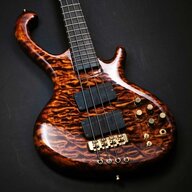
Back in the 70’s I had 2 EB3s. Extremely playable Basses. Yes, it was an adjustment to go to a 34” scale, but I’d find it doubtful that going back to a short scale would be an issue fingering wise.

Quick question, do you feel cramped playing a guitar? If not, it’s not a 30” scale bass that’s the problem.
 
  • Like
Reactions: KJMO and amper
To be fair, I have an obsession with Beatle basses, had five at one time. Loved the tone but couldn't play any of them longer than 10 minutes for a variety of ergonomic reasons, sold all of them. You gotta do what's best for you. I lucked out that last ones I've gotten into are comfortable and easy to play.