• TalkBass has been independent since 1998. Add your voice.
    Create a free account to reply to discussions, view embedded media, and browse with fewer display ads.
    Join freeLog in
    Want zero display ads or expanded classifieds tools? Compare plans.

Short Scale Journey Didn't Last Long

Neck dive is not due to 30" scale. It is due to having the ergonomics messed up which is surprisingly common in short scale instruments.

If you keep the bridge near the end of the body and keep the upper horn at the 12th fret you'll have less neck dive than the 34" counterpart.

I'm playing 32" scale instruments. Zero neck heaviness. Great sounding and playing basses.

Here's my 32" P bass next to my 34" Stingray. Both balance great but the P is slightly more neck heavy. I've since swapped necks on the P for a 2x2 and the P is even less heavy. The difference in reach to the lowest 2 frets and the stretch between frets is noticeable between 34" and 32". Upper fret access seems about the same.
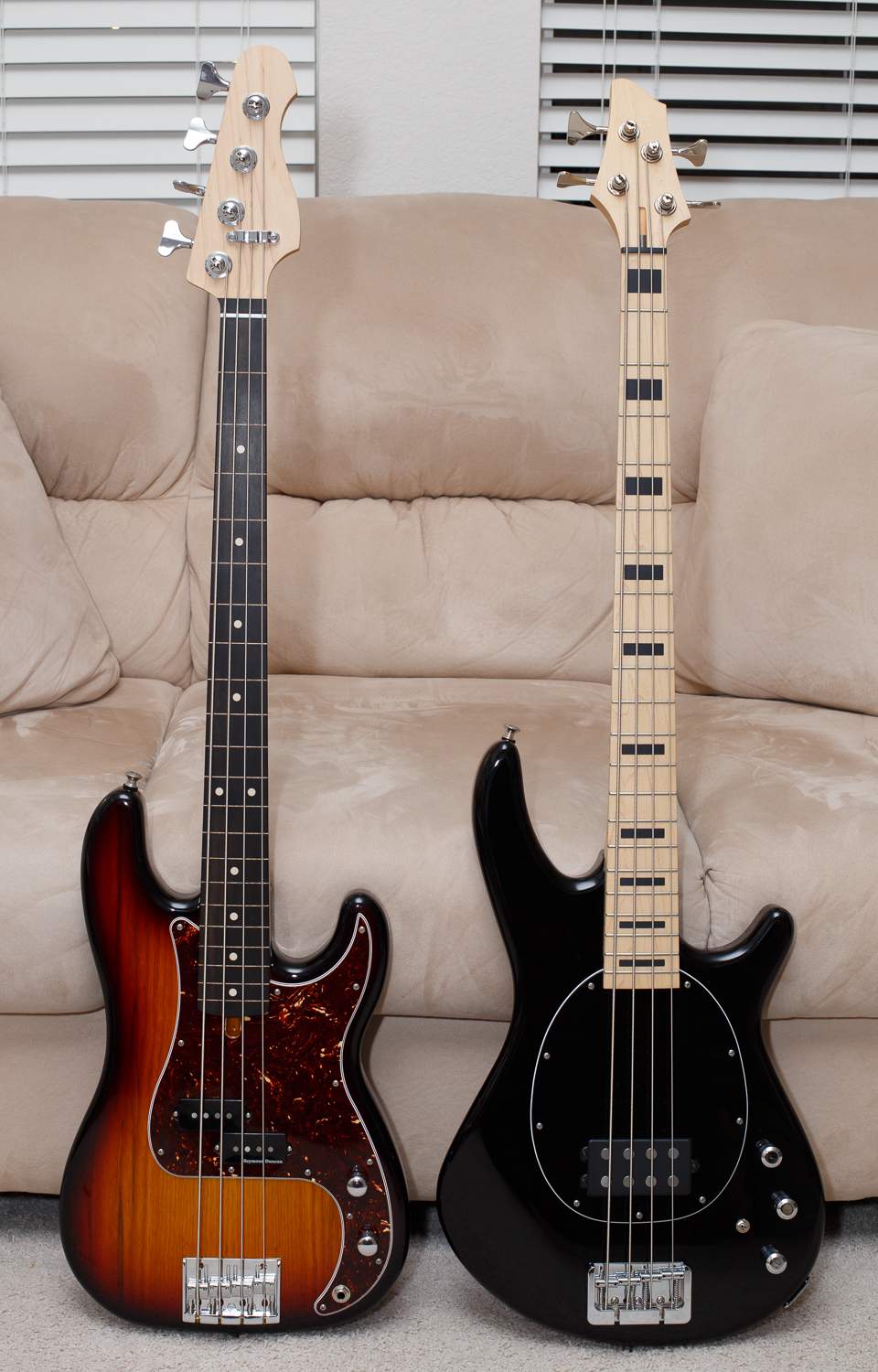

basses-1.jpg
 
I tried several short scales: Douglas Violin bass; Epiphone Woody Allen, Epiphone Club Bass; and the Ibanez Mikro bass. I also tried the Ibanez Mezzo bass (32" scale) in a store a few times. I ended up either sending back or selling all of these. I am only about 5'4" and female, but all of these basses made me feel cramped. What I have not seen mentioned here is arm length. I do have longer arms and I think that, and also a history of playing upright bass, are two reasons I prefer a standard scale bass. I cannot even say any of these basses were really lighter, or felt lighter. In fact, the Mikro and Mezzo basses felt or actually were heavier than each of my Ibanez basses that are either 7.4 pounds (SR650E) or 6.14 for the SRH500 fretless. So glad I went back to standard size basses!
 
If shorties aren't for you, there are plenty of other basses you can play. But blaming neck dive on the shortie factor alone is a red herring. My Dano Longhorn doesn't neck dive. My violin basses dive a little bit but it's hardly unbearable. My friend has an AmPro Mustang and it didn't dive too darn much IMHO.
 
A few years ago I purchased a Squier Jaguar short scale bass for $125.00 (new). I spent about the same amount modifying it (DiMarzio pickups, new pots, etc.). That was a great little bass: light, no neck-dive, great sound, etc. Then I joined a band and I felt self-conscious about playing a cheap-o short scale, so I sold it. I regret that, it was a fun little bass.

My experience is very much like yours:
- Mine cost $125 new.
- Agreed it's a great little bass.
- No neck-dive, great sound, etc.
- My only mod so far is a mint PG and block fret markers,
- But I may do more mods in the future.

Where we differ is I've never given a sh** about what others think so I still have mine.

057912
 
Sharing this to see if anyone else had a journey similar to my "love the one you're with" story.

In my head, I wanted a short-scale for long gigs. Never had one. Easy to play, light weight; what's not to love, right? Went to the music store to pick up a repair and, concerned about neck dive, decided to try on each short-scale bass with a strap. Results:
  • 2 Gibson SG basses - horrible neck dive
  • 2 Gibson LP2-style basses - horrible neck dive
  • Epiphone Allen Woody and Violin basses - good balance, but the bodies are thicker than I'm used to, so it would take some re-learning for my right arm/hand/wrist
  • 2 Fender Mustang PJ basses - horrible neck dive
  • 2 American Fender Mustang basses - neck goes to about parallel with the floor. I guess I could live with that. But as I'm jamming on the first 7 frets, I notice my left elbow touching my ribs. Never felt "cramped" before while playing bass standing up. This would require some re-learning for my left arm, plus the re-learning of the shorter scale with my left hand. I wouldn't call it annoying, but...
My conclusion was, I'm simply not going to find anything that feels as ergonomically comfortable as my current standard-scale basses. And I think I'm very happy with that and just saved myself some dough. Both my current basses are pretty light, but in the last hour of 4-hour gigs, they begged the question, could I go even lighter? I found my answer - yes, but only with tradeoffs that I'm too stubborn to make.

Anyone else follow this path when considering (or trying/buying) shorties?


This is my personal experience but I think really what you want is a lighter weight bass. I would say something maybe like an epiphone jack cassady that comes in around 8 or under pounds is a good idea.

I have 1 short scale bass. A 1977 fender music master. It is heaver than my 2009 american jazz bass. Which is is insane lol but it is what it is. I love it for recording and just messing around but i'd never play it on a gig. End rant...

When I bought it I only played it for like 2 months. I had just started my masters degree and went heavy towards the upright bass with no gigs on electric having moved to a new city/state. I only played the short scale when practicing electric. 2 months of only that and i had to play an electric tune in the schools big band and brought my jazz bass thinking nothing of it. I had to re-learn in a way how to play it. thats a little over-dramatic but i was feeling weird for the first 2 times through the song before figuring it out.

So yes there is a learning curve. I doubt I'll get another short scale, and if I do it'll be after getting a bunch of other "normal" sized basses.

My advice to you is look at lighter 34 inch scale basses.
 
I have an EBMM short scale and it’s incredibly well balanced. String tension issue is easily solved by going up on gauge a little. If you feel cramped that is a whole different issue and probably gonna want to stick to 34 or 32
 
No neck dive on any of my shorties, and I now own about 8 of them. I'll add that hanging parallel to the ground is not neck dive to me. None of them Gibson or Epiphone. And I'll add the my Musicman SS scale, not the one in this pic, balances like what I suppose would be a neck dive sensitive person's dream :) . And sounds freiiikkking awesome! Both Stingrays actually sound kind of identical.

Joe Sterling.jpg
 
I think most bass players gravitate toward short scales when they get older! Todays choices are 10 times what they were 25 years ago! A boutique bass build was unheard of back in the day! The light weight and compact size makes life easier! When i could not close the back doors of my saturn aura with my thunderbird (in case) laying across the back seat, i started looking at shortscales. That was six years ago! I now play short scales exclusively. I have an sg, a japan built mustang and a birdsong. With the 3 basses i own, i can attain any sound i desire with the proper amp settings!
 
I think most bass players gravitate toward short scales when they get older! Todays choices are 10 times what they were 25 years ago! A boutique bass build was unheard of back in the day! The light weight and compact size makes life easier! When i could not close the back doors of my saturn aura with my thunderbird (in case) laying across the back seat, i started looking at shortscales. That was six years ago! I now play short scales exclusively. I have an sg, a japan built mustang and a birdsong. With the 3 basses i own, i can attain any sound i desire with the proper amp settings!
I sold my thunderbird w it’s case when it wouldn’t fit in our cars.
 
  • Like
Reactions: Joe Nerve
Thanks, everyone. I had no idea there would be 88 replies and counting, especially since I read the board weekly but post rarely. It is fun and interesting to see the varying interpretations of my message. Not enough time to respond to everything. I appreciate your suggestions. I will continue to try some basses as I encounter them.
 
Thanks, everyone. I had no idea there would be 88 replies and counting, especially since I read the board weekly but post rarely. It is fun and interesting to see the varying interpretations of my message. Not enough time to respond to everything. I appreciate your suggestions. I will continue to try some basses as I encounter them.
I'm just surprised that every Mustang you tried had dive. I've had vintage (late 70s), modern (JMJ version) and variants (like my Squier Bronco) and the upper button being at the 12th generally has meant no dive.

FWIW I am also quite partial to Gotoh Resolite tuners, which are even lighter (and smoother-geared) than Hipshot Ultralites, so if I did have any dive with that body style I suspect it'd be easily countered with those.
 
Sharing this to see if anyone else had a journey similar to my "love the one you're with" story.

In my head, I wanted a short-scale for long gigs. Never had one. Easy to play, light weight; what's not to love, right? Went to the music store to pick up a repair and, concerned about neck dive, decided to try on each short-scale bass with a strap. Results:
  • 2 Gibson SG basses - horrible neck dive
  • 2 Gibson LP2-style basses - horrible neck dive
  • Epiphone Allen Woody and Violin basses - good balance, but the bodies are thicker than I'm used to, so it would take some re-learning for my right arm/hand/wrist
  • 2 Fender Mustang PJ basses - horrible neck dive
  • 2 American Fender Mustang basses - neck goes to about parallel with the floor. I guess I could live with that. But as I'm jamming on the first 7 frets, I notice my left elbow touching my ribs. Never felt "cramped" before while playing bass standing up. This would require some re-learning for my left arm, plus the re-learning of the shorter scale with my left hand. I wouldn't call it annoying, but...
My conclusion was, I'm simply not going to find anything that feels as ergonomically comfortable as my current standard-scale basses. And I think I'm very happy with that and just saved myself some dough. Both my current basses are pretty light, but in the last hour of 4-hour gigs, they begged the question, could I go even lighter? I found my answer - yes, but only with tradeoffs that I'm too stubborn to make.

Anyone else follow this path when considering (or trying/buying) shorties?
If you gotta feel uncramped with your usual 34” scale reach, but need a lighter bass check out Glarry.
Cheap. Easy to mod inexpensively and just over 7 lbs.
Seriously
Check out the Glarry club
Official Exquisite/Glarry/Burning Fire Bass Club?
 
Sharing this to see if anyone else had a journey similar to my "love the one you're with" story.


In my head, I wanted a short-scale for long gigs. Never had one. Easy to play, light weight; what's not to love, right? Went to the music store to pick up a repair and, concerned about neck dive, decided to try on each short-scale bass with a strap. Results:
  • 2 Gibson SG basses - horrible neck dive
  • 2 Gibson LP2-style basses - horrible neck dive
  • Epiphone Allen Woody and Violin basses - good balance, but the bodies are thicker than I'm used to, so it would take some re-learning for my right arm/hand/wrist
  • 2 Fender Mustang PJ basses - horrible neck dive
  • 2 American Fender Mustang basses - neck goes to about parallel with the floor. I guess I could live with that. But as I'm jamming on the first 7 frets, I notice my left elbow touching my ribs. Never felt "cramped" before while playing bass standing up. This would require some re-learning for my left arm, plus the re-learning of the shorter scale with my left hand. I wouldn't call it annoying, but...
My conclusion was, I'm simply not going to find anything that feels as ergonomically comfortable as my current standard-scale basses. And I think I'm very happy with that and just saved myself some dough. Both my current basses are pretty light, but in the last hour of 4-hour gigs, they begged the question, could I go even lighter? I found my answer - yes, but only with tradeoffs that I'm too stubborn to make.

Anyone else follow this path when considering (or trying/buying) shorties?
There’s always the Gretsch 6128 Thunderjet.
It’s chambered so it’s got a little bit more balance.
13F090B4-D54D-4D3A-9660-B16D1271D8AB.jpeg
 
Sharing this to see if anyone else had a journey similar to my "love the one you're with" story.

In my head, I wanted a short-scale for long gigs. Never had one. Easy to play, light weight; what's not to love, right? Went to the music store to pick up a repair and, concerned about neck dive, decided to try on each short-scale bass with a strap. Results:
  • 2 Gibson SG basses - horrible neck dive
  • 2 Gibson LP2-style basses - horrible neck dive
  • Epiphone Allen Woody and Violin basses - good balance, but the bodies are thicker than I'm used to, so it would take some re-learning for my right arm/hand/wrist
  • 2 Fender Mustang PJ basses - horrible neck dive
  • 2 American Fender Mustang basses - neck goes to about parallel with the floor. I guess I could live with that. But as I'm jamming on the first 7 frets, I notice my left elbow touching my ribs. Never felt "cramped" before while playing bass standing up. This would require some re-learning for my left arm, plus the re-learning of the shorter scale with my left hand. I wouldn't call it annoying, but...
My conclusion was, I'm simply not going to find anything that feels as ergonomically comfortable as my current standard-scale basses. And I think I'm very happy with that and just saved myself some dough. Both my current basses are pretty light, but in the last hour of 4-hour gigs, they begged the question, could I go even lighter? I found my answer - yes, but only with tradeoffs that I'm too stubborn to make.

Anyone else follow this path when considering (or trying/buying) shorties?
Try this easy fix for neck dive
 
  • Like
Reactions: raphaeld
I’ve been gravitating back to 34’s after a 2 decade run playing shorties. The Wattplower has been mentioned a few times and I must say it balances well and Reverend builds a fine instrument that sounds killer. Here’s mine.

08668FC9-1D31-492D-83F8-57C4A0332BD4.png
 
  • Like
Reactions: raphaeld and LowWay