• TalkBass has been independent since 1998. Add your voice.
    Create a free account to reply to discussions, view embedded media, and browse with fewer display ads.
    Join freeLog in
    Want zero display ads or expanded classifieds tools? Compare plans.

Short Scale Journey Didn't Last Long

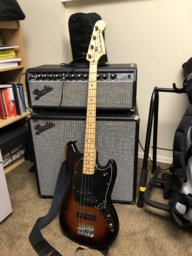
My PJ mustang had some neck dive when I got it, but hipshot ultralites and a cotton strap solved it.

I wouldn’t necessarily go to a short scale because of weight, I think you’d have an easier time finding a full length bass in the weight you want than adjusting to a short scale.
 
I always wondered if the shorter necks would reduce the headstock/tuner leverage and counteract the general body styles that have shorter upper horns to manage neck dive. It sounds like it is the same as standard 34" scale lengths.

I can always tell that if the upper horn strap attachment doesn't line up with the 12th fret, the chances of it balancing well is low.

I never really noticed neck dive until I bought a bass that was perfectly balanced. Changing the strap doesn't mean a poorly balanced bass doesn't have a tendency to neck dive, it just grabs your shirt to hold it in place. I find it still puts a pressure on your shoulder that can be painful when standing and playing for extended periods of time.
 
  • Like
Reactions: logdrum
The only short scale that works for me is my Wes Lambe Hybrid "Charlie Hunter" -type bass & guitar. But I tune the string 1 1/2 steps up so E is G. My original Mustang I put piccolo strings. Can't stand it being that short. But I am okay with a Uke bass. Go figure. However if I am given a short scale in a jam or recording studio, I would not hesitate to play it.
 
Neck dive solution on Epiphone EB-0 / 3 (bolt on neck) for those that don’t want to attempt to drill a strap button screw hole in the sharp edge of the upper “horn”. It’s one of the most comfortable basses I have now out of 13.

D570403A-07DF-48AB-BD50-A7698D5B4822.jpeg


531256F6-30B3-418D-BACB-304C17B2B373.jpeg
 
I keep thinking I want a mustang just for kicks. But switching between DB and BG, I don't think I'd find it comfortable for gigging. And the diminished overtones would bug me. I still might get one for the living room to go with my mini strat, because I think they're cute af.
 
It has been my impression that anytime a company makes a short scale version of a full-scale bass by shrinking the instrument in every dimension, it is not comfortable to play. It was not until I played a short scale bass with a thicker neck that the short scale made sense to me.
I am not familiar with all short scales (obviously), but I have found Birdsongs to be as close to the perfect short scale as I can imagine. They are lightweight, designed to balance perfectly, and have a deeper neck than I expected. However, the deep neck is what makes it so comfortable to play. My fretted Cortobass is shown below.
I am curious about the short scale Stingray; it seems to me it would have a neck thicker than the Fender short scales.
30487620-00BF-4522-98E0-953509D2CE4B.jpeg
 
@socknroll1 Haven't read the entire thread yet, but...

I have average to below size hands and I too did not gain any dexterity or stamina when I tried a short scale for a while. In my experience, short scale forces me to be too square and cramped with my fingers. I can't even come close to the same dexterity on a regular scale bass. On short scale my fingers literally trip over each other when I try to move around too much. I still own a short scale Reverend Dub King, but I've only been using that for simple reggae or americana style playing.

If I can make a recommendation... For my 4-hour-gig cover band my go to is a G&L Jazz Bass with an empress body. It weighs about 7.3 lbs, and balances just right. The neck is a little heavy compared to the light weight body, but not so much that I get any noticeable neck dive. The neck profile is 1 1/2" nut and 9.5" radius with rounded edges and it feels GREAT! At G&L you can even opt for the low profile frets, but mine has standard medium jumbo. I put D'addario NYXL 45-95 on it, so the gauge is lower than average strings. Super easy to play and this set-up really helps arm/wrist/hand fatigue on those long cover band gig nights. I do most of my practicing on a full size Stringray Special, so when I pick up the G&L JB it feels super easy to play.

my two cents... take it or leave it.
 
I’m going down that path now. I’ve been playing my 34” with a capo at the second fret to simulate the 30” scale as I wait for my mustang pj to arrive. I’ve ordered custom gauge strings to get the tension I’m looking for at the shorter scale. I don’t care about neck dive, this experiment is just to see if I like the tension and the way the strings respond at 30”. If it’s successful, I’m having cliff Bordwell build me a prototype 30” with a custom profile neck. I’m 100% sure this bass will balance and be under 7 pounds. My 34” Bordwell is 6.5 pounds.

If the prototype is a success, we’ll build the deluxe version 3 months later.

My left hand loves the 30” scale, my right hand needs high tension strings. This is gonna be a delicate design challenge.

But I would expect a shorter neck to have less neck dive since there’s less leverage pulling it down. I’m surprised fender screwed this up. I wonder if ultralight tuners would help.

I’ve heard some great things about the Wattplower. Maybe check one of those out.
Wattplower seems like a sweet bass. I’d probably stick with the original but the I’m sure the MarkII would work just fine.
 
My conclusion was, I'm simply not going to find anything that feels as ergonomically comfortable as my current standard-scale basses. And I think I'm very happy with that and just saved myself some dough. Both my current basses are pretty light, but in the last hour of 4-hour gigs, they begged the question, could I go even lighter? I found my answer - yes, but only with tradeoffs that I'm too stubborn to make.

I play almost exclusively 35" 4 strings with P-with necks so I understand that for some folks a short scale can be uncomfortable if it feels scrunchy. However, my question would be: besides dive and thick bodies what were your main ergonomic issues? I noticed that all the bases you note are vintage styled models that lack the the refinements of modern basses.

If better shaped bodies, and more flexible neck position are your main beefs, there's alot of great short scales that might fit the bill. I've played Birdsong, Serek, Lowdown, and others who make short scales that -except for finger scrunch for my big hands- are impeccably ergonomic, lightweight and really fantastic in every way. I'm pretty sure there are some more non-custom, mid-range instruments with similar refinements from mass market companies, but I haven't done the research yet.
 
A few years ago I purchased a Squier Jaguar short scale bass for $125.00 (new). I spent about the same amount modifying it (DiMarzio pickups, new pots, etc.). That was a great little bass: light, no neck-dive, great sound, etc. Then I joined a band and I felt self-conscious about playing a cheap-o short scale, so I sold it. I regret that, it was a fun little bass.
I had that same bass. Did my own mods, as well. Ended up selling because it just sat. Great little basses, though. Of course, Fender makes one as well, if you're thinking possible upgrade.