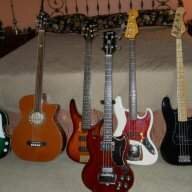
How about a long scale made with lighter material? Lighter tuners, lighter bridge, lighter body, etc...

TalkBass has been independent since 1998. Add your voice.
Create a free account to reply to discussions, view embedded media, and browse with fewer display ads.
Join free Log in
Want zero display ads or expanded classifieds tools? Compare plans.

I was pretty much the same until I played a Lakland Skyline 30 Hollow body. I own one now and it’s ALL I play !Sharing this to see if anyone else had a journey similar to my "love the one you're with" story.
In my head, I wanted a short-scale for long gigs. Never had one. Easy to play, light weight; what's not to love, right? Went to the music store to pick up a repair and, concerned about neck dive, decided to try on each short-scale bass with a strap. Results:
My conclusion was, I'm simply not going to find anything that feels as ergonomically comfortable as my current standard-scale basses. And I think I'm very happy with that and just saved myself some dough. Both my current basses are pretty light, but in the last hour of 4-hour gigs, they begged the question, could I go even lighter? I found my answer - yes, but only with tradeoffs that I'm too stubborn to make.
- 2 Gibson SG basses - horrible neck dive
- 2 Gibson LP2-style basses - horrible neck dive
- Epiphone Allen Woody and Violin basses - good balance, but the bodies are thicker than I'm used to, so it would take some re-learning for my right arm/hand/wrist
- 2 Fender Mustang PJ basses - horrible neck dive
- 2 American Fender Mustang basses - neck goes to about parallel with the floor. I guess I could live with that. But as I'm jamming on the first 7 frets, I notice my left elbow touching my ribs. Never felt "cramped" before while playing bass standing up. This would require some re-learning for my left arm, plus the re-learning of the shorter scale with my left hand. I wouldn't call it annoying, but...
Anyone else follow this path when considering (or trying/buying) shorties?


I gave that a hard look but decided on the Sterling Short Scale as it has the narrower neck. Love the lookGot me a G&L Tribute Fallout Bass, love it, so many tones available, comfortable, not real light, but not real heavy. Worth checking outView attachment 3993748

Sharing this to see if anyone else had a journey similar to my "love the one you're with" story.
In my head, I wanted a short-scale for long gigs. Never had one. Easy to play, light weight; what's not to love, right? Went to the music store to pick up a repair and, concerned about neck dive, decided to try on each short-scale bass with a strap. Results:
My conclusion was, I'm simply not going to find anything that feels as ergonomically comfortable as my current standard-scale basses. And I think I'm very happy with that and just saved myself some dough. Both my current basses are pretty light, but in the last hour of 4-hour gigs, they begged the question, could I go even lighter? I found my answer - yes, but only with tradeoffs that I'm too stubborn to make.
- 2 Gibson SG basses - horrible neck dive
- 2 Gibson LP2-style basses - horrible neck dive
- Epiphone Allen Woody and Violin basses - good balance, but the bodies are thicker than I'm used to, so it would take some re-learning for my right arm/hand/wrist
- 2 Fender Mustang PJ basses - horrible neck dive
- 2 American Fender Mustang basses - neck goes to about parallel with the floor. I guess I could live with that. But as I'm jamming on the first 7 frets, I notice my left elbow touching my ribs. Never felt "cramped" before while playing bass standing up. This would require some re-learning for my left arm, plus the re-learning of the shorter scale with my left hand. I wouldn't call it annoying, but...
Anyone else follow this path when considering (or trying/buying) shorties?

I have three short scales and love everyone of them. To me, neck dive has a lot to do with upper strap button location. Most short scales have buttons higher up the neck than the twelfth fret. My squire jag and danelectro long horn have moderate dive easily solved by a good non slip strap, but the viola bass has very pronounced dive that is only compensated by use of a headstock tie. Anyway, there are solutions and to me the playability of the short scale is worth it. Who knows though, if I ever get a long scale I may love it too.Sharing this to see if anyone else had a journey similar to my "love the one you're with" story.
In my head, I wanted a short-scale for long gigs. Never had one. Easy to play, light weight; what's not to love, right? Went to the music store to pick up a repair and, concerned about neck dive, decided to try on each short-scale bass with a strap. Results:
My conclusion was, I'm simply not going to find anything that feels as ergonomically comfortable as my current standard-scale basses. And I think I'm very happy with that and just saved myself some dough. Both my current basses are pretty light, but in the last hour of 4-hour gigs, they begged the question, could I go even lighter? I found my answer - yes, but only with tradeoffs that I'm too stubborn to make.
- 2 Gibson SG basses - horrible neck dive
- 2 Gibson LP2-style basses - horrible neck dive
- Epiphone Allen Woody and Violin basses - good balance, but the bodies are thicker than I'm used to, so it would take some re-learning for my right arm/hand/wrist
- 2 Fender Mustang PJ basses - horrible neck dive
- 2 American Fender Mustang basses - neck goes to about parallel with the floor. I guess I could live with that. But as I'm jamming on the first 7 frets, I notice my left elbow touching my ribs. Never felt "cramped" before while playing bass standing up. This would require some re-learning for my left arm, plus the re-learning of the shorter scale with my left hand. I wouldn't call it annoying, but...
Anyone else follow this path when considering (or trying/buying) shorties?

Can you tell me what the 5 string is- 2nd from the bottom?There's a bunch-o-basses without neck dive. As mentioned, Maruszczyk and Birdsong. Also Lakland, SX, Schecter, Spector, Conklin, Ibanez and others. Tons of short scale options these days.
View attachment 3990289 View attachment 3990290 View attachment 3990291 View attachment 3990292 View attachment 3990293 View attachment 3990295


Keisel makes one,Are you reading this, big manufacturer? We need some relatively affordable headless short scale basses.

You never mentioned the Music Man Stingray short scale. Have you not tried one of those yet?Sharing this to see if anyone else had a journey similar to my "love the one you're with" story.
In my head, I wanted a short-scale for long gigs. Never had one. Easy to play, light weight; what's not to love, right? Went to the music store to pick up a repair and, concerned about neck dive, decided to try on each short-scale bass with a strap. Results:
My conclusion was, I'm simply not going to find anything that feels as ergonomically comfortable as my current standard-scale basses. And I think I'm very happy with that and just saved myself some dough. Both my current basses are pretty light, but in the last hour of 4-hour gigs, they begged the question, could I go even lighter? I found my answer - yes, but only with tradeoffs that I'm too stubborn to make.
- 2 Gibson SG basses - horrible neck dive
- 2 Gibson LP2-style basses - horrible neck dive
- Epiphone Allen Woody and Violin basses - good balance, but the bodies are thicker than I'm used to, so it would take some re-learning for my right arm/hand/wrist
- 2 Fender Mustang PJ basses - horrible neck dive
- 2 American Fender Mustang basses - neck goes to about parallel with the floor. I guess I could live with that. But as I'm jamming on the first 7 frets, I notice my left elbow touching my ribs. Never felt "cramped" before while playing bass standing up. This would require some re-learning for my left arm, plus the re-learning of the shorter scale with my left hand. I wouldn't call it annoying, but...
Anyone else follow this path when considering (or trying/buying) shorties?

Haha cool! I love my mini Precision "Blackie". It's a great traveler. Even thinking about putting a J pickup in the bridge position

Can you tell me what the 5 string is- 2nd from the bottom?
Volker you and I should start a Squier Mini PrecisionClub. I have a red one like you and I love my bass even with stock strings. I have been primarily a short scaler though I did have a Jazz Bass and a Precisionbut for my fat hands short finger and arm short scale works much better--I could not play complicated bass patterns o-n my Precision because frets 1-4 were too long of a reach. I have own ed and enjoyed a 67 Gibson EB-O with nylon tape strings and a 67 Mustang Bass. Loved both of them. Now I play a Fender CB 60 Acoustic Bass, a Squier NMin i Precision and a Squier SS Jaguar. Two short scale basses for you to to try: The Fender CB 60 with Fishman Piezzo Bridge Pickup (32 inch neck, classical guitar body) and a Hoffner violin Paul Mc Cartney bass.