• TalkBass has been independent since 1998. Add your voice.
    Create a free account to reply to discussions, view embedded media, and browse with fewer display ads.
    Join freeLog in
    Want zero display ads or expanded classifieds tools? Compare plans.

Short Scale Journey Didn't Last Long

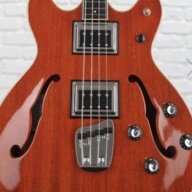
Guild StarFire double cutaway short scale semi hollow body bass. What makes it really usable for me is to take the lower strap and put it over the lobe rather than behind the lobe. This tips the neck to about 45°. I sometimes do the same thing with solid-body basses, but nothing works as well as the StarFire.
 
Sharing this to see if anyone else had a journey similar to my "love the one you're with" story.

In my head, I wanted a short-scale for long gigs. Never had one. Easy to play, light weight; what's not to love, right? Went to the music store to pick up a repair and, concerned about neck dive, decided to try on each short-scale bass with a strap. Results:
  • 2 Gibson SG basses - horrible neck dive
  • 2 Gibson LP2-style basses - horrible neck dive
  • Epiphone Allen Woody and Violin basses - good balance, but the bodies are thicker than I'm used to, so it would take some re-learning for my right arm/hand/wrist
  • 2 Fender Mustang PJ basses - horrible neck dive
  • 2 American Fender Mustang basses - neck goes to about parallel with the floor. I guess I could live with that. But as I'm jamming on the first 7 frets, I notice my left elbow touching my ribs. Never felt "cramped" before while playing bass standing up. This would require some re-learning for my left arm, plus the re-learning of the shorter scale with my left hand. I wouldn't call it annoying, but...
My conclusion was, I'm simply not going to find anything that feels as ergonomically comfortable as my current standard-scale basses. And I think I'm very happy with that and just saved myself some dough. Both my current basses are pretty light, but in the last hour of 4-hour gigs, they begged the question, could I go even lighter? I found my answer - yes, but only with tradeoffs that I'm too stubborn to make.

Anyone else follow this path when considering (or trying/buying) shorties?


I was OK with the Neck Dive, but my problem was that i just could not get a great smooth bass sound on the Short Scales. I tried the Mustang PJ, and the Gibson EB0 SG Bass, as well as some cheaper SS like a SX and the Gretsch Jet Jr. It just sounded floppy, and muddy.
 
Guild StarFire double cutaway short scale semi hollow body bass. What makes it really usable for me is to take the lower strap and put it over the lobe rather than behind the lobe. This tips the neck to about 45°. I sometimes do the same thing with solid-body basses, but nothing works as well as the StarFire.
I've noticed a lot of short-scale basses are semi-hollow. Any reason for this?
 
What type of straps were you using? I had neck dive problems with smooth leather or fabric straps, but once I went to leather with a suede backing, I've never had a Mustang or other short scale have any neck dive problems.
With my EBO and my Mustang I used a thin leather Fender strap which had a really bif should pad. You could manoever the bass and the should pad location so there was no neck dive
 
String tension decreases as the scale decreases. That makes tuning more sensitive on the lower strings like the E. My sugestion is ration tuners on anything around 30" scale or less. I have built a few basses that have standard Strat scales and are great except for they are so sensitive to E tuning. I prefer the Hipshot ultra light tuners.
I have built many short scale basses with the Bronco neck with is thirty inches and is pretty light.
This bass is a Bronco in neck and body only, Everything is changed out. MGB 51 style pickup, Hipshot tuners and Hipshot bridge, cts pots and up braded wiring. 6.5 lbs.
Both of the V basses i built are 30" scale.
The Squire Bullet hardtail was converted to four strings and is very nice except for the E string sensitivity.
 

Attachments

  • IMG_4437.JPG
    IMG_4437.JPG
    1.3 MB · Views: 62
  • IMG_4501.JPG
    IMG_4501.JPG
    659 KB · Views: 57
  • IMG_4161.JPG
    IMG_4161.JPG
    918.2 KB · Views: 60
  • IMG_4502.JPG
    IMG_4502.JPG
    2.3 MB · Views: 61
Last edited:
Sharing this to see if anyone else had a journey similar to my "love the one you're with" story.

In my head, I wanted a short-scale for long gigs. Never had one. Easy to play, light weight; what's not to love, right? Went to the music store to pick up a repair and, concerned about neck dive, decided to try on each short-scale bass with a strap. Results:
  • 2 Gibson SG basses - horrible neck dive
  • 2 Gibson LP2-style basses - horrible neck dive
  • Epiphone Allen Woody and Violin basses - good balance, but the bodies are thicker than I'm used to, so it would take some re-learning for my right arm/hand/wrist
  • 2 Fender Mustang PJ basses - horrible neck dive
  • 2 American Fender Mustang basses - neck goes to about parallel with the floor. I guess I could live with that. But as I'm jamming on the first 7 frets, I notice my left elbow touching my ribs. Never felt "cramped" before while playing bass standing up. This would require some re-learning for my left arm, plus the re-learning of the shorter scale with my left hand. I wouldn't call it annoying, but...
My conclusion was, I'm simply not going to find anything that feels as ergonomically comfortable as my current standard-scale basses. And I think I'm very happy with that and just saved myself some dough. Both my current basses are pretty light, but in the last hour of 4-hour gigs, they begged the question, could I go even lighter? I found my answer - yes, but only with tradeoffs that I'm too stubborn to make.

Anyone else follow this path when considering (or trying/buying) shorties?
I guess the lesson here is that the grass isn't always greener on the other side.
It's so tempting to always be looking for the bigger better thing, music gear feeds on that but if you have an instrument that your happy with musically, aesthetically and ergonomically...be happy and go make some music!
But hey, that's just my two cents.
 
Purchased 2 Mikros, 4 string and 5 string. Love the way they fit my hands (smallish for a bassist) and the weight is fantastic, compared to my LTD 34", 6.5 to almost 11 lbs. The guitars are decent out of the box, but noticed some issues and wanted foolproof. So here's the list of what I changed:

1) Pickups, pots, control knobs and wiring - went with EMG passive sets and knobs
2) Bridge - went with Ibanez 500 series with both, way more adjustable. Although not a direct drop in, the 2 forward screws line up. I made some tiny wood dowels to fill in the old holes and drilled new holes.
3) Tuners - Hipshot Ultra Lites to help with neck dive.

The basses (bodies and necks) are very well made, only thing I changed was to stain the neck on the 5 string. Used ebony stain and came out with a beautiful deep mahogany finish.

Sure, could have spent more on the bass to begin with, but I love to tinker. I have 2 customized Mikros that I love to play, easy on my shoulders, great and fully adjustable sound and fit my hands, for less than $900 for the pair. All of the issues that I was concerned about are gone now, never to return LOL.
Scarlet  23 Sep 20.jpg
Betty 23 Sep 20.jpg
 
My desire to try a short scale stems from an injury and subsequent surgery to my left wrist and elbow. Prior to that i always covered four frets with my left hand. Now, my pinky finger is non functional as a fretting finger so i’m down to three fingers. I want a particular bass but i refuse to participate in the current fiasco that saw that imported bass jump from $750 brand new with case to around $1200 for the same bass and case, so i decided to just relearn with three fingers. If we ever return to some sense of sanity i’ll buy that short scale, but until then i’ll keep relearning my left hand.
The squier mini is a great bass and only $179with a 28.6 inch neck and 3/4 size precision body. I think your three finger will really like the fast short neck and real full size sound. To me sounds better than the 34 inch
Fender Jazz Bass and Squire Precision PJ Bass that I formerly owned
 
Honestly, I think it may just be that you need to find the right short scale bass that suits you. Here are 3 basses of different scale lengths. I just traded the Coronado (30" scale), so I obviously don't play it anymore, but I play the 32" scale D Huff bass *all the time*. For reference, it weighs about the same as my Precision, but plays easier
bass_family.jpg
.
 
  • Like
Reactions: MarMar
Sharing this to see if anyone else had a journey similar to my "love the one you're with" story.

In my head, I wanted a short-scale for long gigs. Never had one. Easy to play, light weight; what's not to love, right? Went to the music store to pick up a repair and, concerned about neck dive, decided to try on each short-scale bass with a strap. Results:
  • 2 Gibson SG basses - horrible neck dive
  • 2 Gibson LP2-style basses - horrible neck dive
  • Epiphone Allen Woody and Violin basses - good balance, but the bodies are thicker than I'm used to, so it would take some re-learning for my right arm/hand/wrist
  • 2 Fender Mustang PJ basses - horrible neck dive
  • 2 American Fender Mustang basses - neck goes to about parallel with the floor. I guess I could live with that. But as I'm jamming on the first 7 frets, I notice my left elbow touching my ribs. Never felt "cramped" before while playing bass standing up. This would require some re-learning for my left arm, plus the re-learning of the shorter scale with my left hand. I wouldn't call it annoying, but...
My conclusion was, I'm simply not going to find anything that feels as ergonomically comfortable as my current standard-scale basses. And I think I'm very happy with that and just saved myself some dough. Both my current basses are pretty light, but in the last hour of 4-hour gigs, they begged the question, could I go even lighter? I found my answer - yes, but only with tradeoffs that I'm too stubborn to make.

Anyone else follow this path when considering (or trying/buying) shorties?
I been thinking about that myself but not so much for weight, what kind of bass do you play now?
 
I’m planning a 32” medium scale build right now, I played a couple customs and it’s a nice sweet spot between full and short scale. 2” in length is enough to make it easier to play, but not so short that the E string feels floppy. I can’t think of any major manufacturers that have them off the shelf though, anybody know?

Edit: Aren’t some of the Ibanez basses 32” scale? Is the Talman?
The Fender CB 60 acoustic electric bass with Fishman Piezzo bridge pickup and a dreadnaught shaped body has a 32 inch neck and goes for $399
 
  • Like
Reactions: Gilmourisgod
Honestly, I think it may just be that you need to find the right short scale bass that suits you. Here are 3 basses of different scale lengths. I just traded the Coronado (30" scale), so I obviously don't play it anymore, but I play the 32" scale D Huff bass *all the time*. For reference, it weighs about the same as my Precision, but plays easierView attachment 3993787 .
The bass on the left is nice, what is it?
 
Back in the stone age of rock (1970s), I had a Teisco / Kawai / Kimberley Bass with a laminated neck (plywood).
NECK DIVE? HAH. It would CRASH DIVE, if given the chance. I eventually attached both ends of the neck strap to the one strap pin, and it was balanced - if precariously.
Later bought a Guild Starfire II Bass. Its large semi-hollow design shifted the balance, and though it was short scale, did not suffer neck dive. (It had other failings - one being the lack of Hagstrom Bisonic pickups)
 
  • Like
Reactions: Dave-shortscale
I love the two Mustang basses I have and get great tones out of both (one is a Squier with Seymore Duncan's stock, the one pictured here I put Lin Fralin Pups on and a high mass bridge). The PJ has massive sustain and I can get jazzy tones thru heavy P-Bass tones with a slight kick in upper-mids.

I use .95 - .40 strings on both.

One thing I've noticed on both is that I don't get the dreaded fret-out at the 6th fret on the G string (C#) that I get on 34" scale length.

I don't get any neck dive (I have an Epiphone Thunderbird so I know about neck dive, and repositioning strap buttons can help with that), but I use leather strap with at least a 2-inch width, I generally use 3" for total comfort, that grip shoulder well.

Don't get me wrong though, I still love my 34" and 35" 5-strings, but also love the Mustangs for playability and fast riffing with no effort. YMMV
 

Attachments

  • 20200522_214311.jpg
    20200522_214311.jpg
    1.2 MB · Views: 57
Last edited:
I got my first short scale ever recently, a squier bronco modded out with DiMarzio PU and Schaller bridge.
Light and very playable, no neck dive! Which is a problem with my Ibanez 505 and Warwick Corvette.
It only has one sound possible that I like, but I really like it (with La Bella tapewounds). Great deal for 200 bucks (or Yucks in my case).
bronco.jpeg


Killing floor, your Duesenberg is beautiful. I'm always afrais I'll scratch a really beautiful bass, but I still dream of finding a Supro Huntington 2 or 3. Not many of them here in Europe for the moment.
 
Sharing this to see if anyone else had a journey similar to my "love the one you're with" story.

In my head, I wanted a short-scale for long gigs. Never had one. Easy to play, light weight; what's not to love, right? Went to the music store to pick up a repair and, concerned about neck dive, decided to try on each short-scale bass with a strap. Results:
  • 2 Gibson SG basses - horrible neck dive
  • 2 Gibson LP2-style basses - horrible neck dive
  • Epiphone Allen Woody and Violin basses - good balance, but the bodies are thicker than I'm used to, so it would take some re-learning for my right arm/hand/wrist
  • 2 Fender Mustang PJ basses - horrible neck dive
  • 2 American Fender Mustang basses - neck goes to about parallel with the floor. I guess I could live with that. But as I'm jamming on the first 7 frets, I notice my left elbow touching my ribs. Never felt "cramped" before while playing bass standing up. This would require some re-learning for my left arm, plus the re-learning of the shorter scale with my left hand. I wouldn't call it annoying, but...
My conclusion was, I'm simply not going to find anything that feels as ergonomically comfortable as my current standard-scale basses. And I think I'm very happy with that and just saved myself some dough. Both my current basses are pretty light, but in the last hour of 4-hour gigs, they begged the question, could I go even lighter? I found my answer - yes, but only with tradeoffs that I'm too stubborn to make.

Anyone else follow this path when considering (or trying/buying) shorties?

I have no interest in choosing to try a short scale bass. It's never crossed my mind, before reading this thread.
 
Sharing this to see if anyone else had a journey similar to my "love the one you're with" story.

In my head, I wanted a short-scale for long gigs. Never had one. Easy to play, light weight; what's not to love, right? Went to the music store to pick up a repair and, concerned about neck dive, decided to try on each short-scale bass with a strap. Results:
  • 2 Gibson SG basses - horrible neck dive
  • 2 Gibson LP2-style basses - horrible neck dive
  • Epiphone Allen Woody and Violin basses - good balance, but the bodies are thicker than I'm used to, so it would take some re-learning for my right arm/hand/wrist
  • 2 Fender Mustang PJ basses - horrible neck dive
  • 2 American Fender Mustang basses - neck goes to about parallel with the floor. I guess I could live with that. But as I'm jamming on the first 7 frets, I notice my left elbow touching my ribs. Never felt "cramped" before while playing bass standing up. This would require some re-learning for my left arm, plus the re-learning of the shorter scale with my left hand. I wouldn't call it annoying, but...
My conclusion was, I'm simply not going to find anything that feels as ergonomically comfortable as my current standard-scale basses. And I think I'm very happy with that and just saved myself some dough. Both my current basses are pretty light, but in the last hour of 4-hour gigs, they begged the question, could I go even lighter? I found my answer - yes, but only with tradeoffs that I'm too stubborn to make.

Anyone else follow this path when considering (or trying/buying) shorties?
 
When selecting a short scale, pay attention to the bridge position and the upper horn strap location. To get a similar feel to a longer scale instrument, you want the bridge pushed about 2" towards the nut and the upper horn strap location around the 14the fret. That will still be less reach to the first fret than a 34" scale instrument like a traditional P or J, but won't be a cramped feeling when playing.

(I could have edited out the feet, but given the recent thread on feet in pics decided to leave them and considered painting my toenails. Heh.) The basses are lined up better in reality than in the pic due to wide angle distortions.

View attachment 3990265
What basses are those?