• TalkBass has been independent since 1998. Add your voice.
    Create a free account to reply to discussions, view embedded media, and browse with fewer display ads.
    Join freeLog in
    Want zero display ads or expanded classifieds tools? Compare plans.

Short Scale Journey Didn't Last Long

Before I joined this group I never once considered the weight of my multiple basses (over the years, I only have three right now) to be an issue. You put it on, you played for 10 minutes or four hours, you took it off. Maybe I am just more sturdy (or just heavier, I weigh 215 lbs) and the weight of the bass never made a difference. It sure is a huge item of consideration among many people on this site.

Yeah, in 25 years of playing bass, I never once put an instrument on a scale, until last year, and that only because the incessant squabbling about weight on this site made me curious. My StingRay, which I'd happily played for 17 years at that point, weighs in at 9.4 lbs.

In my opinion, heavier instruments sound better and have more sustain, though there are obviously limits to what can be comfortably held for 3 hours straight. My StingRay doesn't feel any lighter or heavier than I remember of my first bass, a Fender Jazz Bass Plus V Ash, so obviously a ~9.5 lb instrument is perfectly comfortable for me, and I don't understand why anyone would need a lighter one. Want, maybe, just for ease of transport, especially if carrying a double gig bag, that I can see. But the Warwick Corvette Standards with solid bubinga bodies are not instruments I'd want. The 6-string versions are easily the heaviest instruments I can ever remember picking up. They sound amazing, but OMG the weight! Wouldn't surprise me if they were over 15 lbs.
 
Sharing this to see if anyone else had a journey similar to my "love the one you're with" story.

In my head, I wanted a short-scale for long gigs. Never had one. Easy to play, light weight; what's not to love, right? Went to the music store to pick up a repair and, concerned about neck dive, decided to try on each short-scale bass with a strap. Results:
  • 2 Gibson SG basses - horrible neck dive
  • 2 Gibson LP2-style basses - horrible neck dive
  • Epiphone Allen Woody and Violin basses - good balance, but the bodies are thicker than I'm used to, so it would take some re-learning for my right arm/hand/wrist
  • 2 Fender Mustang PJ basses - horrible neck dive
  • 2 American Fender Mustang basses - neck goes to about parallel with the floor. I guess I could live with that. But as I'm jamming on the first 7 frets, I notice my left elbow touching my ribs. Never felt "cramped" before while playing bass standing up. This would require some re-learning for my left arm, plus the re-learning of the shorter scale with my left hand. I wouldn't call it annoying, but...
My conclusion was, I'm simply not going to find anything that feels as ergonomically comfortable as my current standard-scale basses. And I think I'm very happy with that and just saved myself some dough. Both my current basses are pretty light, but in the last hour of 4-hour gigs, they begged the question, could I go even lighter? I found my answer - yes, but only with tradeoffs that I'm too stubborn to make.

Anyone else follow this path when considering (or trying/buying) shorties?
Have you checked out the Reverend Wattplower 30"scale bass designed by Mike Watt? A beauty imo and it sounds fantastic.
 
I don't have strong thoughts one way or another about them. Just haven't found a shorty that had what it took to break in to my rotation.

A lot of great music has been played on short scales. Can't dismiss it.

Stanley Clarke is exquisitely proportioned to play upright. I can't watch him play a short scale electric. His long arms have nowhere to go and his hands are as big as the bass. If he shows up with a Kala uke I'll have to seek counseling.
 
If you feel cramped when playing then you need a short scale without a strap button on the top horn like a Gibson or Hofner.
I know this potentially adds to neck dive but it also forces the neck further out to the side giving your arm more room.
I went through this journey and realised that a good suede lined grippy strap solves a lot of problems and I now play a Gibson SB350
 
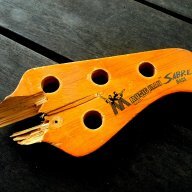
I've played Music Man sabre bass since ever and only late I began to play Fenders.
In the whole the MM Sabre is much more compact, and IMO Music Man can be considered shortscale-ish thanks to Leo Fender improvements:
- fender's full string length AND you get 21 frets (4 spots after the 12th fret).
- thanks to the 3+1 headstock configuration measured from the floor, you gain 1 inch in total length compared wit a P-bass. Also the nut is seemingly a bit closer from the body (more compact bridge maybe). Thus less weight at the end of the neck » no dive
- Someone commented SG Gibson basses have neck dive, not with EB3 slot head in my experience.
- with 78 Music Master bass, Hofner violin bass and other vitage shortscale: definitely feeling cramped, not so much on the left (neck) hand but rather on the right hand, it is more a strings spacing issue really, I feel it is a hinder for the dynamics and balance of the playing hand. I do not use pick but my guess is that narrow strings are more suitable for those who use picks.
 
First, I’m a little confused about the neck dive. Shouldn’t a short scale have less neck dive than a standard scale? Just asking. Second if neck dive is an issue you could alway try a leather strap. I bought one for one of my guitars because that was all they had. It grips my shoulder and no slippage. Just a suggestion. I too am looking for a short scale. Shoulder are getting old.
 
Now, as far as tone goes, I will say that I firmly believe that at standard tuning, a 34" scale bass has dramatically superior tone to a 30" scale bass. It's simply the nature of the beast. But YMMV.

Short-scale instruments require strings with more mass per unit length to achieve equivalent tuning at an acceptable tension (in my opinion). This means that short-scales de-emphasise the fundamental partial and exaggerate the upper harmonics, compared with a long-scale instrument.

The only other option is to run lower tensions, and that gives you floppy, unsatisfying playing feel. Again, my opinion, only. You might like that.

So why did I have Warwick's Custom Shop make me a professional-grade, bespoke short-scale instrument, at great expense?

Because I don't play that instrument in standard tuning. I play it in cello tuning (CGDA), or I play it in baritone guitar tuning (ADGC, top four strings of a 6-string bass), which is much easier to accomplish at shorter scale and doesn't compromise tone.

I'd never want a short-scale bass for standard tuning. For a low E, 34" is a must, to my taste, and for a low B, 34" actually doesn't even sound good. 36" is better for that. I tolerate 34" scale 5-strings because I honestly don't ever have a need to play below D, and I think my next 5-string will be tuned DGCFBb.
 
Try 32" medium scale...its a game changer
Sharing this to see if anyone else had a journey similar to my "love the one you're with" story.

In my head, I wanted a short-scale for long gigs. Never had one. Easy to play, light weight; what's not to love, right? Went to the music store to pick up a repair and, concerned about neck dive, decided to try on each short-scale bass with a strap. Results:
  • 2 Gibson SG basses - horrible neck dive
  • 2 Gibson LP2-style basses - horrible neck dive
  • Epiphone Allen Woody and Violin basses - good balance, but the bodies are thicker than I'm used to, so it would take some re-learning for my right arm/hand/wrist
  • 2 Fender Mustang PJ basses - horrible neck dive
  • 2 American Fender Mustang basses - neck goes to about parallel with the floor. I guess I could live with that. But as I'm jamming on the first 7 frets, I notice my left elbow touching my ribs. Never felt "cramped" before while playing bass standing up. This would require some re-learning for my left arm, plus the re-learning of the shorter scale with my left hand. I wouldn't call it annoying, but...
My conclusion was, I'm simply not going to find anything that feels as ergonomically comfortable as my current standard-scale basses. And I think I'm very happy with that and just saved myself some dough. Both my current basses are pretty light, but in the last hour of 4-hour gigs, they begged the question, could I go even lighter? I found my answer - yes, but only with tradeoffs that I'm too stubborn to make.

Anyone else follow this path when considering (or trying/buying) shorties?
Yes Switching to medium scale was a game changer for me ..faster, lighter, better thump..much easier to play...check one out..
DSCN3113.JPG
 
My Sandberg Lionel is very well balanced, both sitting and on a strap. It's super light and sounds great. Super easy to play too.

My only problem is, and maybe it's just a coincidence, but for some reason the low E string on this bass sounds great for about an hour or so and then immediately loses its clarity.

I know it's not the bass itself as it sounds perfectly balanced with a fresh set of strings on it..... At least for a while.

I've been playing bass for over 40 years and use the same brands (GHS and DR) nickel roundwounds on the short scale as I do my standards scale basses, yet the sudden death of the E string only happens on the short scale Bass.

I think it may have something to do with the shorter scale of the string and it somehow is prone to going dead faster than a long scale string???

But, I have no proof to back that up. Just a theory.

Other than having to change the strings more often than I'm used to, I love the short scale bass that I have
IMG_20200218_160500461.jpg
 
  • Like
Reactions: Dave Neal
Sharing this to see if anyone else had a journey similar to my "love the one you're with" story.

In my head, I wanted a short-scale for long gigs. Never had one. Easy to play, light weight; what's not to love, right? Went to the music store to pick up a repair and, concerned about neck dive, decided to try on each short-scale bass with a strap. Results:
  • 2 Gibson SG basses - horrible neck dive
  • 2 Gibson LP2-style basses - horrible neck dive
  • Epiphone Allen Woody and Violin basses - good balance, but the bodies are thicker than I'm used to, so it would take some re-learning for my right arm/hand/wrist
  • 2 Fender Mustang PJ basses - horrible neck dive
  • 2 American Fender Mustang basses - neck goes to about parallel with the floor. I guess I could live with that. But as I'm jamming on the first 7 frets, I notice my left elbow touching my ribs. Never felt "cramped" before while playing bass standing up. This would require some re-learning for my left arm, plus the re-learning of the shorter scale with my left hand. I wouldn't call it annoying, but...
My conclusion was, I'm simply not going to find anything that feels as ergonomically comfortable as my current standard-scale basses. And I think I'm very happy with that and just saved myself some dough. Both my current basses are pretty light, but in the last hour of 4-hour gigs, they begged the question, could I go even lighter? I found my answer - yes, but only with tradeoffs that I'm too stubborn to make.

Anyone else follow this path when considering (or trying/buying) shorties?


if your main concern is weight, and ballance - try some headless. i use hohner jack(s) for gigs, since 1995. (4, and 5 string). - neck goes however you want - ballance is exactly in your body axis - so, if you prefer it parallel with floor - it's possible, if you want neck go up, and body in front your balls :) -it's possible either.
jftr: longest gig i had was almost 11 hours, NO pause/break. -we started at 23 00'h, and finished at 09 45'next day... 1993.year...
edit: using hardwood precision... :( :(
:) :)
 
I have three Danelectro 59 short horn bass guitars in our arsenal (Black & White, Black Sparkle, and Silver Sparkle), all '90's Korean reissues, purchased cheap, and they're my go to for light work. The original Danelectro bass guitars from the ‘60’s are all 30” short scale instruments, but these Danelectro 59 reissues have long scale necks, which are about the same scale as my ‘51 P-Bass. The reissue Dan-O’s sound great, they have a fast action, balance is ok, maybe heavy to some, but over all not very heavy on the shoulder for long gigs, plus you can really work the neck. The only thing I did was replacing the wood bridge with an adjustable. Lastly, one of my students needed a short scale bass, so off to Guitar Center to see what was on the wall. After playing everything in his wheelhouse, and budget, we landed on the Gretsch Guitars G2220 Electromatic Junior Jet Bass II Short-Scale Bass Walnut Stain. Nice bass, has balls, and fit the bill in all departments.
 
The best advice I can give is getting hands on a headless bass. I have had mine for more than 25 years and have no intetions of replacing it. It has a 34” scale. Furthermore it has an excellent tuning stability, but primarily the ergonomic properties are exquisite. Hang it around your neck and it stays there, no “neck diving”, no left hand support, just use your fingers for playing only.
 
My Sandberg Lionel is very well balanced, both sitting and on a strap. It's super light and sounds great. Super easy to play too.

My only problem is, and maybe it's just a coincidence, but for some reason the low E string on this bass sounds great for about an hour or so and then immediately loses its clarity.

I know it's not the bass itself as it sounds perfectly balanced with a fresh set of strings on it..... At least for a while.

I've been playing bass for over 40 years and use the same brands (GHS and DR) nickel roundwounds on the short scale as I do my standards scale basses, yet the sudden death of the E string only happens on the short scale Bass.

I think it may have something to do with the shorter scale of the string and it somehow is prone to going dead faster than a long scale string???

But, I have no proof to back that up. Just a theory.

Other than having to change the strings more often than I'm used to, I love the short scale bass that I haveView attachment 3993974
I have the suspicion you cut your strings before mountin bthem in the pegs - - -
 

Latest posts