• TalkBass has been independent since 1998. Add your voice.
    Create a free account to reply to discussions, view embedded media, and browse with fewer display ads.
    Join freeLog in
    Want zero display ads or expanded classifieds tools? Compare plans.

Show Me Your Bypass Loopers... Please?

Well, this was perfect timing for me. I was about to post a topic about this very set of questions to see what others were doing on their pedal setups. I just came to the conclusion for myself that I will be essentially isolating the real noise generating pedals in my setup. Speaking of which I will give a little overview, I am still waiting on some parts/pieces (also note that I play guitar as well, so my board config needs to pull double duty for bass and guitar):

Pedals:
TC Electronic Polytune2 Mini
TC Electronic SpectraComp
XTS Atomic Overdrive
ZVex Fuzz Factory 7
TC Electronic Croma Chorus Mini
TC Electronic Vortex Flanger Mini
TC Electronic Flashback Delay
Eventide H9 Max
Eventide H9 Core (but upgraded to Max since I own one)
TC Electronic Sentry Noise Gate
Morley Mini Volume
Ernie Ball 25k VP Jr Volume/Expression

Switchers:
Boss ES-8
G-Lab M4L (4 x midi controlled loops)

After a lot of consideration, I have decided to put my OD and Fuzz pedals onto the M4L which is connected to the ES-8 on one of the loops via the effects loop on the Sentry Noise Gate. This also gives me the room I wanted to put in a more clean/pure overdrive (as opposed to just the colored Atomic Overdrive). The ordering within the overdrives/fuzz pedals does not need to really be changed (i.e. I will have the clean overdrive first in the circuit, then the more dirty overdrive, followed last by fuzz). And I can not think of any reason to do it differently which results in any kind of useful sound when enabling multiple of this type of pedal (possibly the only exception being a parallel loop with a blending two of the pedals, but I have never needed that before...). As such, isolating the noisy pedals onto its own little group all of which are protected behind a very good noise gate to take care of any buzz (especially from some of the Fuzz Factory 7 settings), I feel I have a much better signal path throughout the system. And with the midi functionality of the ES-8 combined with the M4L, I can still control exactly which overdrives/fuzz are on or off at the push of a single switch.

I think the only other pedal I want to add (other than the previously mentioned clean overdrive) would be a Strymon Big Sky, since there is almost always some kind of reverb that enhances just about everything, and that free's up one of the H9's from always being used to pull that duty. Sorry no pics yet, as I am waiting on the M4L as well as a pedal board to put these all on (I have a PedalPad on order and then have the fun task of placing/measuring/cutting/heatshrinking/soldering custom length patch cables...).

Lots of digital pedals in that list, how are you powering it all? I've found that some can be managed on a daisy chain while others get horrendous noise if not on an isolated outlet

 
@BrianVengeance RE Super8

May I ask a personal question? Maybe a few?

What size are your feet?
Any problems hitting three buttons at a time? How about on the Super8, same question?
Did you build it yourself or buy it pre-fabbed?
If DIY, any helpful "Caveats" for me to watch out for when I build mine?

You say it's a "sweet little beast" so I'm guessin' no problemo with the way it works.

Can't wait to build mine, but have to wait! No time at the moment, too much other stuff on the boil. I'm thinking I'll divvy up the loops for subsets of pedal types, so for example all my Overdrives will be in one channel of the Super 8, Modulation another...

No worries about the questions, happy to help. I typically run 11-12US in a sneaker and you have to kinda come at it from an angle to get all three buttons, but it's not that awkward once you get the hang of it. It's actually easier to get three on the Super 8 for me than on my pedals, but 5/8 are side jacked and need the spread for cabling.

The controls are actually really intuitive once you read up on them, and I have to give it to BYOC for getting that much functionality out of so few buttons. It's a well executed and elegant design.

I built my kit and the only real advice I can offer is to take your time and make sure it is fully tested before stuffing the chassis, as it's a pretty tight fit. Not the most exciting build, but not terribly difficult. I also sprung for the painted chassis and it's really nice looking.

The only real peeve I have is that some of my pedals have obnoxiously bright LEDs and they're always on with a looper. It's a minor complaint, but it does make knob twiddling annoying and can mess with your if you glance down while playing.
 
Lots of digital pedals in that list, how are you powering it all? I've found that some can be managed on a daisy chain while others get horrendous noise if not on an isolated outlet

I have a Voodoo Lab Mondo. Takes care of everything right now. As I said, I don't have the M4L yet, so I will need to power it still. The Mondo has a normal outlet that is limited to another 200 Watts (which can power a LOT of things given even some of the most power hungry pedals only use about 3.6 watts (400mA@9V)), which I can use for a small power strip and get the M4L and possibly shift an H9 or two from the DC connections of the Mondo to make room for anything new like another OD or the Big Sky.
 
Last edited:
  • Like
Reactions: TheEmptyCell
Started building my own for a new big board. 5 loops, plus I'm building an external feedback controller that will plug into it.
 

Attachments

  • looper1.jpg
    looper1.jpg
    49.9 KB · Views: 98
  • looper2.jpg
    looper2.jpg
    56.7 KB · Views: 87
Started building my own for a new big board. 5 loops, plus I'm building an external feedback controller that will plug into it.
I seriously considered doing that myself until I saw about the ES-8 and knew that was the direction I wanted to go. I had bought a small programmable controller that I had considered using, a Teensy 3.2 Arduino compatible programmable controller (USB compatible and even MIDI compatible). But I didn't have the time or stamina to write a user interface to allow me to program the switcher like the ES-8 has, which ultimately swayed my decision to simply buy the ES-8.

I have too many half finished projects as it is, and didn't want the pedal board to be yet another one.
 
I seriously considered doing that myself until I saw about the ES-8 and knew that was the direction I wanted to go. I had bought a small programmable controller that I had considered using, a Teensy 3.2 Arduino compatible programmable controller (USB compatible and even MIDI compatible). But I didn't have the time or stamina to write a user interface to allow me to program the switcher like the ES-8 has, which ultimately swayed my decision to simply buy the ES-8.

I have too many half finished projects as it is, and didn't want the pedal board to be yet another one.

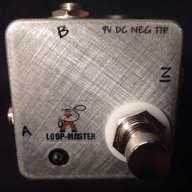
I hear you, my workbench is ridiculous right now with the open projects I'm "about to finish". Maybe my use of "controller" was too generous here. My build is 100% passive minus the power for LEDs. I wanted to combine a feedback circuit to my build and originally planned for 4 loops and a feedback switch; but I decided I could really use a 5th loop in the box. So instead of cramping six switches I made a small 1590a-enclosed pot and momentary switch that i can connect externally to create and control feedback. (It's in the top left of the pictures).
 
The Flooper is way cool Jumblemind, I'll be building one soon. I've got the enclosure, wire, just picked up the jacks, but still need a switch. Oh, and a solder iron would be great too. I'll combine it with an anti-stutter switch, too — ie it only passes signal when it's pressed as opposed to stutter switches that cut the signal off when pressed.


No worries about the questions, happy to help. I typically run 11-12US in a sneaker and you have to kinda come at it from an angle to get all three buttons, but it's not that awkward once you get the hang of it. It's actually easier to get three on the Super 8 for me than on my pedals, but 5/8 are side jacked and need the spread for cabling.

The controls are actually really intuitive once you read up on them, and I have to give it to BYOC for getting that much functionality out of so few buttons. It's a well executed and elegant design.

I built my kit and the only real advice I can offer is to take your time and make sure it is fully tested before stuffing the chassis, as it's a pretty tight fit. Not the most exciting build, but not terribly difficult. I also sprung for the painted chassis and it's really nice looking.

The only real peeve I have is that some of my pedals have obnoxiously bright LEDs and they're always on with a looper. It's a minor complaint, but it does make knob twiddling annoying and can mess with your if you glance down while playing.

Thanks for the tips! Here's something for those overly-bright LEDs — nail polish. A little dab'll do you. Opaque or semi-transparent, cover the dome of the LED so it shines only to the sides.
 
pedalboard_mar31_16.jpg


Up to date shot:

Dingwall's > tuner > comp > Whammy > loopmaster:

Loop 1: Octabvre
Loop 2 (OD): Fifth Gear > Barbershop
Loop 3 (Furrzz): DIY Green Russian Muff> DIY GGG Brassmaster
Loop 4 (filter-mod): Manta > Lunar > MS70CDR

Loopmaster OUT > Fdeck HPF (under the board) > DL8 > amp

The loop is making it so much easier to get my effects set to unity gain. I can keep the pedal on and just hit the bypass on the Loopmaster to make sure I'm not going way over my clean volume.
 
Awesome board!

What's in the Small Bear (?) enclosure (right of the fifth gear)? While I'm asking, what's the pedal to the left of the Smoothie?

Cheers,
FF

The black box is my Muff. Madbean Mudbunny PCB with a 3-way switch for flat/stock/boosted mids (I just keep it set on the boost setting).

The Small Bear Box 2 is the GGG Brassmaster with a giant 8mm violet LED with a TH Custom 3PDT daughter board that's got a trimmer for the LED brightness.
 
Okay, next question: Which Bare Box is it? Looks to be a #2.

Is there room for mounting the switches on the slope that separates the stomp area from the knobs area? I've looked at the dimensions, it's about 1cm of space there, looks like the switches might fit.

From what I gather on the Small Bear site, the #1 comes pre-drilled for the single central stomp and I/O side jacks (which alas neither feature I want — I want Top-Mount jacks & two stomps).


Sorry for the thread derail. To try to appease, here's a looper of sorts I found on Small Bear's site (alas, not a bypass looper, rather an answering-machine modded to phrase-looper)...

Small Bear Loopster

Interior.jpg


I'd seen these answer-machine kits and thought immediately "could hack that into a looper." And so it's been done!
 
  • Like
Reactions: TheEmptyCell
Okay, next question: Which Bare Box is it? Looks to be a #2.

Is there room for mounting the switches on the slope that separates the stomp area from the knobs area? I've looked at the dimensions, it's about 1cm of space there, looks like the switches might fit.

From what I gather on the Small Bear site, the #1 comes pre-drilled for the single central stomp and I/O side jacks (which alas neither feature I want — I want Top-Mount jacks & two stomps).


Sorry for the thread derail. To try to appease, here's a looper of sorts I found on Small Bear's site (alas, not a bypass looper, rather an answering-machine modded to phrase-looper)...

Small Bear Loopster

Interior.jpg


I'd seen these answer-machine kits and thought immediately "could hack that into a looper." And so it's been done!
Yes, it's the #2. I think you could mount switches on the slope. Drilling that might be difficult though.

Pretty sure top jacks would work if you don't have a ton of pots/ switches on the lower shelf (where the hardware on my Brassmaster is mounted).
 
Well, I got my Loopmaster!

Unfortunately, I had to make some adjustments, which means the board's not quite as full as I thought it was going to be, lol! For some reason , the ABY box is much bigger than I anticipated. He sent me the specs, it just didn't register in my tiny, bass player brain. So we went from this:

20160324_212421_zpsit9pecuy.jpg


To this:

20160404_105547_zpsqhzdzqsj.jpg


Not a huge change, but because of the size of the ABY box, I had to sacrifice the I.E. QF2. That turned out to be a bit of a blessing, since I actually didn't have an outlet on the power supplies for the QF2 and the Broughton L/HPF that'll be here Wednesday(going in that empty spot on the top row). So, it'll go like this-

Valenti->Shure wireless->ABY box
ABY Always-on tuner out->Turbo Tuner
ABY "A"->POG2->Holy Fire 9->Blackstar Guitar combo amp
ABY "B"->Loopmaster 7-Loop switcher
Loop 1->T-16
Loop 2->Future Impact
Loop 3->Grizzly Bass
Loop 4->Grand Orbiter->Polytope
Loop 5->Nimbus
Loop 6->Xerograph Deluxe
Loop 7->will be for patching satellite board into this board as needed
Out of switcher->into Broughton L/HPF-Cali76 CB

The fight is on between the POG2 and the Pitchfork. I could save a bunch of space switching to the PF, so we'll see...

I'm pleased. It sounds good and it's dead quiet. Thinking about adding a buffer, but I'm not 100% on that.
 
Last edited:
View attachment 791565 I group pedals in loops in the order I prefer them. Line selector (used to select bass), tuner, boost and HPF (under board) before the looper, then loops of 1) filter/octave 2) compressor/Fairfield Barbershop (both always on, but I want these after the filter and octave), 3) overdrive, distortion and fuzz, 4) phase shifter, chorus and reverb, and 5) volume (I prefer this out of the signal chain when not in use). I pre-select the pedals in each loop so I can easily add then during songs with the looper.

Wow