Can you tell us/me more about the difference between Belle and ODR mini, please?Just tried out the Belle in place of the ODR-mini, and I like it a lot - having the optional switch to lower the amount of compression in the circuit is great.

Enjoy the benefits of a premium membership!
Upgrade Account
-
TalkBass has been independent since 1998. Add your voice.
Create a free account to reply to discussions, view embedded media, and browse with fewer display ads.
Join free Log in
Want zero display ads or expanded classifieds tools? Compare plans.
You are using an out of date browser. It may not display this or other websites correctly.
You should upgrade or use an alternative browser.
You should upgrade or use an alternative browser.
Show me your compact pedalboard setup
- Thread starter garmenteros
- Start date
More options
Who Replied?
@Zbysek I didn't get to spend a lot of time putting them head to head as we were getting ready for a show this week. From the little time I had them A/B'd I noticed this - the ODR-mini tends to have a creamier texture of drive, and a particular snort that I wasn't able to (quickly) dial in on the Belle. The Color knobs behave just a little differently, and on that, I think I prefer the Color on the ODR.
The ODR also has a ton of compression once you hit a certain threshold of gain - if you boost into it, the texture of the drive changes without getting significantly louder. Not saying it's good or bad, but it wasn't what I expected at first, and could be a useful behavior to exploit. The Belle has a switch to change the clipping circuit so that it doesn't compress as much so you get the harder drive and the volume boost. I think the Belle will also do that, but I didn't mess around with settings long enough to compare that setting.
The other thing the Belle has is the Bass control. I think it's more of a cut than a boost. The Color knob (on both pedals) extends or cuts BOTH the highs and lows. Using the Bass control with the Color knob allows you a little more fine control with dialing in your sound - at 'low Color' settings you can add back a bit of low end, and in 'high Color' settings you can pull just a bit of low out so it's not overwhelming. I liked this to be able to pull back just a touch of highs with the Color, and retain the 'max lows' with the Bass control.
The next thing I'm going to try is re-ordering my drives to see if I can get them to stack in a way I like.
The ODR also has a ton of compression once you hit a certain threshold of gain - if you boost into it, the texture of the drive changes without getting significantly louder. Not saying it's good or bad, but it wasn't what I expected at first, and could be a useful behavior to exploit. The Belle has a switch to change the clipping circuit so that it doesn't compress as much so you get the harder drive and the volume boost. I think the Belle will also do that, but I didn't mess around with settings long enough to compare that setting.
The other thing the Belle has is the Bass control. I think it's more of a cut than a boost. The Color knob (on both pedals) extends or cuts BOTH the highs and lows. Using the Bass control with the Color knob allows you a little more fine control with dialing in your sound - at 'low Color' settings you can add back a bit of low end, and in 'high Color' settings you can pull just a bit of low out so it's not overwhelming. I liked this to be able to pull back just a touch of highs with the Color, and retain the 'max lows' with the Bass control.
The next thing I'm going to try is re-ordering my drives to see if I can get them to stack in a way I like.

Thank you for the thorough response...
That's exactly what I find usefull about ODR (mini): the ability to change the saturation by boosting the signal entering the pedal without significant change in volume level...@Zbysek The ODR also has a ton of compression once you hit a certain threshold of gain - if you boost into it, the texture of the drive changes without getting significantly louder. Not saying it's good or bad, but it wasn't what I expected at first, and could be a useful behavior

No idea what version of my mini board I am up to, but here it is.
Back to my slightly larger home made Nano (10mm wider and deeper) from a RB Duo 2.0
Signal chain is Pure Boost - Tuner - mThump (underneath) - Loop box with Oct/OD/Wah in the loop - Comp - Chorus - Tonex One - SB2 DI - Modele B.
Modele B will be a gain stage only for my Powered cab/stage monitor, hence being after the DI.
Just put the Pure Boost and Tonex on the board, then had to get to work. Will get to try it tomorrow. Power is all daisy chained. Tried it without the Tonex earlier in the week and it was quiet - hopefully that is still the case. If not, plan B is to run the Tonex from the battery and everything else from a one spot, until I can work out if there is a power supply that will fit under the board and be suitable. I am not hopeful.
Planning on put a clean and dirty amp sim in the Tonex one. If I am happy with that the Obsessive OD might get switched out for a Mosky Black Rat, or Crazy Tone, something a bit fuzzier for synth tones. Has to be a Mosky pedal to fit this board.
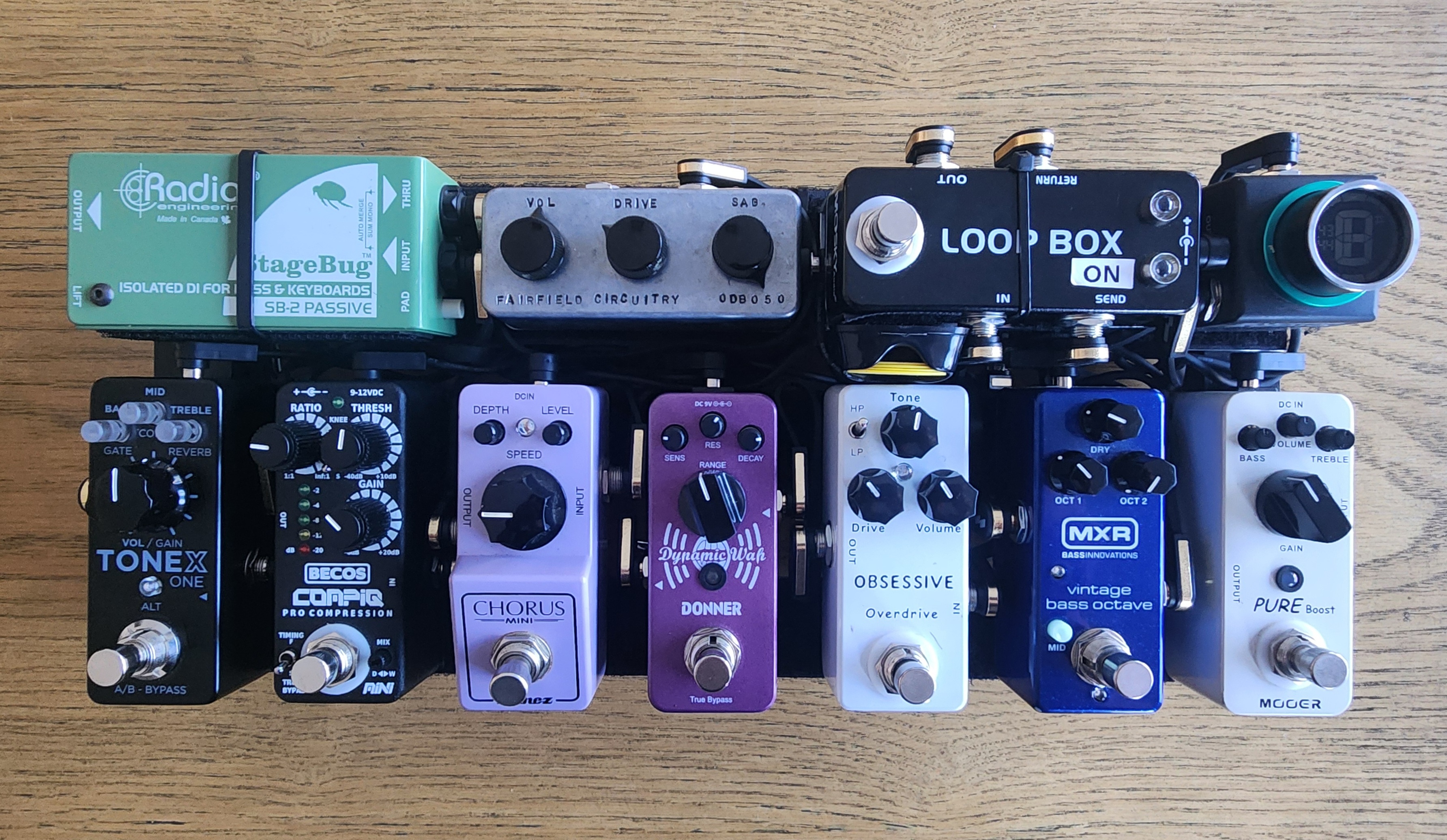
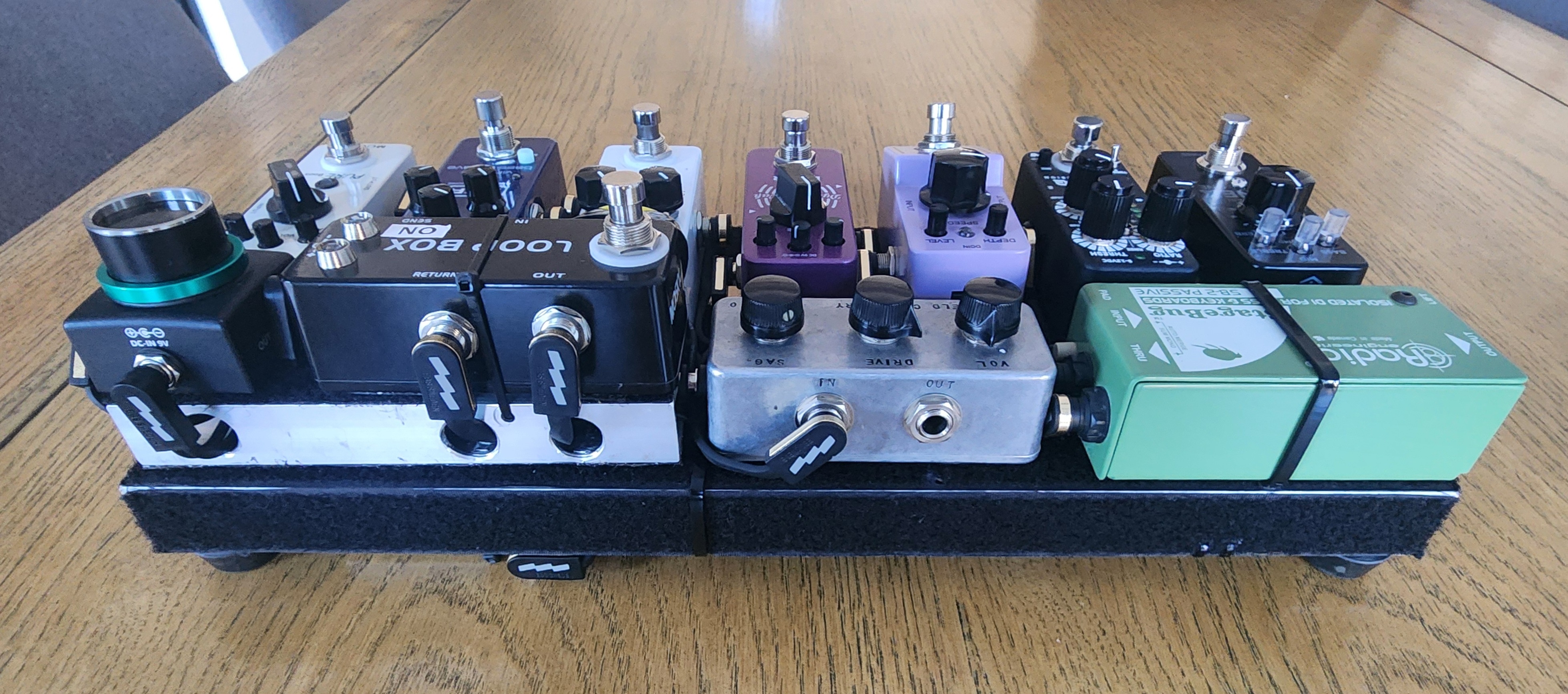
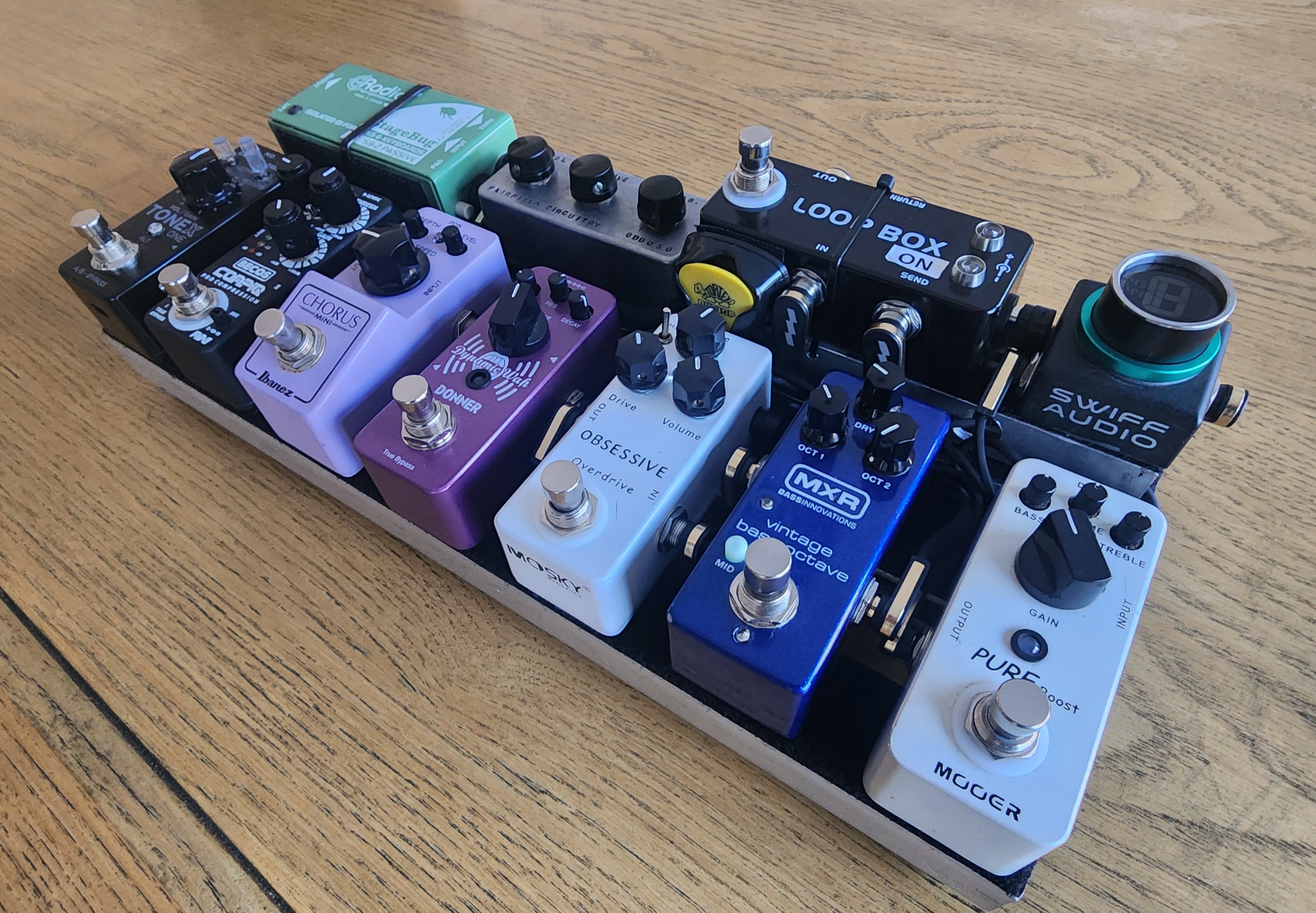
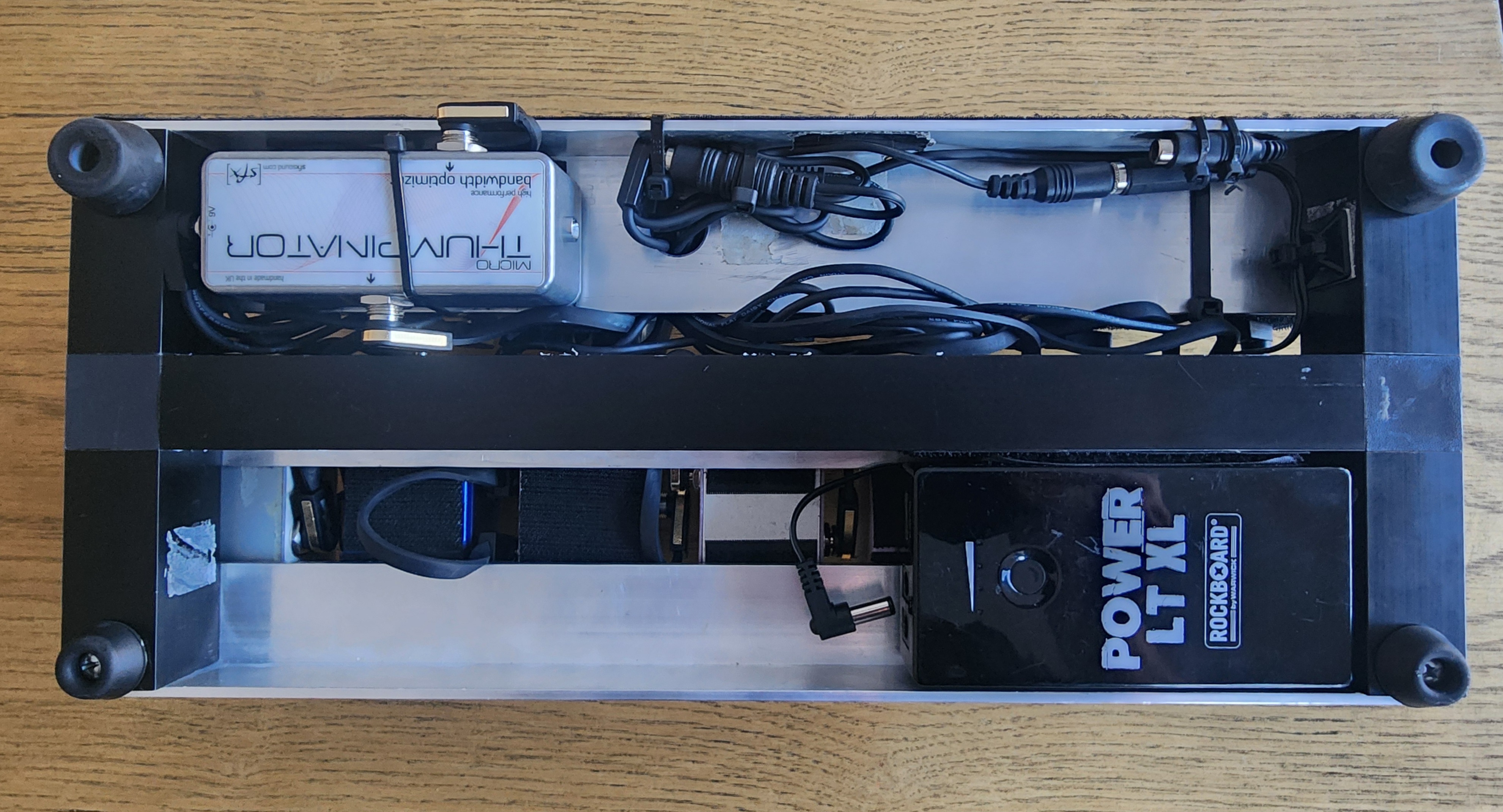
Back to my slightly larger home made Nano (10mm wider and deeper) from a RB Duo 2.0
Signal chain is Pure Boost - Tuner - mThump (underneath) - Loop box with Oct/OD/Wah in the loop - Comp - Chorus - Tonex One - SB2 DI - Modele B.
Modele B will be a gain stage only for my Powered cab/stage monitor, hence being after the DI.
Just put the Pure Boost and Tonex on the board, then had to get to work. Will get to try it tomorrow. Power is all daisy chained. Tried it without the Tonex earlier in the week and it was quiet - hopefully that is still the case. If not, plan B is to run the Tonex from the battery and everything else from a one spot, until I can work out if there is a power supply that will fit under the board and be suitable. I am not hopeful.
Planning on put a clean and dirty amp sim in the Tonex one. If I am happy with that the Obsessive OD might get switched out for a Mosky Black Rat, or Crazy Tone, something a bit fuzzier for synth tones. Has to be a Mosky pedal to fit this board.

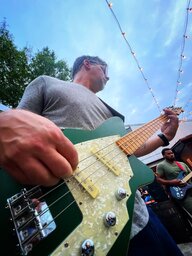
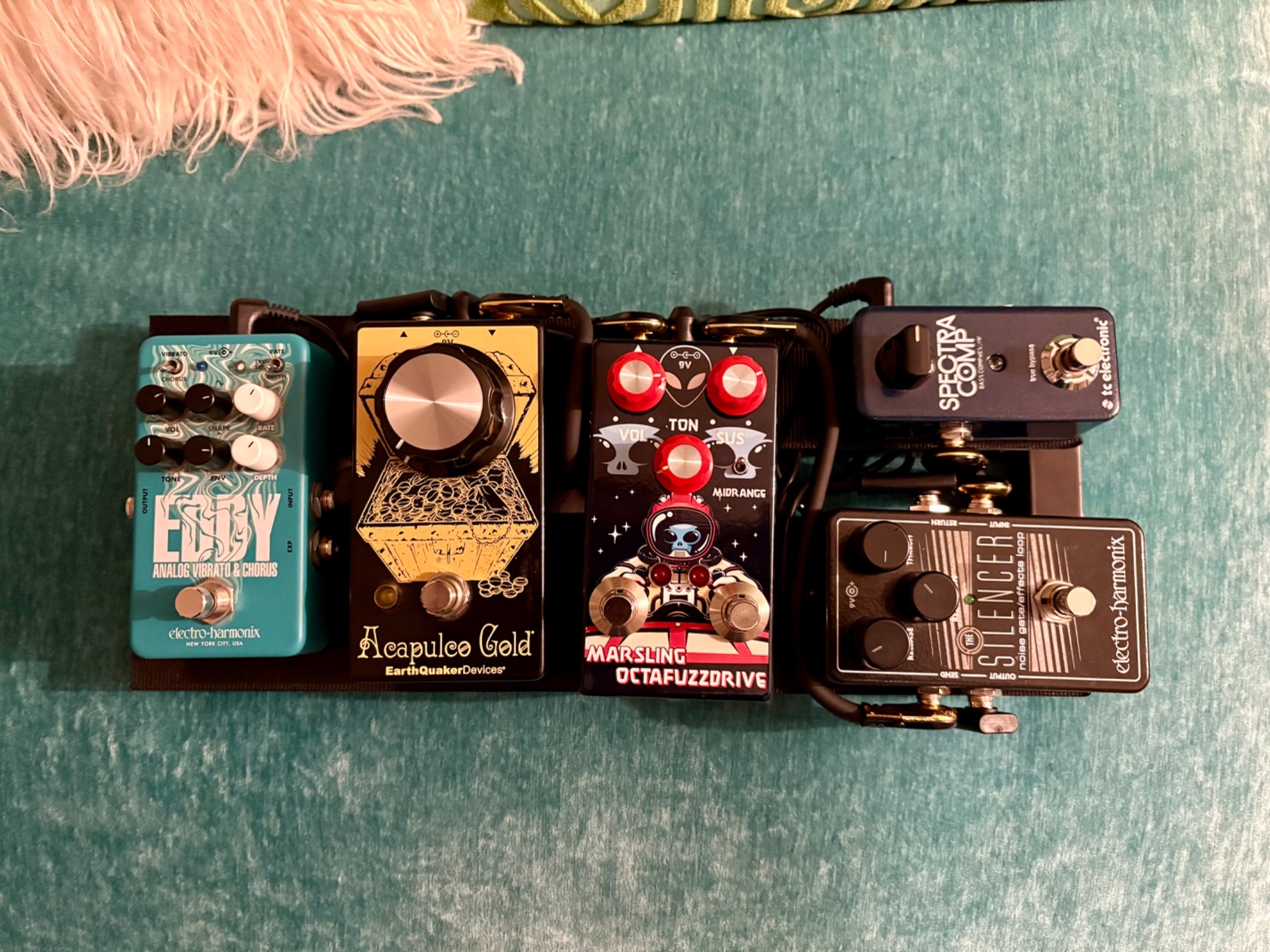
For today's cover performance
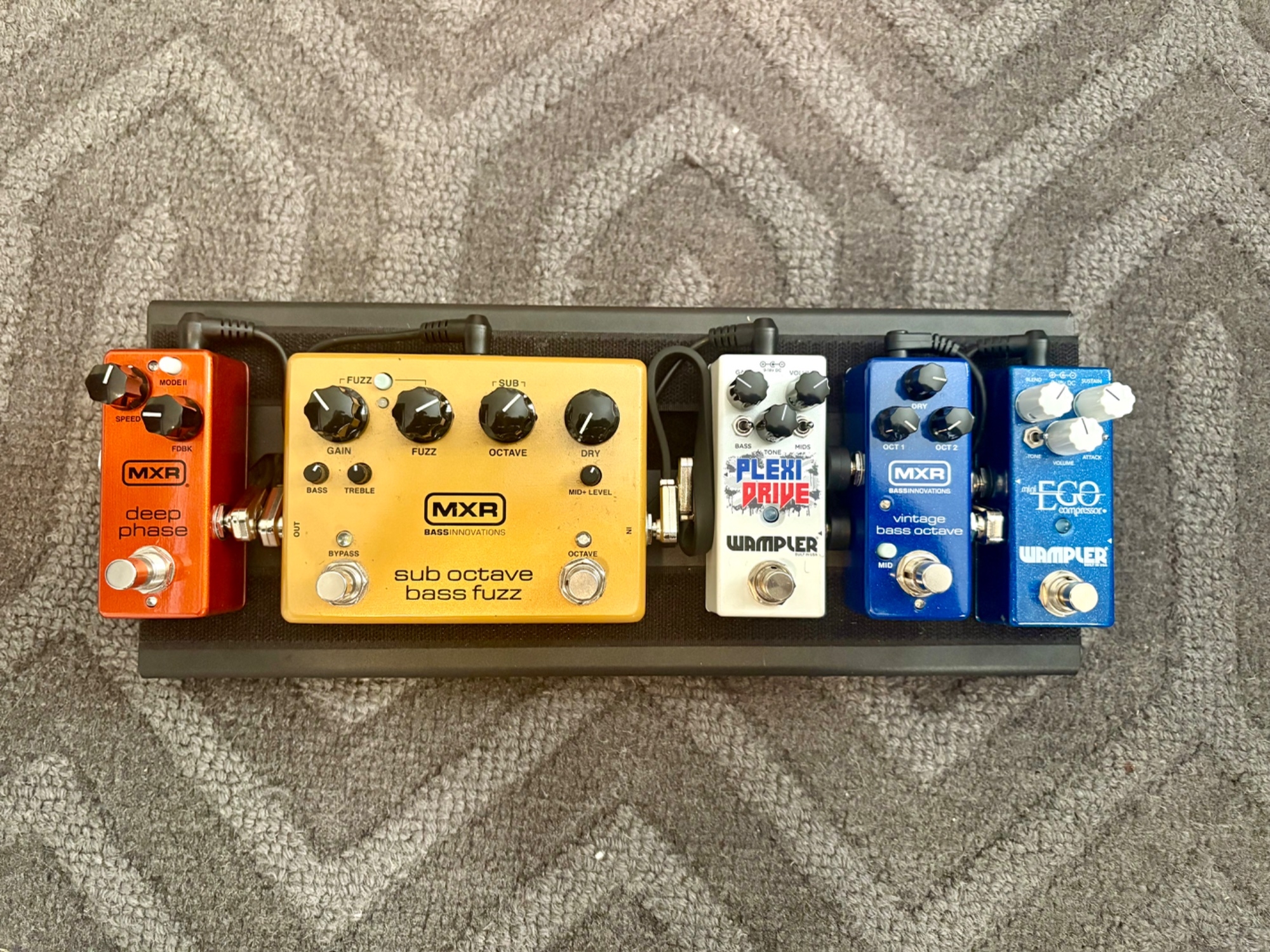
Here’s a new configuration after breaking apart a couple of boards and getting rid of some things. The octave side of the gold MXR is glitching so I’m using it as fuzz only.
Got to take this to rehearsal today. I am really digging the tone of the first pre-set I made on this thing. Gonna work on some more tones.

I recently acquired a UA Apollo interface for my home setup so yesterday I took some time to rebuild my pedalboard. I removed my SGT-DI (moved that to the smaller board that I keep at work) and added a Barber Linden EQ. I also switched out the UA LA-2A for a UA Max for greater versatility:
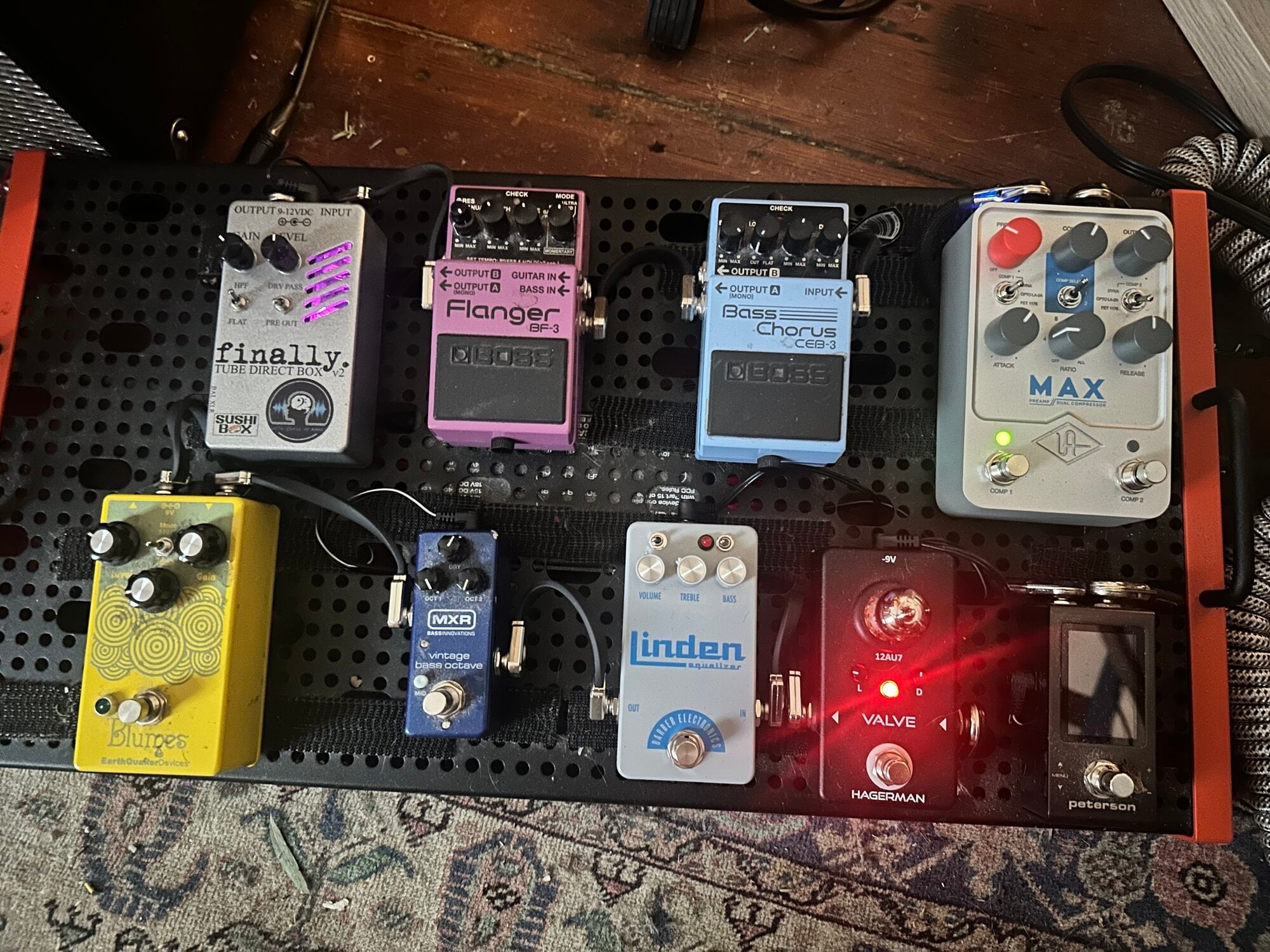
Everything is mounted on a Temple Duo 24 and powered by a Cioks DC-7 underneath. The signal comes in and leaves the board through a Temple 1/4 mod on the right side. Path is Strobostomp > Max > @Jim Hagerman Valve ‘25 edition > Linden > MXR VBO > Earthquaker Blumes > Boss CEB 2 > Boss BF 3 > @Sushi Box FX Finally V2.
When playing into an amp, saturation comes from the 610 preamp in the Max and the tube pedals, and dirt from the Blumes.
When playing into the Apollo I keep the tubes in the chain and usually play into a recreation of a UA or Neve channel strip.
Everything is mounted on a Temple Duo 24 and powered by a Cioks DC-7 underneath. The signal comes in and leaves the board through a Temple 1/4 mod on the right side. Path is Strobostomp > Max > @Jim Hagerman Valve ‘25 edition > Linden > MXR VBO > Earthquaker Blumes > Boss CEB 2 > Boss BF 3 > @Sushi Box FX Finally V2.
When playing into an amp, saturation comes from the 610 preamp in the Max and the tube pedals, and dirt from the Blumes.
When playing into the Apollo I keep the tubes in the chain and usually play into a recreation of a UA or Neve channel strip.
And here is my smaller board, which lives at my office:I recently acquired a UA Apollo interface for my home setup so yesterday I took some time to rebuild my pedalboard. I removed my SGT-DI (moved that to the smaller board that I keep at work) and added a Barber Linden EQ. I also switched out the UA LA-2A for a UA Max for greater versatility:
View attachment 7212547
Everything is mounted on a Temple Duo 24 and powered by a Cioks DC-7 underneath. The signal comes in and leaves the board through a Temple 1/4 mod on the right side. Path is Strobostomp > Max > @Jim Hagerman Valve ‘25 edition > Linden > MXR VBO > Earthquaker Blumes > Boss CEB 2 > Boss BF 3 > @Sushi Box FX Finally V2.
When playing into an amp, saturation comes from the 610 preamp in the Max and the tube pedals, and dirt from the Blumes.
When playing into the Apollo I keep the tubes in the chain and usually play into a recreation of a UA or Neve channel strip.
This is built on a D’Addario xpnd and is powered by a Cioks Sol. Signal path is right to left as the pedals are arranged, and flows into a Focusrite interface.
No I’ve had it for a while, did a NPD post about it when I got it. I like it very much, super musical and squishy, which is what I was looking for.is the Teletronix a recent purchase because of this month’s UAFX sale? How do you like it?
Trying to use extra pedals/amuse myself. When things go sideways.. 
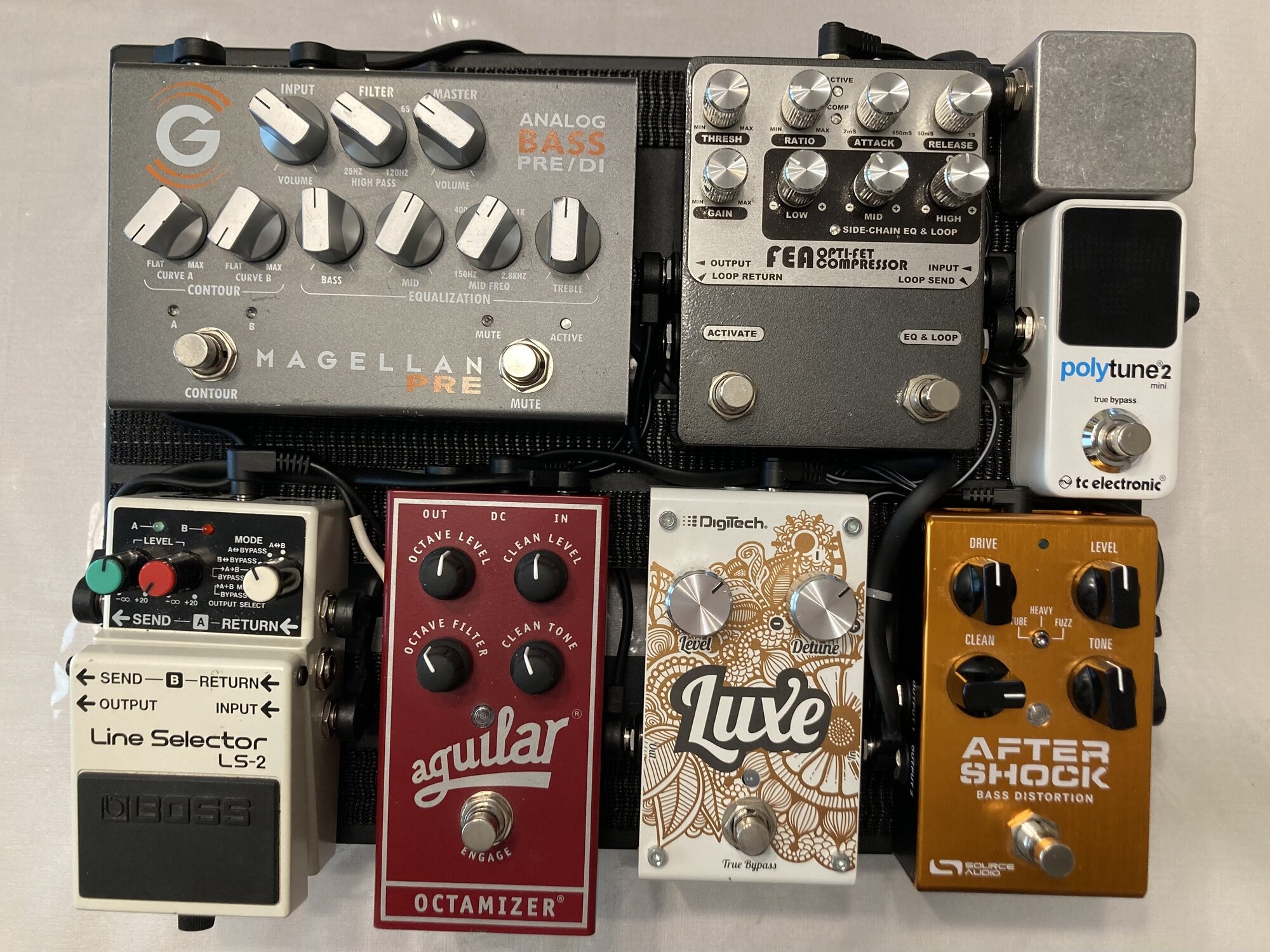
This is my latest pedalboard for a rock/Americana 4-piece band. I'm loving the FEA Opti-Fet compressor!

Hey everyone,
Just wanted to share my current pedalboard setup, built for blues, rock, synth layers and classic heavy grooves. I mainly play a Guild Starfire II Bass and a Rickenbacker 4003W – the Rick is modded with a Nordstrand Nordenbocker pickup in the neck position.
Signal Chain:
Blender Setup:
The blend is set around 50%, which keeps the low end intact while layering in the synth fuzz tone. Octaver + Fuzz in parallel = thick and punchy.
If anyone runs a similar setup or has questions or suggestions, I’d love to hear it! Happy to exchange ideas.
Just wanted to share my current pedalboard setup, built for blues, rock, synth layers and classic heavy grooves. I mainly play a Guild Starfire II Bass and a Rickenbacker 4003W – the Rick is modded with a Nordstrand Nordenbocker pickup in the neck position.
Signal Chain:
- TC Electronic Polytune –
- SHM OTC-201 Compressor – parallel compression, super transparent
- Crazy Tube Circuits Locomotive – tube-style overdrive for classic rock tones
- FTelettronica Looper/Blender
→ Loop contains:- Markbass Octaver Raw
- Walrus Audio Silt Fuzz
(used for synth-style textures à la Muse or Royal Blood)
- Orange Bass Butler Preamp/DI
Blender Setup:
The blend is set around 50%, which keeps the low end intact while layering in the synth fuzz tone. Octaver + Fuzz in parallel = thick and punchy.
If anyone runs a similar setup or has questions or suggestions, I’d love to hear it! Happy to exchange ideas.
Attachments


Updated my pedalboard. Switched out the CAPO for the JHS Colour Box V2 10th anniversary and added the Super Vintage. I’m loving the tones - really happy with this setup.
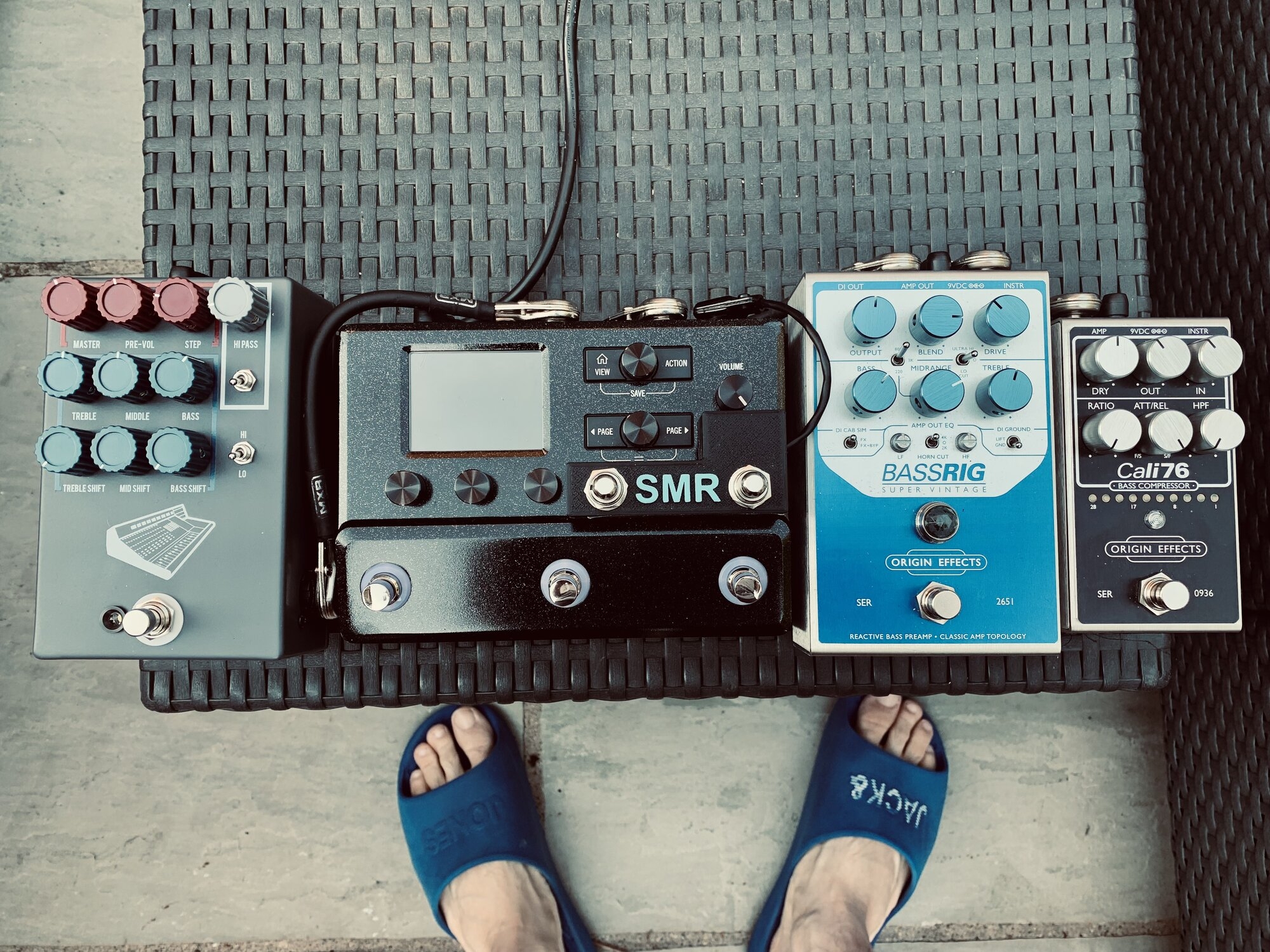



Tel us more about the Diplomat. I have never seen this one...
The board looks so huge! (compared to your feet)Updated my pedalboard. Switched out the CAPO for the JHS Colour Box V2 10th anniversary and added the Super Vintage. I’m loving the tones - really happy with this setup.
View attachment 7216020


