
Enjoy the benefits of a premium membership!
Upgrade Account
-
TalkBass has been independent since 1998. Add your voice.
Create a free account to reply to discussions, view embedded media, and browse with fewer display ads.
Join free Log in
Want zero display ads or expanded classifieds tools? Compare plans.
You are using an out of date browser. It may not display this or other websites correctly.
You should upgrade or use an alternative browser.
You should upgrade or use an alternative browser.
Show us your 3 pickup basses!
- Thread starter Doner Designs
- Start date
More options
Who Replied?

bruce bennett
Commercial User
- Sep 8, 2009
- 73
- 33
- Disclosures
- Owner and Luther for Hard Road guitars
Oh, like you've never been a jackass? or used sarcasm? Or ranted about the same thing over the course of several months?
I think you are missing part of the big picture here. If you and bruce bennett want to calculate nodes 'til the cows come home, knock yourselves out. But it wasn't fourstringbliss's idea "to work through pickup placement by dividing up his scale", you freaked him into it. "and my thought was to put the third pup exactly between the other two. Reading your post I'm rethinking that."
Which I suppose would be fine if there was something more than opinion and theorizing to back it up, but there isn't. It's just your opinion. Which makes it no better than my opinion.* Which makes it both ironic and hypocritical that you would get upset with me for sharing my opinion after two pages of sharing your opinion.
Interesting that you "agree that a little here or a little there when positioning the pickups won't really make much of an audible difference". That's been my whole point all along.
*The corollary to the idea that placing a pickup at an open-string harmonic is advantageous, is that placing a pickup anywhere else is disadvantageous. So as much as you are miffed at my argument that says you are incorrect, realize you are saying the same thing about me.
Unless... If you think it is somehow advantageous to put a pickup at a harmonic, but that it's not disadvantageous to place it somewhere else, I'd really like to know your reasoning.
And I'd still like to know what advantage the harmonic placement has when a person is playing something besides an open string. I need something more than "people like Entwhistle often play open strings between the fretted notes."
If you don't think that's a legitimate question, say so. Then say why.
You want me to relax? put the torch down? live with it? Just chill, yourself. And while you're telling me how I'm talking down to people, be careful not to fall off your horse.
Oh yeah.
I apologize for answering this at such a late point in the thread. but I do see a point here that needs to be made.
I think Blue Talon might be coming at this idea from an incorrect perspective.. it sounds like folks are only thinking that by calculating the harmonic positions inside the pickup area, or that the idea is to place the pickup only under a harmonic point for the best tone.. but that is not the only reasons for locating these points.
Calculating harmonic or nodal points is not about the scale length of the string.. Its about finding the spots where the strings vibrating "width" will produce the right phasing across the magnets of the pickups.
its the reason why a strat "quacks" in the 2nd and 4th positions. the magnetic/mechanical phaseing of the middle pickup is such that you end up with this residual "out of phase" tone when you combine any two pickups on either side the middle..
there are 3 types of phase happening on any stringed instrument.
Electrical: most folks get this one right away. and even though this is way over simplified .. its easiest to describe this in terms of reversing the polarity on the pickups coil connections..
Magnetic: obviously you can flip your magnets to have the North poles up or South poles up OR as in the case of Vintage Supro pickups have the poles running Horizontal to the strings. as opposed to vertical as found in most common pickup designs.
Mechanical: too many people believe this only just refers to the physical location of the pickup along the strings vibrating length. BUT this ALSO refers to the vibrating "ACTION" of the string itself.
IF you could look at a vibrating string from a cross sectional view, you can see it tends to vibrate in a figure 8 pattern. with the center of the figure 8 actually being the normal "resting point" of the string. ) there are some great high speed videos of guitar string vibration in slow motion on you tube so you can see this action for yourself)
IT ALSO vibrates in a WAVE LIKE motion along it entire LENGTH, at the same time.. not unlike the wave form shown on an O-scope with portions of the string being to the left of rest point and portions being on the right of rest point again at the same time... and these will change many times per second during the vibration event. which if you think carefully about this, you can see that a sort of "snake like" motion is happening both from a top looking down, as well as from a cross sectional view.. and there are points on the string that actually DON'T MOVE MUCH during the event.. Now that would clearly be a location that you might NOT want to place a pickup, simply because the strings action would be too small to disturb the pickups magnetic field enough to produce a strong output signal.
So the issues of pickup placement come into play when you have all 3 of these phasing variants begin to overlap each other in a multiple pickup systems.
I will stop here as this is more than enough to open a good discussion.
Last edited:
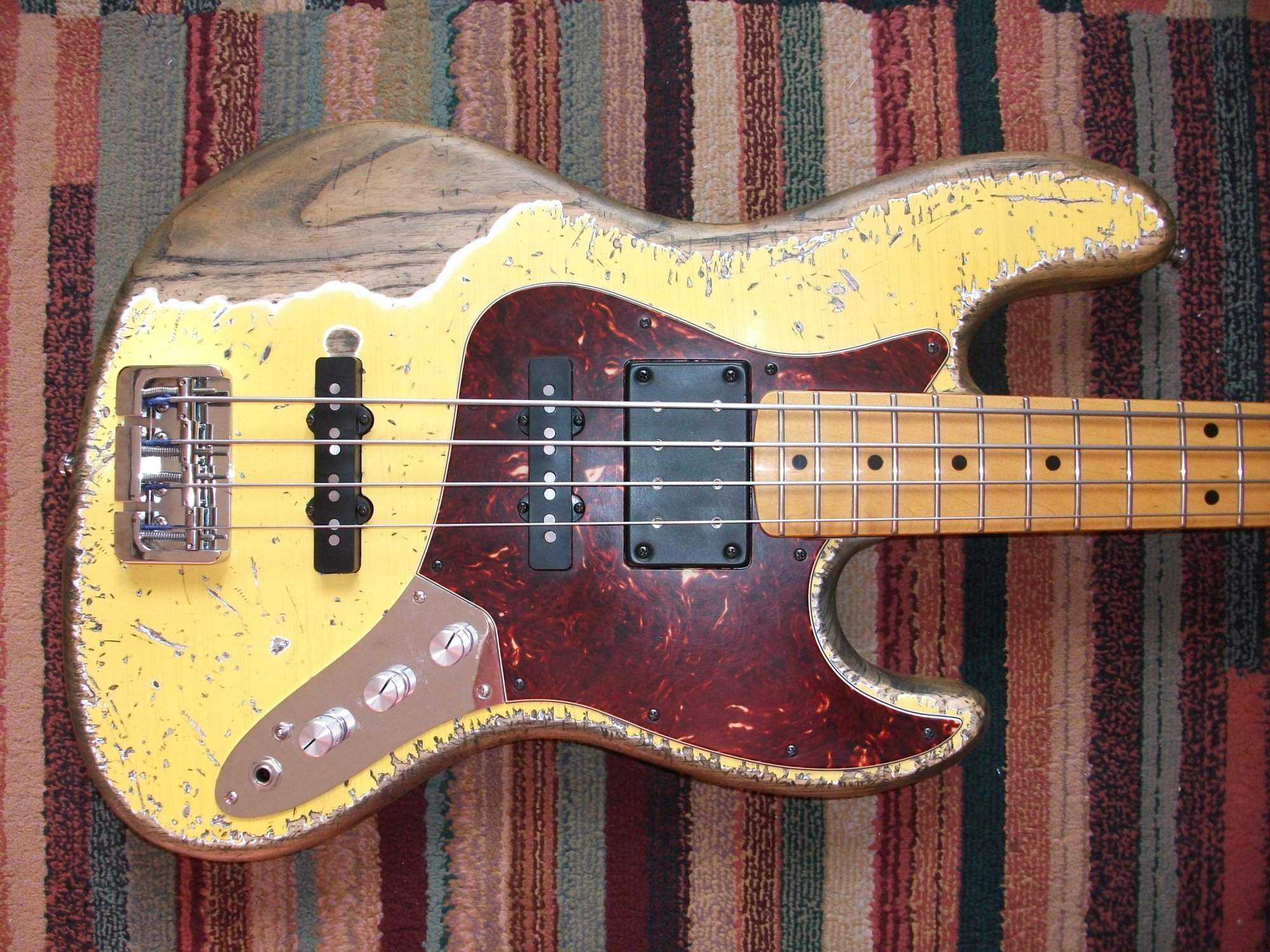
Jazz bass with 2 x Dimarzio Ultra Jazz pickups and a Dimarzio Will Power neck humbucker.
Wired: 2 x Jazz pickups to a pan pot, volume and tone.
Dimarzio Will Power wired to a 3 way mini switch giving: just jazz pickups mix / jazz pickups mix & humbucker / humbucker only.
The tone pot is also a push / pull switch for series / parallel wirings on the humbucker.
Wired: 2 x Jazz pickups to a pan pot, volume and tone.
Dimarzio Will Power wired to a 3 way mini switch giving: just jazz pickups mix / jazz pickups mix & humbucker / humbucker only.
The tone pot is also a push / pull switch for series / parallel wirings on the humbucker.

Is that natural wear?Jazz bass with 2 x Dimarzio Ultra Jazz pickups and a Dimarzio Will Power neck humbucker.
Wired: 2 x Jazz pickups to a pan pot, volume and tone.
Dimarzio Will Power wired to a 3 way mini switch giving: just jazz pickups mix / jazz pickups mix & humbucker / humbucker only.
The tone pot is also a push / pull switch for series / parallel wirings on the humbucker.
View attachment 2766586
Having just seen the "When "relics" go wrong..." thread, I'm flattered!Is that natural wear?


bruce bennett
Commercial User
- Sep 8, 2009
- 73
- 33
- Disclosures
- Owner and Luther for Hard Road guitars
I'm curious about the pickups you used in both basses.
When you say "nodal points", are you referring to harmonics?
My short answer to that is No. I may be using the word "nodal point" incorrectly.. but what I'm referring to are the few locations found along the strings vibrating length that have almost no movement regardless of what note is being played.
let that sink in a moment.
I have a feeling that your not going to accept that fact as is without explanation.. So, here is comes.
If you are familiar with the practice of "Salt testing" acoustic tops.. and the varying salt patterns seen on the tops during the testing.
then you may recognize that there are locations on every top where the salt will come to accumulate because the top is NOT VIBRATING in that area... and that regardless of frequency, there are overlapping areas that almost never move during the entire test. these locations of non-movment are called nodes. (or possibly anti-nodes I've never been clear on that) these "points of low to no movement" also occur along a strings vibrating length as well.
thats really the wrong question to ask, as it has no relevance to the method I'm referring to, as evidenced by the above explanation..And did you establish where those nodal points were with open strings, or with a capo on the 2nd or 3rd fret?
Very little, other than the basic tone of a single coil as opposed to a humbucker. as I used the same set of pickups in another bass that had been "calculated" with none of the phasing issues noted, as with the bass whose photos I had posted.Which brings me back to my original point. I'm wondering how much your choice of pickups had to do with the effects you were hearing.
the pickups in question were custom calibrated Rio Grande single coils ( muy grande in bridge and vintage tall boys in middle and neck) with Alnico II magnets at about 11k and 9K gauss.
as previously stated, the sound of that bass was much like have a very slow phasor or flanger on all the time when any two pickups were engaged and, at least to my ear, was not pleasant to listen to. it also made the bass hard to tune when using a pedal type tuner. clip on tuners had no issues. furthermore, the bass sounded excellent when any 1 pickup was engaged.
whereas the sound of the new "calculated basses" can clearly be heard in the video that Jaymi posted.
they sound exactly as predicted by the math.. and got many good reviews by players.
all that said. please note that my original goal was to make a "strat bass" and I have noted that Wide spaced humbucker designs, as well as other two coil pickups styles.. do not seem to have the sensitivity to phasing issues that the vintage P bass single coils do.
yes, any position on the bass WILL work fine, and you will get sound from it...
my issue was, the sound I got from my first experiment was not something that I was willing to say was up to my standards. so I attacked the perceived problem from another angle... and I feel I found a better sounding and more versitle solution.
but the customer who came in and decided to purchase that bass after playing it, really seemed to like what he heard. So beauty is in the "ear" of the beholder.
I'm not here to shove some hype or sales pitch or theory down anyone's throat.. I'm only offering up my personal experience in building.. nothing more.

Respectfully, that was an analogy, not an explanation. An acoustic instrument top is not elastic in the sense that a string is. If you can provide a detailed explanation or a source for your claim that there are points of lesser excursion along the length of a string, between its anchoring point, that don't change/migrate when the vibrating length is varied at one end with fretting, I'd love to read it. Well, unless you meant that those points don't change regardless of what note the open string is tuned to, as opposed to fretted, in which case I'd already believe the claim.what I'm referring to are the few locations found along the strings vibrating length that have almost no movement regardless of what note is being played.
let that sink in a moment.
I have a feeling that your not going to accept that fact as is without explanation.. So, here is comes.
If you are familiar with the practice of "Salt testing" acoustic tops.. and the varying salt patterns seen on the tops during the testing.
then you may recognize that there are locations on every top where the salt will come to accumulate because the top is NOT VIBRATING in that area... and that regardless of frequency, there are overlapping areas that almost never move during the entire test. these locations of non-movment are called nodes. (or possibly anti-nodes I've never been clear on that) these "points of low to no movement" also occur along a strings vibrating length as well.
thats really the wrong question to ask, as it has no relevance to the method I'm referring to, as evidenced by the above explanation..Which brings me back to my original point. I'm wondering how much your choice of pickups had to do with the effects you were hearing.
Last edited:

Calculating harmonic or nodal points is not about the scale length of the string.. Its about finding the spots where the strings vibrating "width" will produce the right phasing across the magnets of the pickups...
IF you could look at a vibrating string from a cross sectional view, you can see it tends to vibrate in a figure 8 pattern. with the center of the figure 8 actually being the normal "resting point" of the string. ) there are some great high speed videos of guitar string vibration in slow motion on you tube so you can see this action for yourself)
IT ALSO vibrates in a WAVE LIKE motion along it entire LENGTH, at the same time.. not unlike the wave form shown on an O-scope with portions of the string being to the left of rest point and portions being on the right of rest point again at the same time... and these will change many times per second during the vibration event. which if you think carefully about this, you can see that a sort of "snake like" motion is happening both from a top looking down, as well as from a cross sectional view.. and there are points on the string that actually DON'T MOVE MUCH during the event..
I submit to you that there is no such thing. The shape of the string vibration is going to change when you change the note you play on the string -- the figure 8 will be shorter the higher up the neck you play, and therefore the cross of the 8 ("resting point") will move up the neck, and the fattest parts of the 8 where the string is moving the most will shift as well.My short answer to that is No. I may be using the word "nodal point" incorrectly.. but what I'm referring to are the few locations found along the strings vibrating length that have almost no movement regardless of what note is being played.
In other words, the note being played matters a lot in determining where the parts of the figure 8 are located.

I'll add my recent Pawnshop VI conversion to the couple that are already in the thread.
No frills, 3 on/off toggles plus vol and tone.

No frills, 3 on/off toggles plus vol and tone.

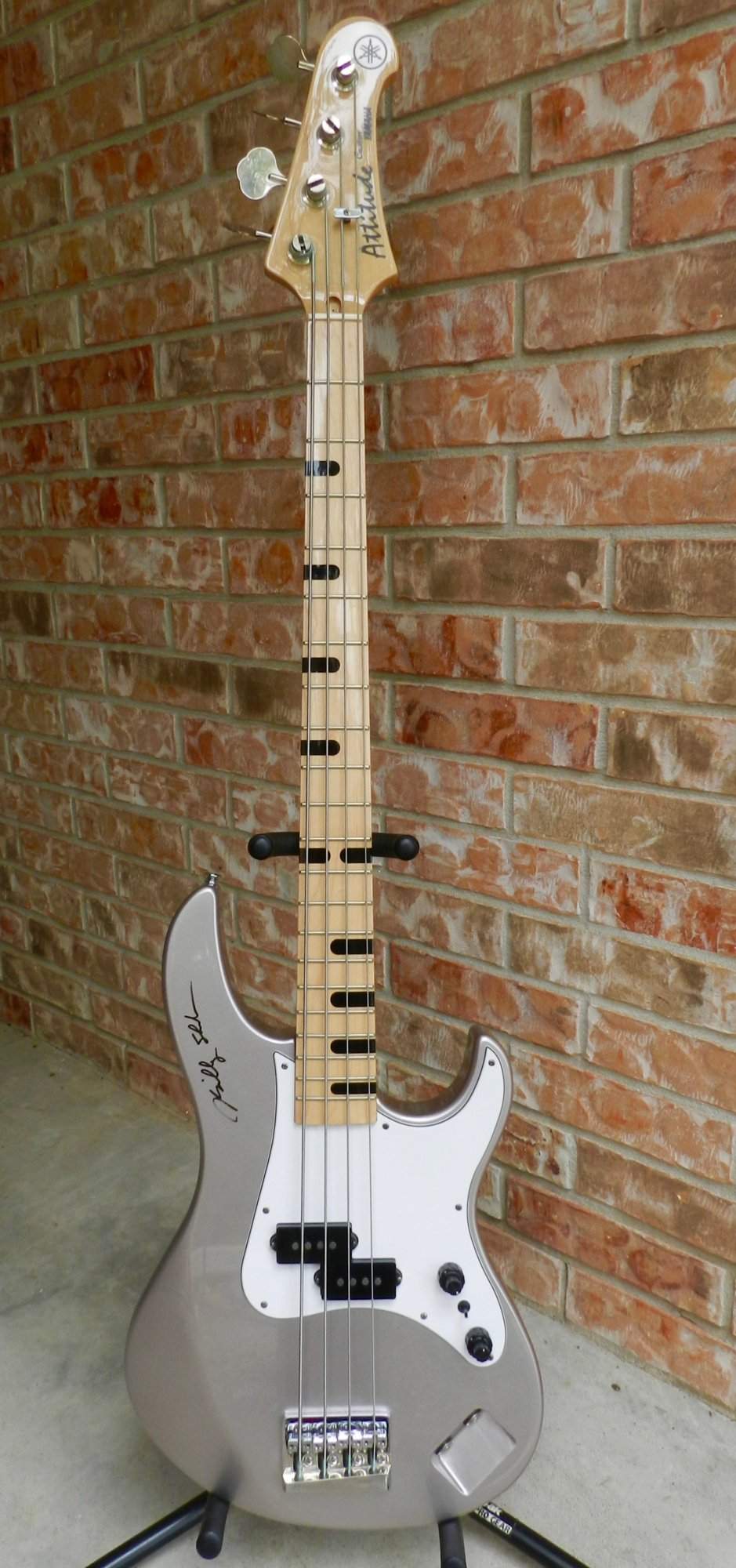
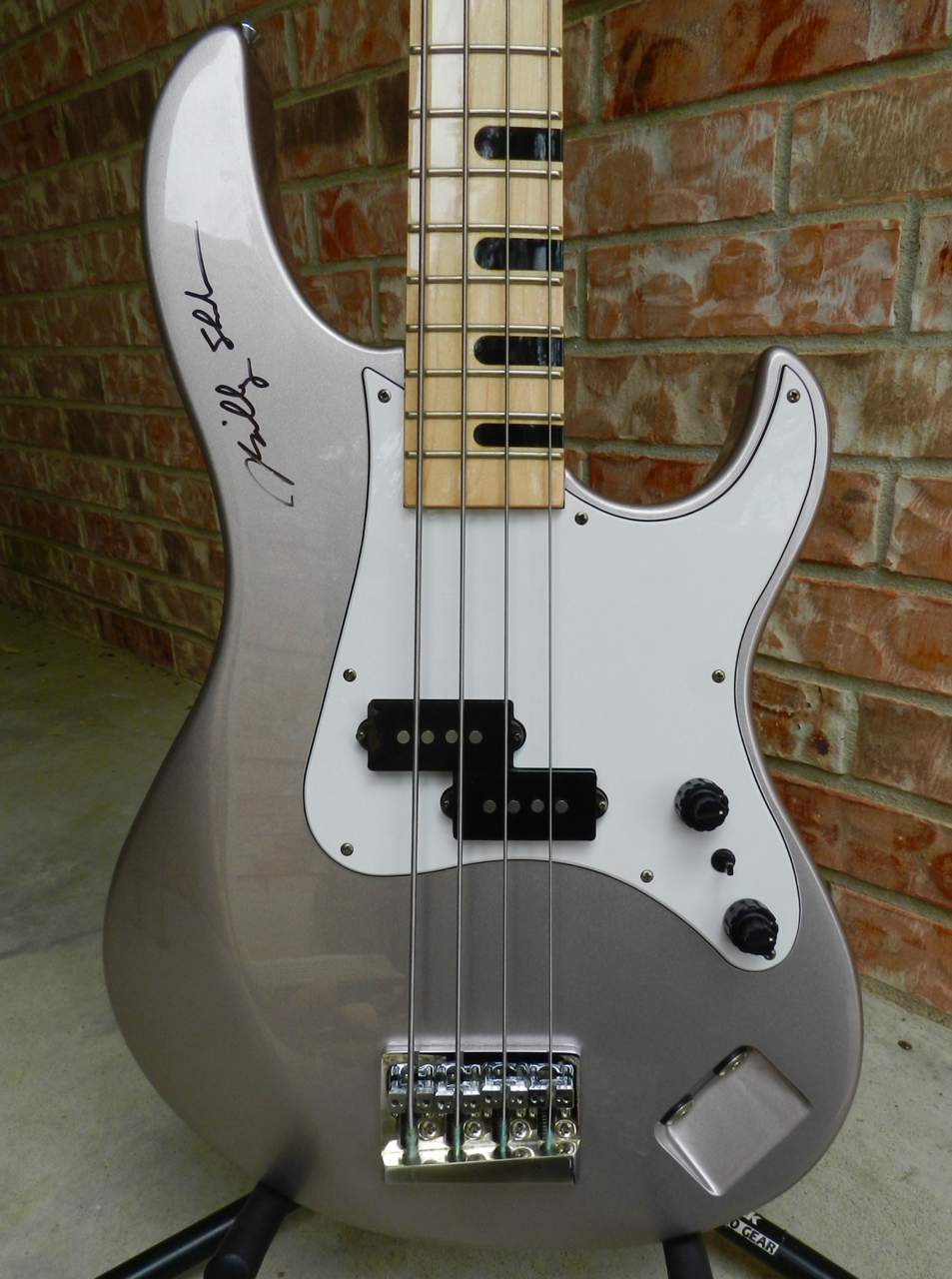
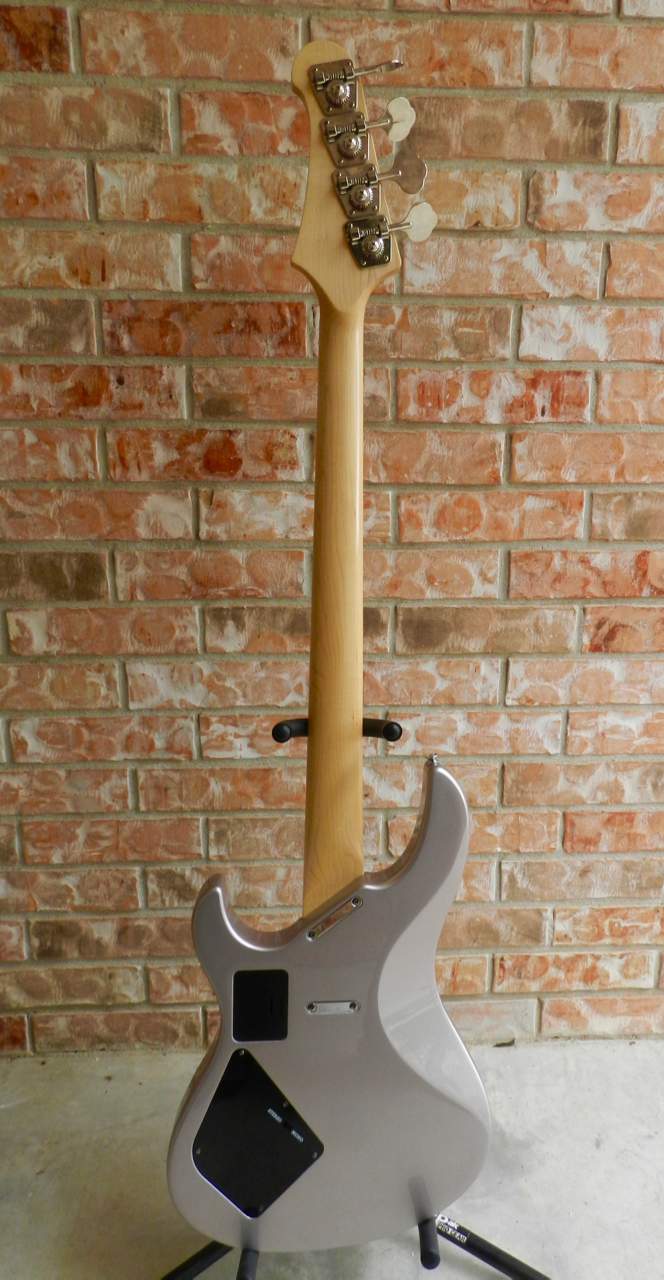
Similar to a Yamaha Attitude LTD (Billy Sheehan) bass...I just got a 1990 Yamaha Attitude Custom, in the original case.
Looks like one pickup... but there's three!
Alder body and a P Bass-ish neck with a wide 1-11/16" nut width and 10" fretboard radius.
Dimarzio X2N-B humbucker hidden under the pickguard right at the end of the fretboard.
Split P pickup in the normal P location.
Piezo pickups at the bridge saddles.
Two stacked control knobs and a three position toggle.
Front knob stack are volume controls for the neck woofer pup and middle P pickup.
Back knob stack are volume for piezo and the P pickup tone.
No tone control for the front woofer pup or for the piezo bridge pups.
Toggle gives Piezo only/Mix/P only.
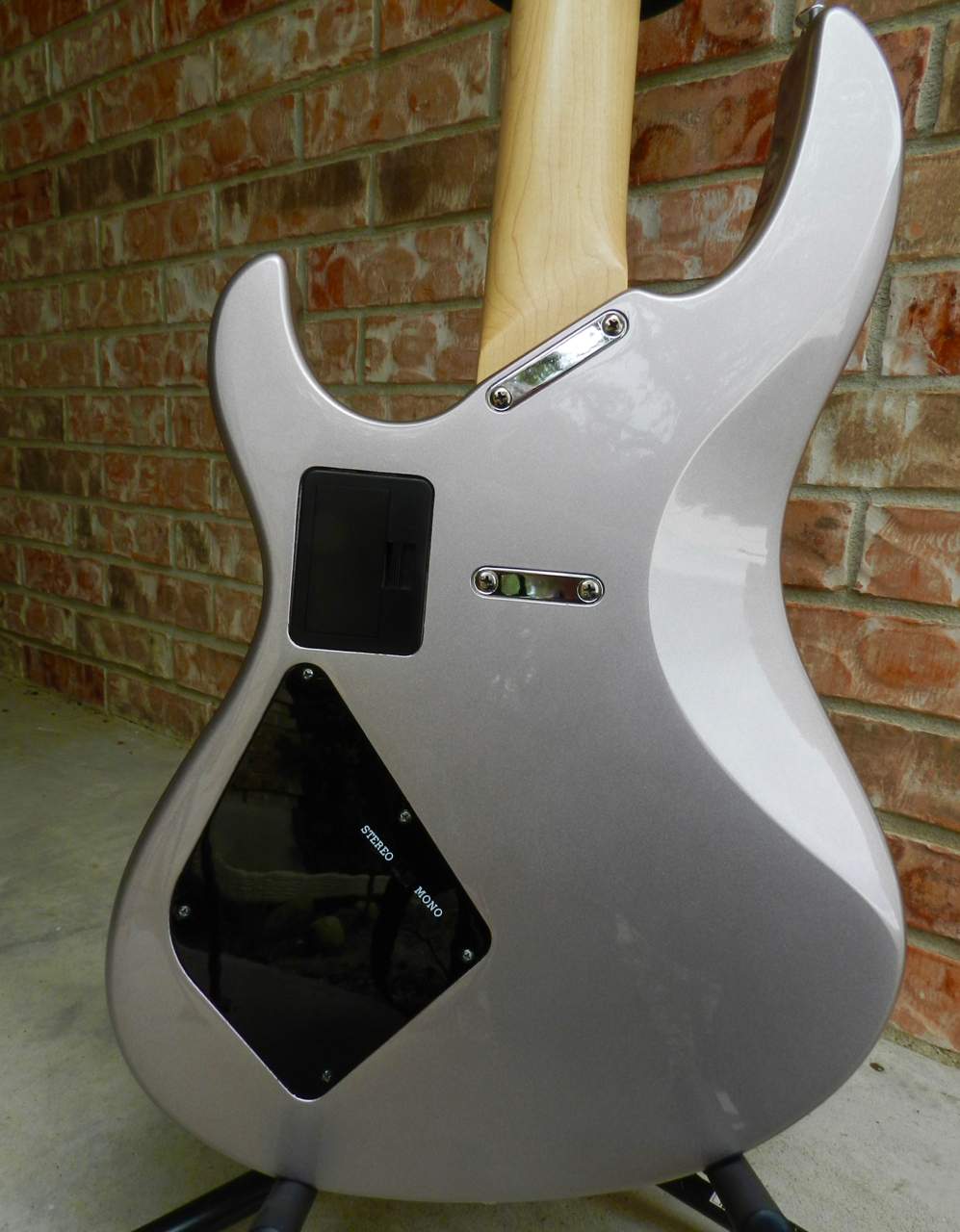
There are two output jacks for stereo or mono output, and a slider switch in the control cavity backplate for mono or stereo.
Looks like one pickup... but there's three!
Alder body and a P Bass-ish neck with a wide 1-11/16" nut width and 10" fretboard radius.
Dimarzio X2N-B humbucker hidden under the pickguard right at the end of the fretboard.
Split P pickup in the normal P location.
Piezo pickups at the bridge saddles.
Two stacked control knobs and a three position toggle.
Front knob stack are volume controls for the neck woofer pup and middle P pickup.
Back knob stack are volume for piezo and the P pickup tone.
No tone control for the front woofer pup or for the piezo bridge pups.
Toggle gives Piezo only/Mix/P only.
There are two output jacks for stereo or mono output, and a slider switch in the control cavity backplate for mono or stereo.
Last edited:

- Apr 18, 2008
- 16,007
- 1
- 31,705
- Disclosures
- I'm highly opinionated and extremely self-assured
- Apr 18, 2008
- 16,007
- 1
- 31,705
- Disclosures
- I'm highly opinionated and extremely self-assured
Very cool! What are those pickups?
Rickenbacker HB-1. Same as the Ric factory uses on the 4004.


I'm a big fan of 3 pickup basses. Was searching for threads and pics of examples out there but its slim pickins. Love to see some pics of customs with three separate pickups. Comments on wiring and what you like/dislike also would be interesting.
I have built three triples (pictured below). Two use a 3 way switch on the middle/neck volume with a separate volume for the bridge and master passive bass & treble controls.
The J bass also has a series-parallel switching for the two J pickups and phase reversal on the bridge (push-pulls). It pains me to admit, but it currently does not have series parallel switching within each of the split J pickups.
The Air Force Bass has on/off toggles and volume controls for each pickup along with master bass and treble. I like the VVV with three switch config best so far.
Next on the project list are to swap the bridge pickups in the P and the J. The J will get a double J quad coil (I plan to glue two Dimarzio Area J's together). The P will get an 8 wire quad coil MM in the bridge (probably Nordstrand).
Not sure about controls for the redone P and J yet. Would like to do the 10 option wiring thing on the quads which will probably require more routing and a bigger pickguard (to make room for rotary switch and/or 3 way toggle for each coil).
Am also thinking about a new build with three quad coil MM pickups - each with all 10 combos and maybe with 3 separate jacks plus option to route all 3 to a single jack.
Not sure about preamps. The AFB has a Bart TC-3 (boost only - no tone control). With three pickups you get so much tonal flexibility it almost seems unnecessary (did I really just say that).
Unnecessary complexity and overkill is a design objective for me most of the time, so preamps for all (eventually) with bypass switches of course.
View attachment 2047517
View attachment 2047518
View attachment 2047519
View attachment 2047520
View attachment 2047521
View attachment 2047522
View attachment 2047523
Does two magnetic pickups and a piezo in the bridge count or strictly three visible magnetic pups?
- Jun 2, 2012
- 5,784
- 6,819
- Disclosures
- Doner Designs is an alias for Steve Doner
Does two magnetic pickups and a piezo in the bridge count or strictly three visible magnetic pups?
Sure it counts. Let's see it!

Actually, 4 coils/pickups and a hidden "dummy coil" (I think.). Disqualified!


BurningSkies
CRAZY BALDHEAD
- Feb 20, 2005
- 27,956
- 20,348
- Disclosures
- Endorsing artist: Dingwall Guitars


