Enjoy the benefits of a premium membership!
Upgrade Account
-
TalkBass has been independent since 1998. Add your voice.
Create a free account to reply to discussions, view embedded media, and browse with fewer display ads.
Join free Log in
Want zero display ads or expanded classifieds tools? Compare plans.
You are using an out of date browser. It may not display this or other websites correctly.
You should upgrade or use an alternative browser.
You should upgrade or use an alternative browser.
Show your P/J Precision!
- Thread starter Daveypoo
- Start date
More options
Who Replied?



Inquiry: What is the advantage of two seperate volume controls for pickups over a blend control with a master volume control?

Inquiry: What is the advantage of two seperate volume controls for pickups over a blend control with a master volume control?
I believe the only real (measurable) advantage is less pots between pickups and output, meaning less loss of highs. With separate volume controls, the signal goes PU -> vol -> output. With a blend pot it goes PU-> Blend (Which is just a fancy two-way volume AFAIK) -> master volume -> output.
But there are of course personal preferences; people may be used to one controlscheme over the other.
I used to think two seperate volume controls also gave you more tones to dial in, but I now believe that is not true. A loud and determined French TB'er convinced me


Parts PJ I recently put together - Nitro 2 tone sunburst MIA '57 body, MIA Standard Jazz neck, Fralin P and 5% overwound J. Wired up with a 3 way switch - P/PJ/J. Plays and sounds great.
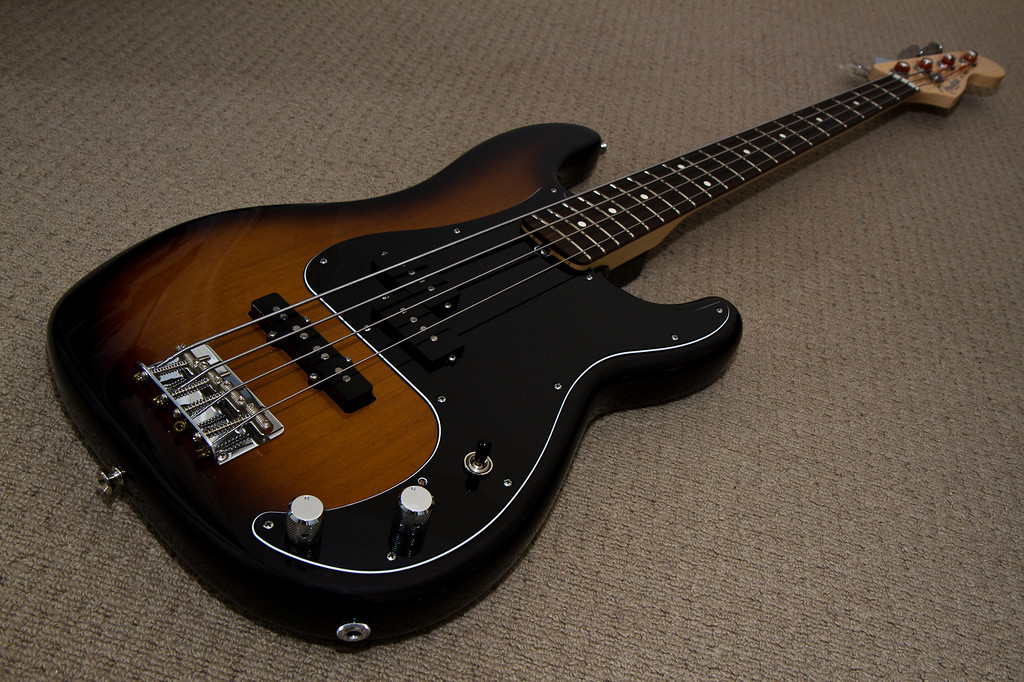
Simple, classic and on point. Sweet axe!
Inquiry: What is the advantage of two seperate volume controls for pickups over a blend control with a master volume control?
IME it is all personal preference. I have basses set up both ways (2 vol, 1 tone and 1 vol 1 pan 1 tone). I find the single vol with pan a little easier to adjust the overall volume level a the bass without affecting the tone while playing during a song. As far as a difference in tonal variety or clarity, in a band setting I hear no difference at all between the the different control setups.
I'd guess the real reason for the VVT configuration has to do more with lower manufacturing cost than anything. A simple 250K is considerably cheaper than a blend pot. Not needing to have more parts in inventory is more cost effective and the VVT control setup is also a simpler wiring process (less time, less cost). Fender is about mass production and reduced cost, (lower production cost = more profit) I'd guess increased profit is the primary reason they designed the Jazz and P/J bass with VVT controls.
Please note that the early Jazz basses had 2 stacked controls, each set of knobs functioning as V-T for a single pickup.
Oh, and from a non-instrument specific but production standpoint the VVT basses wiring and the VTT wiring of the Fender Strat can all use the same pots. Another cost / inventory saving for Fender.

Engine207
Losing faith in humanity...one call at a time.
I find the single vol with pan a little easier to adjust the overall volume level a the bass without affecting the tone while playing during a song. As far as a difference in tonal variety or clarity, in a band setting I hear no difference at all between the the different control setups.
Big, big +1

Big, big +1
Yeah, I'm really close to switching my VVT Stambaugh over to VBT for this reason.




It never made sense to me to put the louder pickup near the bridge.
http://www.talkbass.com/forum/attachment.php?attachmentid=300946&d=1353357644
http://www.talkbass.com/forum/attachment.php?attachmentid=300946&d=1353357644
It never made sense to me to put the louder pickup near the bridge.
http://www.talkbass.com/forum/attachment.php?attachmentid=300946&d=1353357644
That's pretty rare...in fact that's the first bass I've seen with that configuration.

Mine....
 same bass different lighting:
 . The photo on far left is more accurate representation of color.