
• TalkBass has been independent since 1998. Add your voice.
    Create a free account to reply to discussions, view embedded media, and browse with fewer display ads.
    Join freeLog in
    Want zero display ads or expanded classifieds tools? Compare plans.

Double Bass So, I disregarded all advice...

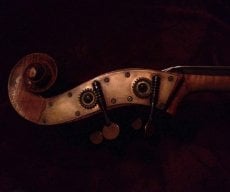
The strings were replaced by the previous owner. I tried using this site to identify them, but the only matches I get are Thomastik spirocores and Super Sensitive red labels.

The strings at the peg end of the bass in the OP of this thread are red, yellow, blue, and something else that i can't quite tell. Spirocores, from ball end to peg end, are either red/(yellow?) ( solos), Red/purple (weich), red/red (mittel), or red/green (stark), so those aren't spirocores. In my experience, the only strings I've seen with a different color for each string on the peg end are the sorts of strings that come on inexpensive chinese instruments... but of course, i could be wrong. In any case, I still advise a fresh set of good strings as a starting place, since bad strings can cause a lot of problems that could easily be attributed to the bass itself. I've had the occasional bad string on my personal basses that had me wondering if something was wrong with the bass, only to find out to my great pleasure that it was only a bad string.

 
The strings at the peg end of the bass in the OP of this thread are red, yellow, blue, and something else that i can't quite tell. Spirocores, from ball end to peg end, are either red/(yellow?) ( solos), Red/purple (weich), red/red (mittel), or red/green (stark), so those aren't spirocores. In my experience, the only strings I've seen with a different color for each string on the peg end are the sorts of strings that come on inexpensive chinese instruments... but of course, i could be wrong. In any case, I still advise a fresh set of good strings as a starting place, since bad strings can cause a lot of problems that could easily be attributed to the bass itself. I've had the occasional bad string on my personal basses that had me wondering if something was wrong with the bass, only to find out to my great pleasure that it was only a bad string.


Yep, new strings are definitely going on this bass, since these show signs of wear and grime. In this case however I'm sure the problem is not in the strings - the TP now makes a lot of buzz anywhere I play a G with enough volume, regardless of which string I'm using, while the rest of the bass (save for Gb and Ab since they are in that neighborhood) is fine. And if I keep the TP down with my foot, suddenly that low G sounds well.
 
Since the problem is worst one one note, G, that suggests to me a resonance problem caused either by a tailpiece which may have gone off center of its saddle to the treble side, or else an open seam somewhere. If I were OP, I'd be checking the ribs for a loose glue joint.
 
The strings at the peg end of the bass in the OP of this thread are red, yellow, blue, and something else that i can't quite tell. Spirocores, from ball end to peg end, are either red/(yellow?) ( solos), Red/purple (weich), red/red (mittel), or red/green (stark), so those aren't spirocores. In my experience, the only strings I've seen with a different color for each string on the peg end are the sorts of strings that come on inexpensive chinese instruments... but of course, i could be wrong. In any case, I still advise a fresh set of good strings as a starting place, since bad strings can cause a lot of problems that could easily be attributed to the bass itself. I've had the occasional bad string on my personal basses that had me wondering if something was wrong with the bass, only to find out to my great pleasure that it was only a bad string.

I can't tell what those string are from the picture, but Pirastro strings are always different colors in the peg box so that you can tell which is which string, whereas Thomastik numbers the balls.

 
Since the problem is worst one one note, G, that suggests to me a resonance problem caused either by a tailpiece which may have gone off center of its saddle to the treble side, or else an open seam somewhere. If I were OP, I'd be checking the ribs for a loose glue joint.

That is the case. The tailgut has moved to the treble side and the tailpiece is slightly twisted. I did check the ribs to be sure, but found nothing of note.
 
I can't tell what those string are from the picture, but Pirastro strings are always different colors in the peg box so that you can tell which is which string, whereas Thomastik numbers the balls.


Learn something new every day. So, any idea what kind of strings those might be?
 
Eukatheude, Are you anywhere near any of CCivitavecchia, Genoa, Livorno, Villefranche??

I'll be out there in 2 weeks and I can see your "cheap" bass..

or we can just go and have some pizza and wine.
Ah... Civitavecchia. Taking a cruise? :) Enjoy!!! I don't think you'll be lunching together:
I moved back from Brescia last month BTW, haven't updated my profile yet... Not that it matters a lot in a mostly US based forum. :D
 
So, the luthier saw it.
Turns out I was very wrong.
But I was also right.

First, he noticed right away the cracks, and showed me the repairs under the top:
IMG_20150721_190609.jpg


He also noticed that the top was refinished, which I was quite stupid not to notice:
IMG_20150721_190519.jpg


As you can see, the decorative black lines are on the back, but here were painted over.
IMG_20150721_190528.jpg

The G buzz I've been getting went away as soon as I showed him the bass (it buzzed 5 minutes before loading the bass in my car)... That sort of thing happens to me a lot when I'm fixing computers. In any case, it's still not buzzing so as long as it stays this way, I'm happy.
He said that the soundpost is to be replaced, and the bridge would better be too. I asked for an adjustable bridge, and said the whole thing would cost 350€.
So I decided to call the guy and ask to return the bass. Of course he declined, and also denied that the bass had had any repairs. Says he bought it as new from a store, and that in that case the store might have ripped him off.

However, the luthier agrees that as far as "basic functionality" goes it works. I won't be playing it in any orchestra, but it should still be suited for the acoustic gigs I'd planned to play it on. Which is fine by me.
He suggested I try steel strings if I remove the shims, since those strings have a lesser "vibration area" which would allow for lower action. He also says that the store might have just stuck them there in order to avoid any possible buzzing when the bass gets tried out, and that it might work well without them nonetheless.
I would have had the luthier adjust at least the soundpost, but since I'm going to be messing around with the bridge (and so risk having the post shift or fall) I'm going to go to him for that at a later time.

What have I learned?
To agree on a f****** return policy next time.
 
Hahaha good ending.

So that's why I got a carbon fiber bass and why you don't buy used unless you know your craft well.. Of course you can run into flukes but..

And by the way, there is no return agree policy with standard people selling used items..


Oh and what did he say about dressing your fingerboard??
 
Last edited:
Hahaha good ending.

So that's why I got a carbon fiber bass and why you don't buy used unless you know your craft well.. Of course you can run into flukes but..

And by the way, there is no return agree policy with standard people selling used items..


Oh and what did he say about dressing your fingerboard??

Yeah I know there isn't, but I could have asked. Something along the lines of "give me one week to have it checked out and I'll decide if I want to keep". Well, whatever.
He didn't say anything about the fingerboard. I suppose that was out of mercy...
 
"What have I learned?
To agree on a f****** return policy next time."

Lesson learned. An expensive lesson, to be sure, but it's good that the community has your attention now. We do things the way we do for good reasons.

It is customary for doublebasses and bows to be bought and sold "on trial." This is also called "approval" by some, but the concept is the same: the prospective buyer has a week or two to live with their potential purchase and bring it to a trusted luthier for evaluation before agreeing to finalize the sale.

Now that you have a relationship with a luthier, when it is time to upgrade it would be prudent to purchase a better bass from that luthier. If you consider another private-party purchase, have the seller meet you at your luthier's shop for an inspection and throw the luthier some cash for their time and expertise.

Should you encounter a seller who won't agree to those very reasonable requests, walk.

Welcome to the community.
 
Lesson learned for sure. So what's the part that you were right about? Is it that it's minimally functional? So, if you had to do it over again, what would you do?