- Mar 8, 2011
- 12,232
- 51,187
- Disclosures
- Authorized greenboy designs builder/Owner of BNA Audio
There's such a thing as too much garlic?
I’d much rather fight about this for the next 24 pages


TalkBass has been independent since 1998. Add your voice.
Create a free account to reply to discussions, view embedded media, and browse with fewer display ads.
Join free Log in
Want zero display ads or expanded classifieds tools? Compare plans.
There's such a thing as too much garlic?
ok guys. As generic of a topic as this is I have a big dilemma.
If you check my sig, you will see that I am a (proud) owner of Aguilar amps.
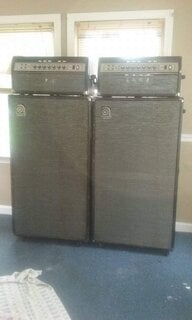
They sound great and all but yesterday I tried to hook up a fender bassman tube clone.
Wow! I couldn't believe the sound I was getting. Barefaced big twin 2 has a renown of being a cab that is able to pump monstrous lows, that are sometimes even hard to control. But with the clone, every low note has a clear and round, veery warm low end that doesn't extend over the limits. What surprised me even more is that every note I played, even on higher registers is still meaty and has a great low mid presence and just keeps on going and seamlessly blends with the low notes with zero volume difference.
My aguilar amps work great as well but there was an obvious and immediate difference in the sound the moment I plugged in.
I immediately felt groovier and a better bass player.
Should I go after an all tube amp? I never played a solidstate with a similar warmth and meat to the sound and I am starting to think I never will.
The bassman clone was 40w and I couldn't believe how loud it actually was.
The size of these amps is bugging me though.
I love Judy Garland's voice. In 1989 I did a roadshow tour (CA stops) for MGM Classics of the newly restored Wizard of Oz in celebration of the 50th anniversary (back in my cinema support days). Beautiful 35mm 3 stripe Technicolor print, larger cinema venues. I used some of Judy's other music for walk-in. She had such range and emotion in her voice and the arrangements really supported her.
If you are a WOZ fan, there was a musical number that was not used in the picture and remained fairly unknown until sometime around the 50th anniv. It was quite racy for the time, has elements of what is now known as Beat, or even Hip Hop. There's a great upright bass arrangement it this song, it's mixed pretty up front and in your face (for the era). Well worth listening to IMO just for what it represented. You won't typically hear bass mixed this forward in film scores of this era because low frequencies on film were limited by the width of the sound track (minus the bias line or lines in the case of duplex tracks) on the film for variable area tracks. What's ironic is that the visual representation of the audio on modern recording software packages is essentially the same as variable area track representation on film. As dynamic range improved (finer grain films, smaller scanning slits, PV cells replacing PE cells, quieter electronics, and Dolby A NR, higher power handling speakers, subwoofers (first used with the Dolby CP-50 and CP-100 processors), it was possible to improve low frequency dynamic range as well as high frequency extension. This is why bass (kick and gtr) have grown in prominence in more modern mixes. Of course the shift to digital audio (fiorst TDS, then DTS, SDDS and Dolby Digital) made sound on film limitations a moot point.
Enough of the OT stuff, though it really is bass oriented.
~Thanks for the informative post. I could be wrong but I believe you may have taken this out of context.
When I meant odd order harmonics, I was referring (and I think ThisBass may have been as well) to the make up of a single note and it's harmonic content as analyzed by a Fourier series.
The more "square" a signal becomes due to saturation of active devices as they near B+, Vdd or Vcc the more augmented it's odd order harmonic content becomes.

The band "Periphery" was using AxeFX for years too. They recently went back to Tube Amps because they said nothing could compare to the sound and tone of an all tube amp. These were Mark Holcombs (guitarist) exact words when I talked to him at a Sam Ash guitar clinic.I admit I based my point of view on my feelings, but also on the last Metallica's rig rundown where both guitar techs explain they only now use AxeFx and Matrix SS power amp.
Because "it's way more reliable, always sounds the same and can handle heavy touring, unlike tube amps"
Thanks for this great feedback.The band "Periphery" was using AxeFX for years too. They recently went back to Tube Amps because they said nothing could compare to the sound and tone of an all tube amp. These were Mark Holcombs (guitarist) exact words when I talked to him at a Sam Ash guitar clinic.
The band "Periphery" was using AxeFX for years too. They recently went back to Tube Amps because they said nothing could compare to the sound and tone of an all tube amp. These were Mark Holcombs (guitarist) exact words when I talked to him at a Sam Ash guitar clinic.

Correct, you might be wrong on this. The stories and the truth are often not the same, especially on the internet.It seems to me that many people use those AxeFX as it's easier to carry around. But after a while they all seem to come back to the real thing again. I might be wrong but I've heard the same story before
OK, then I urge Fractal to make an AxeFX for bass players!Correct, you might be wrong on this. The stories and the truth are often not the same, especially on the internet.
I wonder if he's tried a Kemper? There are touring professionals using it now.The band "Periphery" was using AxeFX for years too. They recently went back to Tube Amps because they said nothing could compare to the sound and tone of an all tube amp. These were Mark Holcombs (guitarist) exact words when I talked to him at a Sam Ash guitar clinic.
OK, then I urge Fractal to make an AxeFX for bass players!
Also, one of the guitar
My guitarist moved to Quilter Power Amps and pedals. He just brings his pedal board and cabinet to shows. He says he will keep his Tube amps for recording. We shall see how long it last because his sound is thinner & one dimensional right now. With the tubes it was thick, lush & 3DOK, then I urge Fractal to make an AxeFX for bass players!
Also, one of the guitar player of my band got rid of his entire "real thing" for an AxeFX. He says he will probably never go back to a "real" amp. He has everything he wants and even more in a single lightweight device.
I wear my bass on a strap and put my Tube head on top of my Cabs. Not the other way around.Hey! ........Why do they have to be so big and heavy??

~
OK, it could have been some other factor which the lead players like about the way in which tube amps broke up when pushed, but that was what anecdotally reached me at the time.
And as I am sure that you recall, companies came out with dummy load boxes (such as from Altair and Tom Scholz), to let a player variably dial down the final volume to the speaker while pushing a power stage just the right amount, whatever THAT was. ~

Sooner or later Line6 Helix and Fractal AX8 will practically nail it, won’t be everyone’s cuppa, by they will be mighty mighty close.