I'm on the lowest rung of the highest level.Wait, what? Jimmy is not at the highest level? I'm shattered. Shattered like an aluminum cone


TalkBass has been independent since 1998. Add your voice.
Create a free account to reply to discussions, view embedded media, and browse with fewer display ads.
Join free Log in
Want zero display ads or expanded classifieds tools? Compare plans.
I'm on the lowest rung of the highest level.Wait, what? Jimmy is not at the highest level? I'm shattered. Shattered like an aluminum cone
 Seems someone has greased the steps on me
Don't I know!!! The music business is only slightly less random than professional wrestling.Well, I still look up to you brotha Jimmy. I'm still trying to get to the highest wrung of the lowest ladder
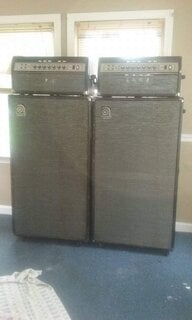
Sounds like my reaction when I first discovered the Mesa Subway D800! But then again I've never played through a tube amp. I just can't imagine the hassle of moving it around and constantly changing tubes. But if you can try a Mesa Subway, it's about as tubey as you're going to get from a small class D amp.
Tubes wear out. They do not last forever.
Nothing lasts forever....and tubes are only part of the equation. Tube amps may require a little more maintenance than solid state, but there is absolutely no need to "constantly" change tubes. Tubes can last for years. Moving a heavy amp is like moving anything else. Too heavy? Use a hand truck, or *gasp!* ask for help. To some ppl, the tone of a tube amp is so satisfying that they are willing to deal with the 1st world problems of moving heavy music gear in order to achieve it. If we find tube tone to be extremely satisfying for the relatively long period we hear it (vs the relative short period we move it) then we find ways to do it. If it is not important enough, we retreat into lighter gearspace. I use both tube amps, as well as small lightweight gear at different times. Depends on my mood, and the circumstances of the gig. I'm an old guy, and despite arthritis and a previously broken back, I will make the 1st world sacrifice of lifting a heavy load, in order to achieve my ideal tone on occasion. And yes, horror of it all, I have been known to occasionally (very rarely) change some tubes.
At least they can tag team...Don't I know!!! The music business is only slightly less random than professional wrestling.
Nokia phones....
Power tube wear out pretty fast..they can last a couple of years if used at home..but if used regularly at venues, they last about a year...

A lot of gigs, we just don't have the board real estate. When I can, I do, but we're a large band with 5 singers and 3 horns. And we do a lot of gigs with sound techs with 16 ch boards, and we do a lot of gigs with multiple bands. Like in December, there are three bands on this one show and some of the acts that we play with have their own instruments to deal with. So it's easier said than done a lot of the time, and I just run with a DI because arguing about the mic got to be a distraction on too many gigs.
I love Judy Garland's voice. In 1989 I did a roadshow tour (CA stops) for MGM Classics of the newly restored Wizard of Oz in celebration of the 50th anniversary (back in my cinema support days). Beautiful 35mm 3 stripe Technicolor print, larger cinema venues. I used some of Judy's other music for walk-in. She had such range and emotion in her voice and the arrangements really supported her.
If you are a WOZ fan, there was a musical number that was not used in the picture and remained fairly unknown until sometime around the 50th anniv. It was quite racy for the time, has elements of what is now known as Beat, or even Hip Hop. There's a great upright bass arrangement it this song, it's mixed pretty up front and in your face (for the era). Well worth listening to IMO just for what it represented. You won't typically hear bass mixed this forward in film scores of this era because low frequencies on film were limited by the width of the sound track (minus the bias line or lines in the case of duplex tracks) on the film for variable area tracks. What's ironic is that the visual representation of the audio on modern recording software packages is essentially the same as variable area track representation on film. As dynamic range improved (finer grain films, smaller scanning slits, PV cells replacing PE cells, quieter electronics, and Dolby A NR, higher power handling speakers, subwoofers (first used with the Dolby CP-50 and CP-100 processors), it was possible to improve low frequency dynamic range as well as high frequency extension. This is why bass (kick and gtr) have grown in prominence in more modern mixes. Of course the shift to digital audio (fiorst TDS, then DTS, SDDS and Dolby Digital) made sound on film limitations a moot point.
Enough of the OT stuff, though it really is bass oriented.
They don't wear out after a year, though. And I don't need to buy a whole new set of transistors if I drop one on the concrete.
 . All it did was dent a metal protector on the corner of the head and made a small crater in the sidewalk. If you drop one tube out a of a matched set you really don't have to replace the whole set either.
Maybe there are many factors that can extend the life of power tubes..but I'm not lying.. everyone knows power tubes die after a while.. if you have a recipe for everlasting power tubes, then call me a liar..
Cheers
That movie probably brings back more fond childhood memories for more generations than all other movies combined.Will go searching for this song from WOZ tomorrow. I did love that movie, although I haven't seen it in decades.
I don't think it's a myth if you gig a lot and move your amp a lot.

Yup, sad for sure.That movie probably brings back more fond childhood memories for more generations than all other movies combined.
And then the sad feeling about such talent and beauty ending so early. I remember talking to my mom and her trying to explain suicide to me.


I'm glad that in my little musical niche, big amps and cabs still rule the show. Sound techs who regularly work the board for doom shows know not to ask for a dry DI.No, I'm bummed enough about being forced to DI when I'd rather be micing
V1 has been the only preamp tube I've ever had to replace.I don't know what my stuff is biased at, but I'm getting pretty good tube life.
It used to be that way...I'm finding it's not always the case anymore, though. I bought a little ART mic preamp for home stuff years ago, use it fairly regularly still, and the cheapo Sovtek in it has lasted 17 years.
That much is true, especially if they don't have a prominent role in the output of the amp. Been my experience that V1 is usually the first to go in any preamp with more than one tube.

Regarding your statement about old production tubes vs new production tubes:Pay close attention to the bias.....dont exceed 70% dissipation and i would go with 60 to 65% dissipation.....bias as COOL as you like the sound which is usually not less than 50% total dissipation.
FWIW, NOS (meaning old production) power tubes will last much longer than modern production.
Preamp tubes are easy to swap and usually will last a LONG time unless they go noisy etc.
I doubt that there is data confirming predictable shorter tube life. If tubes fail prematurely under normal usage it is probably due to sloppy QC.Regarding your statement about old production tubes vs new production tubes:
First, what construction factor do you think mainly limits tube life?
Second, do you have data that current construction methods systematically lead to predictably shorter life?
I just wonder sometimes with all the mythology surrounding tubes whether players sometimes understand that these are just engineered devices. They aren’t some kind of mystical device that issues forth from the psychic vortices.
My $0.019 without looking into the matter is that two things can lead to premature tube degradation. One is the glass to metal seal, which allows oxygen to leak into the tube. The other is susceptibility of the internal plates to vibration. On the latter point, the musician can do a lot of good to isolate the head from the cab, especially at high volumes and with cabs having less than optimal bracing. On the former point, I’m somewhat dubious that glass to metal sealing technology has gotten worse over the years; though I suppose there could be QC issues. Is any of that kind of data known or published? Or are folks just going on experience with a few parts?