

Enjoy the benefits of a premium membership!
Upgrade Account
-
TalkBass has been independent since 1998. Add your voice.
Create a free account to reply to discussions, view embedded media, and browse with fewer display ads.
Join free Log in
Want zero display ads or expanded classifieds tools? Compare plans.
You are using an out of date browser. It may not display this or other websites correctly.
You should upgrade or use an alternative browser.
You should upgrade or use an alternative browser.
Special Edition Build-Off -- K-Space
- Thread starter Jon Clegg
- Start date
More options
Who Replied?

Wow, this one is looking so much nicer than @Fat Freddy ’s! 

turindev
Commercial User
- Jul 1, 2005
- 514
- 1,594
- Disclosures
- Builder, m7bassworks.com
Love the progress on this one! I have been wanting to add a 1/42” dyed poplar laminate layer to my builds, but have chickened out so far. How did that process go for you? Did you glue all 3 layers at once, or one at a time?

Is that really a bottle of Corona I see before me?.......Neck pocket routed
View attachment 3778777 eww

You lookin' fer trouble?.....Wow, this one is looking so much nicer than @Fat Freddy ’s!

Maybe a little... I'm feeling pretty well covered with my new personal protective equipment.You lookin' fer trouble?.....

Your ears are dooomed!Maybe a little... I'm feeling pretty well covered with my new personal protective equipment.
View attachment 3779087

Love the progress on this one! I have been wanting to add a 1/42” dyed poplar laminate layer to my builds, but have chickened out so far. How did that process go for you? Did you glue all 3 layers at once, or one at a time?
It went pretty well. I did this one 1 layer at a time, one piece at a time (more or less) because I was piecing it together from small pieces. If I had one big sheet to work from I would have done it all at once.
Yes it is. Had to drink something while I was cooking dinner.Is that really a bottle of Corona I see before me?.......
Seems like perfect PPE for a physical therapist or a chiropractor.Maybe a little... I'm feeling pretty well covered with my new personal protective equipment.
View attachment 3779087

You lookin' fer trouble?.....
I’ve got @Beej’s back.
That was a quality roast.
Can't argue with that
 ....
....Hopefully, Jon will get it right this time.....
I'm thinking that a slide bass with a whammy thingy would make a wonderful addition to my collection...

Belly carve, carved! (and I didn't break into the chambering!  )
)
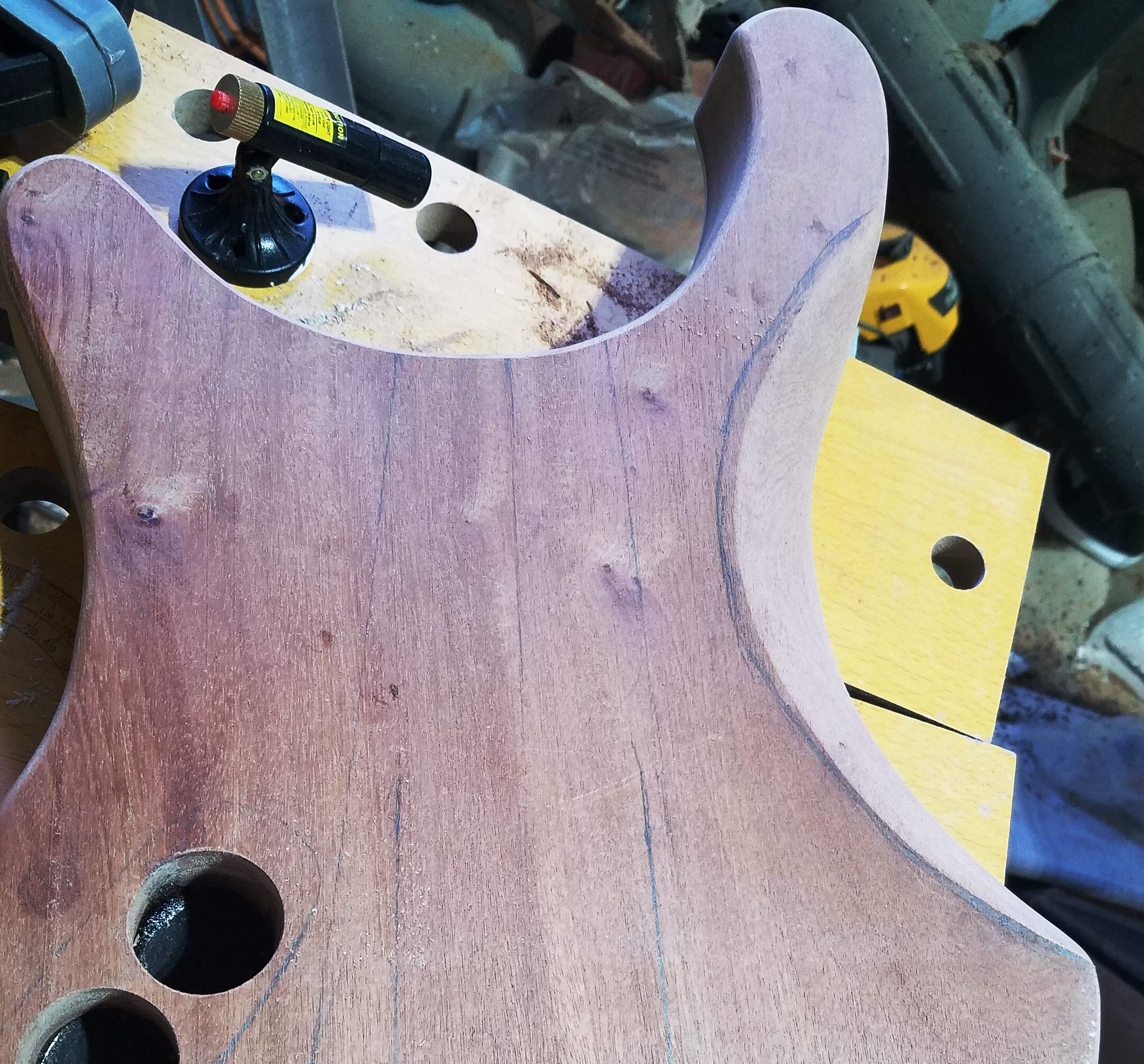
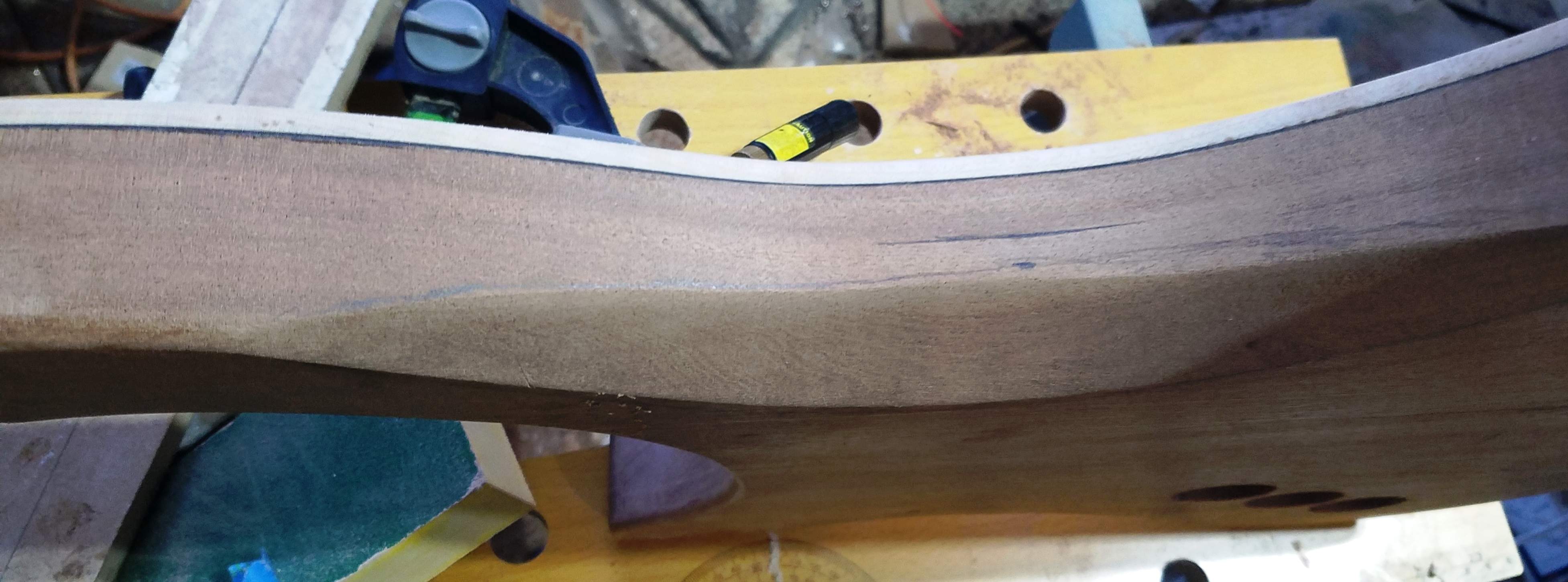
Next I'll get the neck shaped and fitted.
)Next I'll get the neck shaped and fitted.
S'Ok....I can lose weight!...Belly carve, carved! (and I didn't break into the chambering!
View attachment 3780055
View attachment 3780056
Next I'll get the neck shaped and fitted.
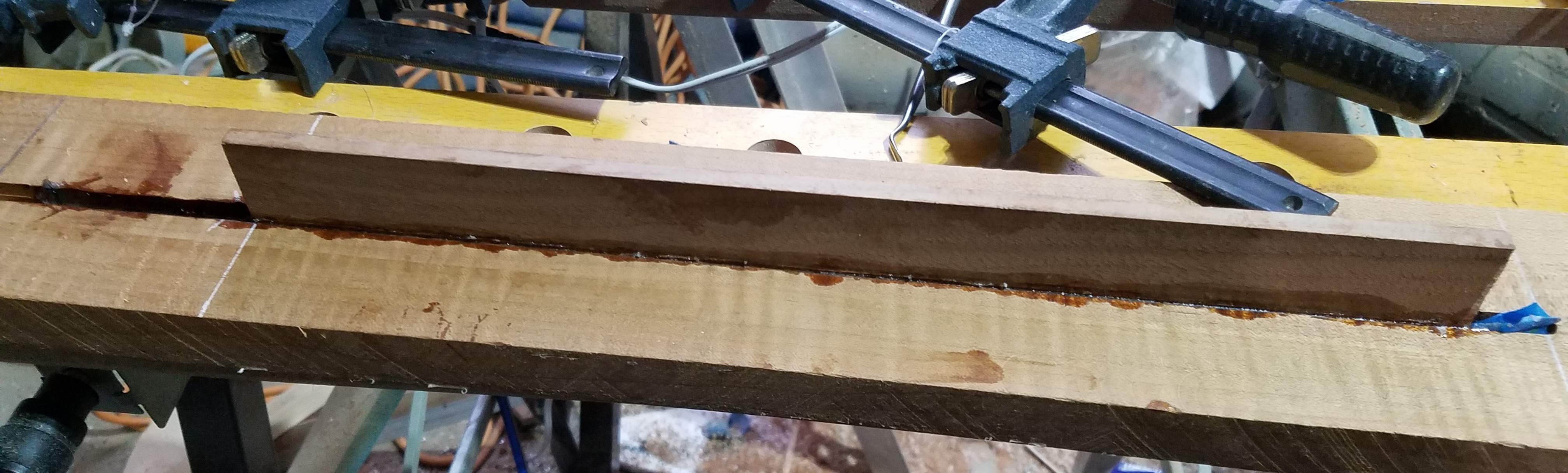
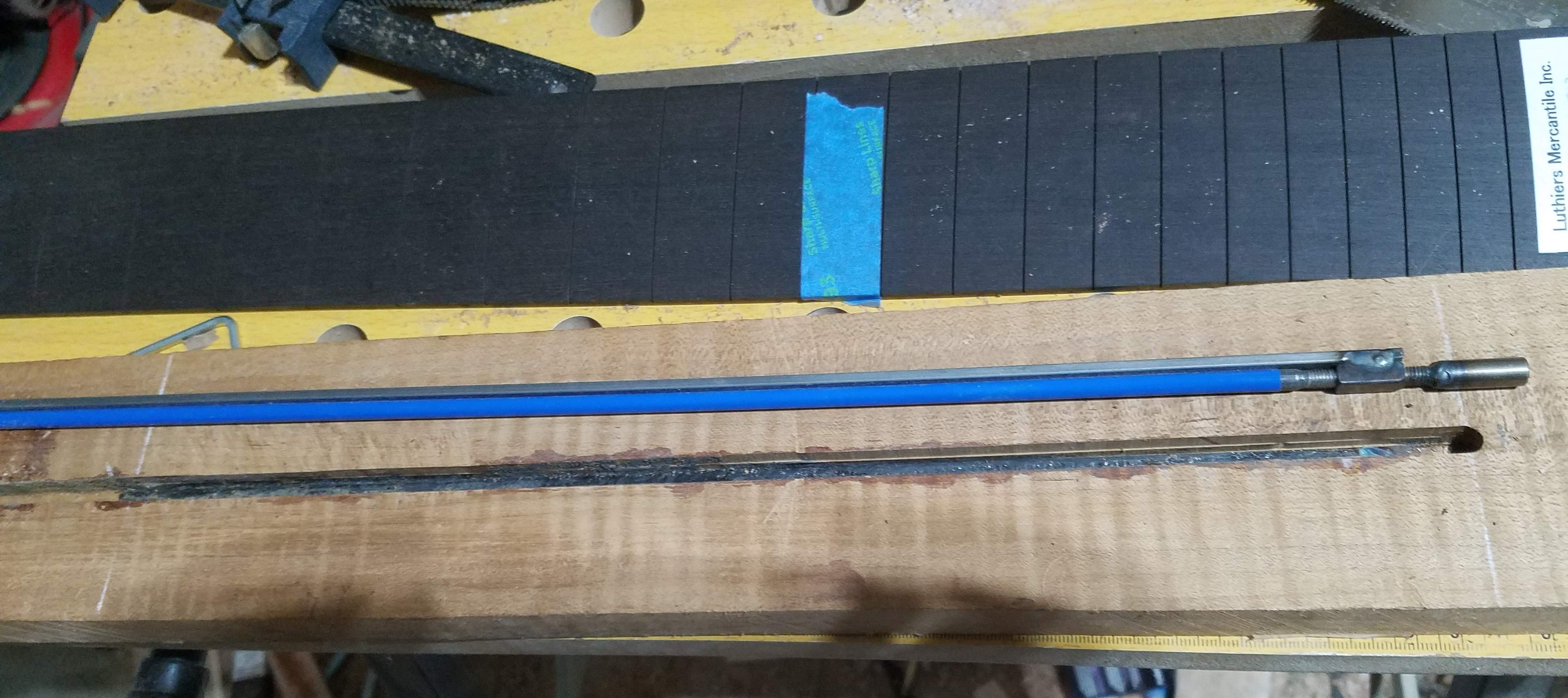
On to the neck. First up, routing the channel for the TR and installing the CF back-strap. The back strap runs from the heel to the 5th fret. I'll secure it in the slot with epoxy and a walnut plug.
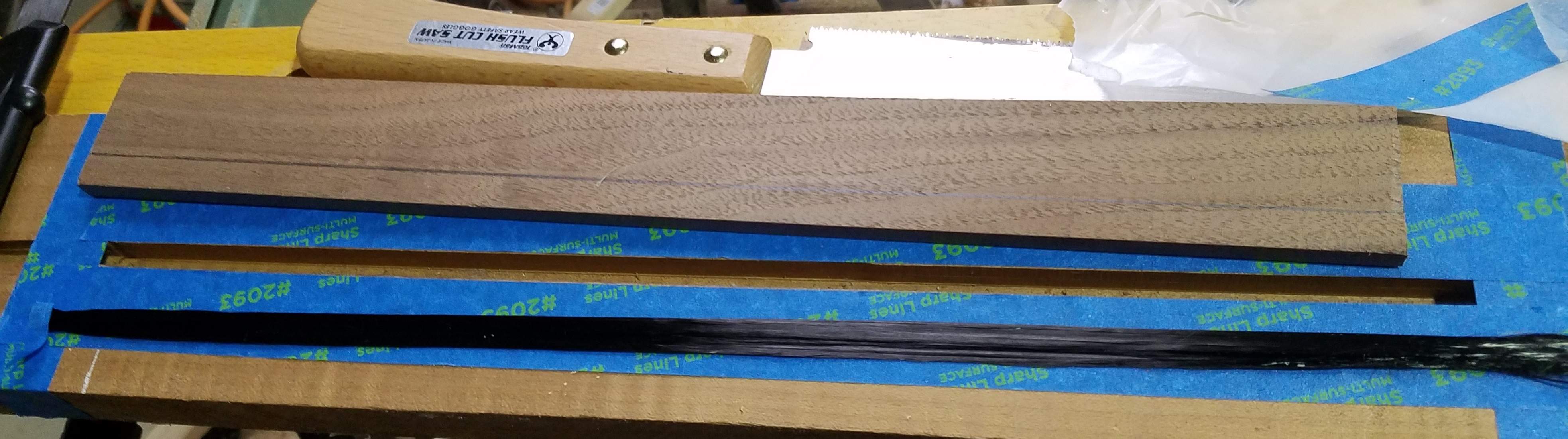
Plug installed:
Now the plug is routed out to make room for the TR:
Next up will be making the Bruce Bars, and routing the slots for them.
Plug installed:
Now the plug is routed out to make room for the TR:
Next up will be making the Bruce Bars, and routing the slots for them.
So, I'm curious about the CF back strap method vs the normal CF rods flanking the truss rod.
My understanding is that the back strap sits "under" the truss rod. I also see some of you do them full length, some of you do them only part length like in the case above where it will only run from the heel to the 5th fret. I've also seen rods flanking the truss rod that ran either full length or in some cases only half way up the neck.
So here's my questions -
My understanding is that the back strap sits "under" the truss rod. I also see some of you do them full length, some of you do them only part length like in the case above where it will only run from the heel to the 5th fret. I've also seen rods flanking the truss rod that ran either full length or in some cases only half way up the neck.
So here's my questions -
- How do you determine which method you want to use (back strap vs rods flanking)?
- How do you determine how long the rods/strap should be?
- Is all of this just a building preference?
Yes, the strap is beneath the TR as close to the back of the neck as possible, the idea being that CF is strongest in tension. So why do I use the backstrap? Well for one, I got a bunch of the CF TOW ribbon for free from @T_Bone_TL a while back so that's one reason. Also, @Bruce Johnson highly recommends this method. I've used a couple of different methods: Flanking CF rods, flanking aluminum bars, and back strap; of the the 3 the backstrap is probably the easiest (fewer steps) and most economical.
How long? Bruce recommends from the heel to the 5th fret, so that you have the extra stiffness where you need it, but some flexibility for adjusting the relief.
Largely a preference? Yes. For CF rods, you end up buying a lot of plastic/epoxy binder and not much CF. All the methods work, you could even do a sort of hybrid of doing flanking CF TOW backstraps under wood plugs if you wanted.
How long? Bruce recommends from the heel to the 5th fret, so that you have the extra stiffness where you need it, but some flexibility for adjusting the relief.
Largely a preference? Yes. For CF rods, you end up buying a lot of plastic/epoxy binder and not much CF. All the methods work, you could even do a sort of hybrid of doing flanking CF TOW backstraps under wood plugs if you wanted.

Yes, the strap is beneath the TR as close to the back of the neck as possible, the idea being that CF is strongest in tension. So why do I use the backstrap? Well for one, I got a bunch of the CF TOW ribbon for free from @T_Bone_TL a while back so that's one reason. Also, @Bruce Johnson highly recommends this method. I've used a couple of different methods: Flanking CF rods, flanking aluminum bars, and back strap; of the the 3 the backstrap is probably the easiest (fewer steps) and most economical.
How long? Bruce recommends from the heel to the 5th fret, so that you have the extra stiffness where you need it, but some flexibility for adjusting the relief.
Largely a preference? Yes. For CF rods, you end up buying a lot of plastic/epoxy binder and not much CF. All the methods work, you could even do a sort of hybrid of doing flanking CF TOW backstraps under wood plugs if you wanted.
Yep. The CF backstrap, like Jon is doing here, isn't intended to increase the overall stiffness of the neck. Its purpose is to prevent the back of the neck stretching around the 12th fret zone; to prevent the dreaded "12th fret kink" or "ski jump" problem. The CF backstrap is simple insurance against a particular problem. Running the CF backstrap from the 5th to the heel allows the overall length of the neck to have enough flexibility to pull into a good relief curve under string load.
If you specifically want to increase the overall stiffness of the neck, then you add reinforcements down the full length. This can be commercial CF bars, aluminum plates, CF stranding (TOW) set in epoxy, laminates of extra-hard wood, or other methods.
Of those methods, CF stranding has the highest stiffness in tension by far. A tiny bundle of CF strands down the back of the neck, like right under a skunk stripe, will stiffen the neck more than any of the other methods. And, it adds the least amount of non-wood material to the neck.
Two important things:
1.) Making a bass neck as stiff as possible isn't generally a good thing. A neck that's dead flat and will not move at all under string load will be difficult to set up for the best comfort playing, and will not have the (usually desirable) tone characteristics of wood. Both topics get debated a lot around here.
2.) Stiffness and Stability aren't the same thing. A really Stiff neck can be very Stable or very Unstable, depending on how it's built. Another long topic in neck design.
This is all good info, and highly interesting. So thank you to both of you for that!
So I guess my next question is:
All of this is just me asking a million questions because I have no real world experience, so keep that in mind.
I had thought on my 5-string build I'm planning I was gonna do a single truss rod and a couple flanking carbon rods that only ran partial length of the neck. TBH I'm questioning the actual need for the CF rods at all and thinking maybe it'll be just fine with just a truss rod. It'll be a wenge/purpleheart hippie sandwich and from what I've read those two woods are pretty dang stiff in their own right, so I started thinking "just put a truss rod in it and let it be, don't over-complicate it". But I also refer to the experts on my ever-evolving design ideas.
So I guess my next question is:
- Doesn't the back strap method add to the overall "depth" of your truss rod channel and inherently add to the concern about break-out if you carve too thin on the back of the neck during shaping?
All of this is just me asking a million questions because I have no real world experience, so keep that in mind.
I had thought on my 5-string build I'm planning I was gonna do a single truss rod and a couple flanking carbon rods that only ran partial length of the neck. TBH I'm questioning the actual need for the CF rods at all and thinking maybe it'll be just fine with just a truss rod. It'll be a wenge/purpleheart hippie sandwich and from what I've read those two woods are pretty dang stiff in their own right, so I started thinking "just put a truss rod in it and let it be, don't over-complicate it". But I also refer to the experts on my ever-evolving design ideas.
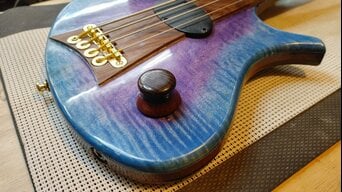
I used cf back strap with conventional dual action truss rod on my latest project. I'm pretty sure that back strap made the neck a bit stiffer. At least it needs quite a lot more force to bend it, especially in the way strings bend the neck.
So I guess my next question is:
- Doesn't the back strap method add to the overall "depth" of your truss rod channel and inherently add to the concern about break-out if you carve too thin on the back of the neck during shaping?
Well, yeah. You want the CF bundle to be as close to the finished back of the neck as possible (well, within 1/8"). That means that you have to figure out ahead of time how thick you intend to make the neck, rout the channel for the CF bundle to a specific safe depth, and then trim the back of the neck to a specific safe thickness. You know, some engineering!


