• TalkBass has been independent since 1998. Add your voice.
    Create a free account to reply to discussions, view embedded media, and browse with fewer display ads.
    Join freeLog in
    Want zero display ads or expanded classifieds tools? Compare plans.

Spector Club - Part 9

Status
Not open for further replies.
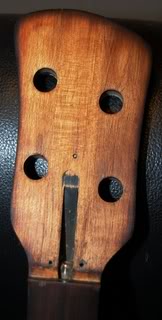
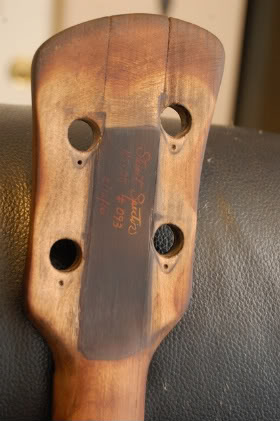
Ah, OK. Well, I got it off by basically "shaving" or whittling it with my Benchmade combat knife - cause that's what I have at 2300 hrs that works.:smug:
It looks like this now.:)
Had to save the signature area but the clear coat IS discolored...:(
d1af7343.jpg
e7362c5b-1.jpg

I hate to say this to you. But looking at that headstock. I think it's a lost cause.

Here's why. Fire has a nasty habit of pulling the moisture out of things. The cracks in that headstock are where the three pieces of Rock Maple have been bonded. This means the heat near that area of the headstock was high enough to melt the glue (or soften it greatly). This is not a good sign. If this neck starts developing fissures at those joints it's dead.

That wood looks pretty cooked. Meaning in the abscence of visible fire damage, the wood has had the moisture heated out of it. It's like cooking it in an oven. And there are now areas inside the grain, deep inside the fibers of the wood that are compromised. It's an organic material and extreme heat accellerates the deterioration of the wood. Part of the purpose of the finish is to preserve the moisure inside the wood. And that's because without it the wood cannot bend or flex.

My fear for this neck is that even if you refinished it and attempted to hydrate it, it will be weakened to the point that it's a matter of time before that headstock gives/snaps when put under the enormous pressure that bringing large bass cables up to tune creates.

You are very fortunate this is a bolt-on. I'd order a new neck.

You'll need to send the whole guitar back to ensure it's fitting/seated properly. But I think you are never going to be able to trust this neck.

If it got this hot, the truss rod got hot as well. It's not tempered steel. So that means it expanded and contracted during the event. Which also makes it suspect in my opinion.

Did any of the frets come off? Or is glue seeping (or was glue) seeping from under them?

I only mention all of this because my grandfather was a furniture maker and my father is an accomplished master carpenter... I've been around antique furniture that was "slightly" fire damaged and my entire life I've heard my dad go on and on about how wood is never the same after being "baked" in a fire.

Just thought I'd share. I'd hate to see you put all this effort into that neck only for it to be compromised or give you issues.

Contact PJ and run this by him. [email protected]
I'm thrilled you are saving this bass. Perhaps if you decide to order a replacement neck you can do what I've always wanted to do... order one with the Crown Inlays.

:bassist:
 
I hate to say this to you. But looking at that headstock. I think it's a lost cause.

Here's why. Fire has a nasty habit of pulling the moisture out of things. The cracks in that headstock are where the three pieces of Rock Maple have been bonded. This means the heat near that area of the headstock was high enough to melt the glue (or soften it greatly). This is not a good sign. If this neck starts developing fissures at those joints it's dead.

That wood looks pretty cooked. Meaning in the abscence of visible fire damage, the wood has had the moisture heated out of it. It's like cooking it in an oven. And there are now areas inside the grain, deep inside the fibers of the wood that are compromised. It's an organic material and extreme heat accellerates the deterioration of the wood. Part of the purpose of the finish is to preserve the moisure inside the wood. And that's because without it the wood cannot bend or flex.

My fear for this neck is that even if you refinished it and attempted to hydrate it, it will be weakened to the point that it's a matter of time before that headstock gives/snaps when put under the enormous pressure that bringing large bass cables up to tune creates.

You are very fortunate this is a bolt-on. I'd order a new neck.

You'll need to send the whole guitar back to ensure it's fitting/seated properly. But I think you are never going to be able to trust this neck.

If it got this hot, the truss rod got hot as well. It's not tempered steel. So that means it expanded and contracted during the event. Which also makes it suspect in my opinion.

Did any of the frets come off? Or is glue seeping (or was glue) seeping from under them?

I only mention all of this because my grandfather was a furniture maker and my father is an accomplished master carpenter... I've been around antique furniture that was "slightly" fire damaged and my entire life I've heard my dad go on and on about how wood is never the same after being "baked" in a fire.

Just thought I'd share. I'd hate to see you put all this effort into that neck only for it to be compromised or give you issues.

Contact PJ and run this by him. [email protected]
I'm thrilled you are saving this bass. Perhaps if you decide to order a replacement neck you can do what I've always wanted to do... order one with the Crown Inlays.

:bassist:

Thanks, I just couldn't ignore this one. Ya know, it just kept calling me. I deleted it off my watch list 4 times!:help:
I had a couple conversations with the owner about it. A local guy wanted it for "parts"....:spit: So, I'll pour on some love and see what happens.
I appreciate your thoughts and input, It helps me make a better decision on what to do or how far I wanna go... and a second opinion is always better than one. :cool:
I think you may be right, but I am not all together sure it's quite done yet. The cracks are JUST barely into the seams on the back, non existent in the front. I put a feeler gauge in the cracks and didn't go but a 1/64th or so in. Except above the A string tuner, it goes aboput 3/8 in from the edge with a paper thin gauge .0015". :hmm:
But, yeah it is a bit "dry". Worst is the top edge of the headstock. I'm not too shabby in the wood shop, either. :) Lucky for me and this bass or she'd be in parts by now, Frankensteined into someone's Hondo! :eek:
The fretboard is in good shape except for some soot/char staining on the 1,2,3 rd frets. The frets are intact and have not moved, no seepage, the dots did melt/expand a bit (like a pimple) and 1/8" dots? I filed them down then 220 gritted them smooth which took out most of the staining from the soot.
BTW, there are few coats of Watco wood cleaner/wax for Dark woods applied. It's a dark brown liquid that does give a little staining effect. That's why the wood doesn't look as white as it does bare natural. It made the fretboard a bit darker, too. I was thinking about an ebony stain for the fretboard though. ;)
The chips in the end of the fretboard were my overzealous whittling of the Ebony board off the head :( The clear coat melted/bubbled and the hand sander didn't seem to be getting anywhere so, I gave it a shave! LOL.
26b0cf19.jpg
34d79671.jpg

Pj said a new neck would be at least 500.00 and no idea when they could get to it. Which is why I am forging on with this neck. :D Maybe later I can get a crown inlayed neck.:cool:
 
Yeah ya know what...I found out last night my NS-95 won't fit in the case that I used for my former Rebop 5! :( But my Legend 4 was an excellent fit so it has a new home now. Good thing I had a gig bag to take to band practice.


Please! I'm enjoying your refurbish!


Yeah I wonder if Spector has a case that my NS-95 will fit in? I didn't realize the body is so much bigger! /:


I looked at modifying my Rebop 5 case but the NS-95 body goes all the way to case edge to case edge. Yikes! Might have to search for older case myself. I'll call PJ...

My NS-95 came with a SKB Freedom case. Fits perfectly.
 
... copied from http://www.sadowsky.com
July 2010
Roasted Maple Necks

Sadowsky Guitars has always taken pride in the quality and stability of our neck wood. We are now pleased to offer "roasted maple" necks for an unprecedented level of stability. Lumber for maple necks and fingerboards is placed in a special oven after normal kiln dying. The wood is roasted at temperatures ranging from 180º to 220º Celsius. The result of this treatment is wood that is significantly more resistant to absorbing or releasing moisture. With this increased stability, the "roasted maple" process enables us to offer figured maple neck blanks for the first time in our three decades of instrument making. We have always advocated that figured neck stock was too unstable to use. However, any piece of wood than has a stability problem will warp during the roasting process and be discarded. It would also be a recommended option for players who reside in areas of extreme humidity (low or high), or who travel a lot through variable climates, as well as players who desire a figured maple neck for aesthetic reasons.

NOTE: The roasting process is performed on lumber. It cannot be applied retroactively to finished necks. Any revisions to existing instruments already on order will delay build time by approximately five months.
[Invalid or Expired Link Removed]
 
I didn't know Spector was doing "Roasted" necks. :hiding:
(Sorry if someone used that already :p)

Hey! Thanks! "Roasted Neck".. I like it..:D
OK, Disclaimer. The following ad is not real. You CAN NOT get this bass,

2000 Spector NS-2J-RN

[FONT=&quot]NS-2J-RN™ [/FONT]
[FONT=&quot]A USA Series bolt-on 4-string bass with a single "J" pickup at the bridge and a single "J" pickup at the neck.[/FONT]
  • [FONT=&quot]Available in a variety of exotic woods (EX Models) and AAAA Quilt Maple (FM Models)[/FONT]
  • [FONT=&quot]EMG J at the neck
    EMG J at the bridge[/FONT]
  • [FONT=&quot]With EMG “BTS” electronics[/FONT]
  • Natural Roast 3 piece rock maple neck, 34" scale
  • [FONT=&quot]Neck features the deep-socket neck pocket for increased sustain[/FONT]
  • Special Dark Oil Rub finish including the headstock. Has a “Burnt Edge” appearance.
  • [FONT=&quot]Black aluminum hardware including Gotoh GB7E tuners and solid brass bridge.[/FONT]
 
I demoed an Ian Hill Euro 4LX today and I'm sure I'm going to buy a Euro now. My first time playing one of these, and I'm absolutely floored. The tones are so fat, yet so detailed and precise - the Tonepump sounded fantastic to me. The neck is so easy to play, the action so crazy low, it took a little while to stop digging in like I do on my Fender P/J. The build quality is so solid, and the solid black paint job flawless.

I also wanted to compare the Euro to an L-2000, another bass I was considering buying. The G&L was good sounding and solidly built, but going back and forth taking turns plugging the two basses in, the playability and tone of the Spector just smoked the L2K.
 
Any way to tell what Preamp I have? I took my Spector Euro 4LX open this afternoon for the first time to replace the battery. It didn't really need it but I bought it used and didn't know how old the current battery was. Also, I wanted to peek inside!

The preamp was just a black box with no markings. It didn't look at all like the version I saw on Spector's site.

Click here for the tonepump page on Spector's site. Well, just the google cache version. Main site seems to be down.

The previous owner re-wired it to be Volume/blend with indent instead of volume/volume. I like that setup a LOT better than a volume/volume setup.

I'm at least the 4th TalkBass owner of this bass. Pretty sure I'll be the last. I love it!
 
Status
Not open for further replies.