• TalkBass has been independent since 1998. Add your voice.
    Create a free account to reply to discussions, view embedded media, and browse with fewer display ads.
    Join freeLog in
    Want zero display ads or expanded classifieds tools? Compare plans.

Spector Club Pt. 4 (Insert Clever Title Here)

Status
Not open for further replies.
I think I found the only thing I don't like about my new euro 4. I put some new strings on it last night and it was a major PITA. I guess I'm used to other bridges where the string is stuck in the bridge and can't come out making it easier to wind the string around the tuning peg. Every time I'd start winding it up the bottem end would pop out of the bridge. Any tips and tricks that you spector guys have? I gues I could use a piece of tape over the bridge slot's to keep them in place.
It's the price you pay for having the convenience of a quick release bridge.

I typically, after cutting the string to length, will wrap it arround the tuning peg a couple of times, leaving just enough slack to still get it in the bridge groove while holding the apex of the string far enough away from the finger board to take up the slack, keeping it anchored at both ends. Tighten up the tuning peg with your other hand.

BTW, I don't think this has been discussed: After 20+ years of using Spectors I've found the only 100% stable (so it can't twist, get caught at an angle or shift) anchoring of the string ball in the Spector bridge is to have the hole of the ball horizontal to the bridge, exactly like this:
[Invalid or Expired Link Removed]
Any way other than this and the ball may shift, bend at an angle putting a sharp edge on your wire loop (I had a string snap, years ago, from this). Another, lesser hazard is having that ball (if mounted in a vertical position) shift off one side edge or the other while playing. It may not snap, but you will suddenly be very out of tune as it releases a little tension. With the ball in the correct position, as shown above, this is impossible.

Here's a very good (bad) example of why you should always do it the way above. Look at the A string compared to the others. The others have shifted and are all in potentially unstable positions. The A is the only one that cannot shift (and probably won't break) at any point.
IMG_6265.jpg
 
Great collection. Enjoy the new one. I do mine.

Further question on Spector necks ...

... I was under the impression from correspondence with PJ Rubal that all Spectors have a 16" FB radius. Are neck widths and profiles different between the US and Czech models being produced today?
 
The Euro 4LX I just traded was one of the very first models. The TonePump in it didn't have the output adjustment feature the one in my brand new 4LX does.

And it was a lot more tame than the one in my new 4LX. My new 4LX came to me with the TonePump output set in the middle. The older 4LX was slightly less as strong output wise... and it didn't have the little dial on it for adjustment. So I'd agree that the older TonePumps are more tame.
Which is strange as the early Tone Pumps had the voltage doubler in them (per PJ).
 
Thanks for the string tip. I'll keep it in mind.

I had the tech guys at Sam Ash NYC install a new set of DR High Beams when I got it so I haven't restrung it yet myself. There's a Badass bridge on it which is string-through, unlike your photos.

Any suggestions there?
 
Yeah, thanks for the tip. I didn't think to do it the way you suggested. I like the fact that after I get the string wound up I can give it just enough slack to pull it back out of the bridge to make sure the strings not twisted at all. I'm not sure I'm digging the roto's I put on it anyway so a change back to the highbeams might be in my near future.
 
Thanks for the string tip. I'll keep it in mind.

I had the tech guys at Sam Ash NYC install a new set of DR High Beams when I got it so I haven't restrung it yet myself. There's a Badass bridge on it which is string-through, unlike your photos.

Any suggestions there?
The one thing about the Badass, or any non-quick release bridge, is that the string ball is probably going to be stable no matter what.

I just prefer quick release as I change (and recycle) my strings embarassingly often. :p
 
This probably belongs in the Strings Forum but now that Rotos and High Beams have been mentioned ...

Ever since I got my NS-2-JA-R last November it hasn't kept tune very well. Every new day I found it slightly off, usually sharp but evenly across EADG. Where I first thought the tuning keys were responsible I eventually chalked it up to temperature changes in my apartment causing the neck to move. But no buzzing has occurred. I do my own setups.

Since the weather warmed up here it stabilized. I am now thinking the culprit may be the DR High Beams. I have Roto 66s on my Tele.

I tend to pluck hard but I have never had a tuning issue with that guitar.

Thoughts, guys?
 
Ever since I got my NS-2-JA-R last November it hasn't kept tune very well. Every new day I found it slightly off, usually sharp but evenly across EADG. Where I first thought the tuning keys were responsible I eventually chalked it up to temperature changes in my apartment causing the neck to move. But no buzzing has occurred. I do my own setups.

Thoughts, guys?

My NS-2-JA-R is now three days old. And I must have played it three or four hours yesterday at two or three sittings.

Aside from the initial setup I did getting it fresh out of the box... stretching the strings, tuning it, setting intonation (and the BADASS is much easier for that than the locking Spector bridge, but soon it'll be a non-issue... Spector has added intonation screws to their bridges and once the supply of old bridges is gone these will be standard), it hasn't lost tune.

I've owned several other basses from manufacturers such as MusicMan, Steinberger, Ibanez and have honestly found that none keep tune like my Spectors.

The Q4 was bad about slipping tune, but after I replaced the tuners with Gotoh GB7s (like on the USA Spectors) and a Hipshot A brass bridge, it holds tune just as well as my other higher-end Spectors.

And I only use Spector strings... except on my about to be Fretless NS-2A. On that one I've put D'Addario chrome flatwounds on it. But I always use flats on my fretless basses.

I guess it could be strings, unless the temperature variation/humidity in your house is that drastic that your basses do the expand/contract thing like crazy. But then I'd expect to see cracks in their finishes and other signs that they were in an unstable temperature environment.
 
Which is strange as the early Tone Pumps had the voltage doubler in them (per PJ).

Yeah, I don't know what to tell you about that. I know that this is supposed to be the case, but if this TonePump unit had the voltage doubler, it is one of those gimicks that didn't work too well.
Which might explain why they stopped doing it. My new 4LX is much hotter than the older one was. Which is why I traded it to Beaver.
Not only did I not need two 4LX models... I always reached for my new 4LX when I wanted to play.
Now I have a real choice between two very different sounding Spectors.
And I don't know what to do about my Q4. I never touch it any more. It's a nice bass... but it's not got the same neck profile as my other three Spectors. So it's the odd bass out.
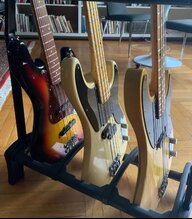
I'm going to keep it just to have one of the newer Korean models... and to have that 5th Spector to keep my 5-guitar rack full.
 
Which is strange as the early Tone Pumps had the voltage doubler in them (per PJ).

My apologies in advanced if this question has already been asked, but: when were the voltage doublers used, and how do you get around/disable them?

I recently picked up a gorgeous 2006 NS-2J, with the Tonepump. The volume is overpowering - I have to hit the db cut on my amp to use it when switching from another bass. It's easily twice as loud as my other Spectors. Is this normal? It's my only USA Spector, so I have nothing to compare it to. I popped open the back, but I did not see any obvious trim pots, defeat switch, etc.

thanks!
 
Yeah, I don't know what to tell you about that. I know that this is supposed to be the case, but if this TonePump unit had the voltage doubler, it is one of those gimicks that didn't work too well.
Which might explain why they stopped doing it. My new 4LX is much hotter than the older one was. Which is why I traded it to Beaver.

This has become one of my newest "What were they thinking?!?" peve with Spector (I love the basses, but there have been many of these head scratchers over the years :eyebrow:). This applies to new or old Tone Pumps as even the "voltage doubler" didn't pass on the stepped up voltage to the pickups:

Pretty much anybody that has had premium EMG's in a bass at 9 volts and then changed it to 18 volts (or even 27 volt, although not much difference from 18) will notice the improvement in tone. Now, with the Tone Pump, you cannot do this. I know, I've tried (go back a few pages in this thread to find my posts on it + PJ advised against it).
At least when Spector was doing the OBP-1 or EMG's pre you still had this excellent option. Not sure if the Haz-Lab can do 18 volts.
Tone Pump?......:spit:
 
This probably belongs in the Strings Forum but now that Rotos and High Beams have been mentioned ...
Naw...
No need as it's mostly as it applies to Spectors.

The string change in pitch (once sufficiently stretched, assuming no tuner/bridge/neck issues) after sitting with temperature changes is more about the strings themselves.
Being metal they are going to be much more susceptible to expansion and contraction from temperature changes than your wood bass.

If I'm playing in a well air conditioned venue I check my tuning fairly often (especially after the first or second song) as my hands warm them up enough to make them go a little flat in that situation.
 
Today I tried out an older CRFM 5 string. No serial number and 34" scale. The bass sounded awesome, except the B string. It was very floppy and farty sounding. I tried it with 3 different heads and 3 different cabs and couldn't get it to sound even acceptable. The low D sounded just ok, but anything below that was terrible. I assume that's why Spector (and mostly everyone else) went to 35" scales.

I really wanted to walk out with my first 5 string, but just couldn't. Anyone else have this issue?
 
Status
Not open for further replies.