• TalkBass has been independent since 1998. Add your voice.
    Create a free account to reply to discussions, view embedded media, and browse with fewer display ads.
    Join freeLog in
    Want zero display ads or expanded classifieds tools? Compare plans.

Split J pickup anyone? Why not?

There are plenty of side-by-side jazz bass hum cancelling pickups..... but they don't quite sound like a single coil.
Here's a good example of the Lindy Fralin ones which are described on their website as sounding a little thicker than their single coils.
It really is just a Pbass pickup without the two halves being staggered.
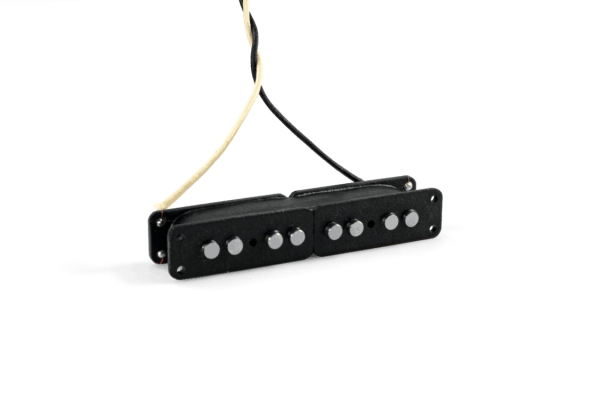
Split-Jazz-Bass-e1567793712766-600x400.png

That doesn't sound like any P bass pickup I have; FAR closer to Fralin single coil Jazz pickups than my Lollar and Klein P bass pickup.

It's not only the stagger or lack of that's the difference. The dimension of the coils are different and their spatial relationship to magnetic fields are different.
 
They are different.
The side to sides sound more like a single coil than the stacked ones, IMO.

Carvin/ Kiesel made a stack coil, the only one I know, there may be more. Most everyone else makes side by side.

I have a set of DiMarzio Ultra Jazz in a 70s Jazz type bass. I like them. They're side by side coils.
Fenders noiseless, through Gen 3 at least, are stacks. Maybe gen 4 too, i cant remember if they were or not. They were pretty nice though. Duncan has always had the "hot stacks"

Nordy makes soapbar stacks too. Fat Stacks.
 
  • Like
Reactions: DJ Bebop
I was thinking about a side by side coils enclosed in a J form enclosure. Just technically asking: a two stacked coils vs. the traditional single coil J pickup should give the same sound. Shouldn't it?
Any J pickup that says it’s hum cancelling is likely a split.
There are several types of hum canceling J pickups. Split coil pickups are also known as dual inline coils. Stacks are coils wound one on top of the other. Parallel coils are sometimes seen with two blades running the length of the pickup. Sidewinders have one central blade (or length of pole pieces?) with a coil wound on either side. Then there are less traditional pickups like Lace Alumitones. But since you (OP) asked about split coils initially, here's a photo of a split-coil jazz pickup.
Split coil J pickup.jpg
 
Last edited:
After years of "personal findings", all I can say is I can't take the single coils hum anymore. No matter how good they sound, the hum will basically "kill" my mood while in recording or rehearsal, and is especially annoying while in live situations.

In my view, split and stacked coils ended up evolving over the years to the point that the difference between them became, although present, more subjective, in terms of sound quality, and totally effective in terms of noise cancellation.

Perhaps something similar has been happening with the bass heads.

Oh boy, I don't even miss the days when carrying gear all around was a huge PITA!

Now I have a micro bass head with absolutely CLEAN sound, low heat, low power-demanding, huge power output for a thing with less than 3lbs, which will fit nicely inside my gig bag.

"It's evolution, baby"...

But, as always, it's only my personal view and YMMV.
 
In a 5 string inline split coil J pickup, there are pole pieces for 2 strings in one of the coils, and pole pieces for 3 strings in the other. 2 does not equal 3 - the coils have different inductances, and different amounts of hum. They don't completely hum cancel (they also won't work well wired in parallel). Compared to a single coil which has 5 sets of pole pieces and no cancellation, 3 minus 2 is 1, which means you have one fifth of the hum of a singe coil. It's certainly better, but if you're used to complete hum cancellation, you don't quite get there with a 5 string split coil J pickup. A pair of them can be designed to completely hum cancel when both are on, so at least in that case, they're never worse than a pair of single coils.
Since learning about split-coil J pickups and seeing the lopsided nature of the 5-string versions, I have always wondered about that. Specifically, I wondered how it would work if the pair of pickups were "mismatched" so to speak, for instance if the neck pickup sensed BEA + DG while the bridge pickup sensed BE + ADG. Then, no matter what the volume level was set at, there would always be 5 strings worth of coils and magnets interacting.

It seems like that would work, to me. But the reasons why it would work or not work are beyond the limits of my knowledge, so I'm just throwing it out there for more knowledgeable people to consider.
 
This is exactly why I got into the EMG stuff and have never regretted doing it. Just the opposite... I can have complete confidence that my basses will sound absolutely good and dead-quiet wherever I plug them in.
I don't use EMG pickups, but my philosophy is exactly the same.
 
  • Like
Reactions: Alessandro Cruz
Although I really enjoy to see old gear and other pieces of equipment working and sounding good, reliability is something I've learned to take as a general rule as a professional. Even my tools, If I can throw some more dollars to get top notch stuff, I'll do without a blink of eye ( I love cordless power tools, BTW ).

As a musician, I have to surround myself with stuff that I know won't let me down when I need it most. Cables, strings, accessories and so it goes...

Take a good note: Not too long ago, there were a lot of people swearing at carburators and saying that electronic fuel injection was unreliable and "tech for dummies". Who's the standard today?
 
Bartolini has made a split J pickup for a long time that I've used.

Fender also has a split J pickup I had in my Fender Jazz Deluxe and currently in a DIY J. The Fender has 1 large pole per string instead of 2 smaller poles.

Dimarzio makes a spit J pickup that's very hot with adjustable poles.

I've also used Duncan stacked coil J pickups.

I've never really compared any of them to single coil pickups for tone since I was just happy to be rid of the noise and sound good.

Same here in regards to the split coil J-Style Bartolini’s. I have a set of them in my Mike Lull M5V. I really like their sound. And I once owned a Jazz Bass with a pair of DiMarzio Model J’s. I really liked their sound too. Very meaty tone. Almost like a P-Bass, but with the definition of a Jazz, with zero hum.
 
Not sure if it’s been said already but you do realize anytime you see a bass made in the last three years and it has what looks like single coils in it, odds are it’s actually the dual coil inline ...Especially PJs
 
I haven’t had too much trouble with single coil noise or other hum for a long time, Jazz or Starfire. If at someone’s house with old wiring might use both pickups to kill hum though. Often I prefer single coil directness and clarity, seems more natural. I haven’t felt the need to look for hum cancelling J pickups….

Anyways, at least theoretically, split coils and humbuckers will always sound a bit different than single coils. Wiring coils in series like that gives more volume, less treble, and a sort of beefy squashed sound. Two coils wired in parallel gives that scooped or comb filtered sound we all well know from a J bass due to phase cancellation.

AFAIK