• TalkBass has been independent since 1998. Add your voice.
    Create a free account to reply to discussions, view embedded media, and browse with fewer display ads.
    Join freeLog in
    Want zero display ads or expanded classifieds tools? Compare plans.

Split J pickup anyone? Why not?

I haven’t had too much trouble with single coil noise or other hum for a long time, Jazz or Starfire. If at someone’s house with old wiring might use both pickups to kill hum though. Often I prefer single coil directness and clarity, seems more natural. I haven’t felt the need to look for hum cancelling J pickups….

Anyways, at least theoretically, split coils and humbuckers will always sound a bit different than single coils. Wiring coils in series like that gives more volume, less treble, and a sort of beefy squashed sound. Two coils wired in parallel gives that scooped or comb filtered sound we all well know from a J bass due to phase cancellation.
Two coils wired in parallel is not what gives the Jazz a scooped sound. Sensing the string at two different locations is what does it.

Just out of curiosity, how many hum canceling J pickups have you actually heard? Honest question.
 
Specifically, I wondered how it would work if the pair of pickups were "mismatched" so to speak, for instance if the neck pickup sensed BEA + DG while the bridge pickup sensed BE + ADG. Then, no matter what the volume level was set at, there would always be 5 strings worth of coils and magnets interacting.
[\QUOTE]
That is how the 5 string sets are wired- they cancel hum when both are up full, just like any 4 string J, and they’re quieter ( though not perfect) when they’re not both up full.
 
Two coils wired in parallel is not what gives the Jazz a scooped sound. Sensing the string at two different locations is what does it.

Just out of curiosity, how many hum canceling J pickups have you actually heard? Honest question.


Dude. Honest question?

Look into series and parallel wiring of pickups. It’s pretty interesting, does some stuff to sounds. Apparently if you wire your 2 Jazz pickups in series it gets rid of the scoop, more volume, less treble, more like a P bass split coil which is in series. So I’ve heard. Like I said haven’t felt the need for hum canceling in single J pickups myself, in answer to “why not?”

This was linked earlier: Jazz Bass® Pickups - Understanding The Replacement Options

in there they say:
“While this is a generalization, single coil pickups tend to have a more open tone that is less compressed than split or stacked coil pickups. Hum-cancelling tends to take out noise in the upper register (air and hiss), and along with it, removes some of the top end or brightness in tone. Often referred to as having a bit of ‘top-end roll off’ or darker tone, split or stacked coil pickups are typically less bright.”

Just like you’d expect wiring stuff in series!

But they go on to say the Nordstand vintage split coils sound very close to single coils……so it’s all good.
 
Anyways, at least theoretically, split coils and humbuckers will always sound a bit different than single coils. Wiring coils in series like that gives more volume, less treble, and a sort of beefy squashed sound.

This is a common misconception. Wiring coils in series does not do this when the coils each have half the inductance. If people did actual blind tests between single coils and split coils, and did the in environments where there is no hum to give away the answer, the myth of single coils sounding better would evaporate.
 
26860056[/URL], member: 309154"]Dude. Honest question?

Look into series and parallel wiring of pickups. It’s pretty interesting, does some stuff to sounds. Apparently if you wire your 2 Jazz pickups in series it gets rid of the scoop, more volume, less treble, more like a P bass split coil which is in series. So I’ve heard.

You are missing some subtle, but very important points in your understanding of the theory involved here. For starters, series vs parallel has nothing to do with the scoop - that is all due to combining two pickups at different places.

Your other conclusions are also not true, when applied to split coils, but I’ll leave out the explanations for brevity.
 
Last edited:
I wondered how it would work if the pair of pickups were "mismatched" so to speak, for instance if the neck pickup sensed BEA + DG while the bridge pickup sensed BE + ADG. Then, no matter what the volume level was set at, there would always be 5 strings worth of coils and magnets interacting.
I think the result would be unbalanced, just in a different way.
The coils under the B and E strings would be facing N and S. The coils under the D and G strings would be facing S and N. Good so far -- each coil would be reversed polarity and phase, and do what a humbucker is supposed to do. The coils under the A string, though, would be S and S (or N and N) -- same polarity and phase, and have a hotter output than the other four strings.
 
So Leo started off making a P bass with one single coil, then after a few years changed to using two coils wired humbucking and each sensing two strings. That split coil P became the generaly accepted sound of a P bass and the one most commonly sought. (at least partially because it is the sound we are most used to from thousands of recordings and live performances)

When Leo made the jazz bass he chose to use two single coils wired in parallel, which when both were on at around equal volume were humbucking. Either pickup on it's own is prone to 60 cycle hum, but a bit brighter/having more top end, than a split or stacked coil pickup in a jazz format. (again, our conditioning to what a jazz bass "should" sound like plays a part) You can bet if the original jazz basses came with humbucking pickups, that would be what most people would consider the jazz bass sound now. But that's not what happened...

I happen to like the sound of the set of Bartolini jazz bass pickups I have in my fretless bass. Do they sound exactly like single coil alnico jazz bass pickups, no, but they sound absolutely wonderful to my ears and not having to bother about 60 cycle hum when recording at home is a bonus, but each to their own.

I don't know if any other pickup makers humbucking jazz bass pickups sound exactly like a single coil J pickup, (I certainly haven't tried them all) though plenty claim theirs do. If I was playing live in a band I wouldn't bother about 60 cycle hum, nobody notices it when a band is playing, even when there are Tele's Strat's, J basses, or many other guitars and basses with single coil pickups all playing together.
 
  • Like
Reactions: BlueTalon
I think the result would be unbalanced, just in a different way.
The coils under the B and E strings would be facing N and S. The coils under the D and G strings would be facing S and N. Good so far -- each coil would be reversed polarity and phase, and do what a humbucker is supposed to do. The coils under the A string, though, would be S and S (or N and N) -- same polarity and phase, and have a hotter output than the other four strings.
I see what you're saying about the A string windings and polarity, but I'm not sure it would have the effect of making it hotter than the other strings. I'd be really interested in hearing a set like that. If I had a 5-string with J pickups handy, I'd be tempted to have a set made just to see if it works, or see what strangeness results from it.
 
Dude. Honest question?

Look into series and parallel wiring of pickups. It’s pretty interesting, does some stuff to sounds. Apparently if you wire your 2 Jazz pickups in series it gets rid of the scoop, more volume, less treble, more like a P bass split coil which is in series. So I’ve heard. Like I said haven’t felt the need for hum canceling in single J pickups myself, in answer to “why not?”

This was linked earlier: Jazz Bass® Pickups - Understanding The Replacement Options

in there they say:
“While this is a generalization, single coil pickups tend to have a more open tone that is less compressed than split or stacked coil pickups. Hum-cancelling tends to take out noise in the upper register (air and hiss), and along with it, removes some of the top end or brightness in tone. Often referred to as having a bit of ‘top-end roll off’ or darker tone, split or stacked coil pickups are typically less bright.”

Just like you’d expect wiring stuff in series!

But they go on to say the Nordstand vintage split coils sound very close to single coils……so it’s all good.
Yes, it was an honest question. It still is. I notice that you haven't actually answered it.

You don't need to own any hum canceling J pickups to have heard some.
 
I think the result would be unbalanced, just in a different way.
The coils under the B and E strings would be facing N and S. The coils under the D and G strings would be facing S and N. Good so far -- each coil would be reversed polarity and phase, and do what a humbucker is supposed to do. The coils under the A string, though, would be S and S (or N and N) -- same polarity and phase, and have a hotter output than the other four strings.

There are plenty of pickups made this way, and this does not happen. At the transition, if things aren't lined up correctly, you get less output, not more, but most of the time, you won't notice anything different at all.
 
  • Like
Reactions: Rich Fiscus
Maybe look at it this way. The single headlight on a motorcycle projects a different light pattern on the read ahead than do two headlights on a car. And even if you placed those two headlights together, or had a two headlight motorcycle. The light, which also happens to be an electromagnetic field just in different parts of the spectrum, will produce different patterns depending on being a single point source or two in close proximity. And yes the light will interact differently, and I think to a lesser extent, but this is only presented as an analog to help visualize that a single field is different from two fields.

Very good analogy ^

OP, I'm sure it has been stated somewhere in the following 4 pages of replies, but your best bet if that's your goal is either the stacked singles or (gulp) active pickups. :bag:
 
  • Like
Reactions: Old Garage-Bander
Not sure if it’s been said already but you do realize anytime you see a bass made in the last three years and it has what looks like single coils in it, odds are it’s actually the dual coil inline ...Especially PJs

In the late 70's/early 80's, when Fender wasn't selling many basses, the basses that were selling by and large had Dimarzio pickups in them. My first PJ (bought 41 years ago) was a Kramer (fretless), it had Dimarzios in it, and (as Dimarzio didn't make any singe coil J's) it had humbucking pickups, with the J being an inline. This has been very common for over 40 years (with the exception of Fender, who was a few decades behind).
 
Quote:
Jazz Bass players love the warmth and openness of tone that comes from the Jazz Bass single coil pickup design. But as any single coil, they are also susceptible to the unwanted electrical noise that the pickup interprets as signal. Sadly us humans detect that as noise not signal!
So assuming you want to keep your Jazz Bass tone and not opt for the Precision Bass humbucker pickup tone what can you do?Jazz Bass Dummy Coil Hum Cancelling - By Ironstone
 
So assuming you want to keep your Jazz Bass tone and not opt for the Precision Bass humbucker pickup tone what can you do?

You can actually try in line hum cancelling pickups that are made to sound the same, rather than assume that "they sound different". A split Precision pickup typically has about 6 Henries of inductance. A single coil J typically has about 4. The P sounds different, not because it is a split coil, or because it cancels hum, but because it has considerably more inductance, which changes the upper mid and treble response. There are split coil J's with inductance that's in the same range as a single coil J (Try a Nordstrand or a Dimarzio Area J) that, if you can ignore that fact that it doesn't hum, you'll find it sounds like a single coil J.
 
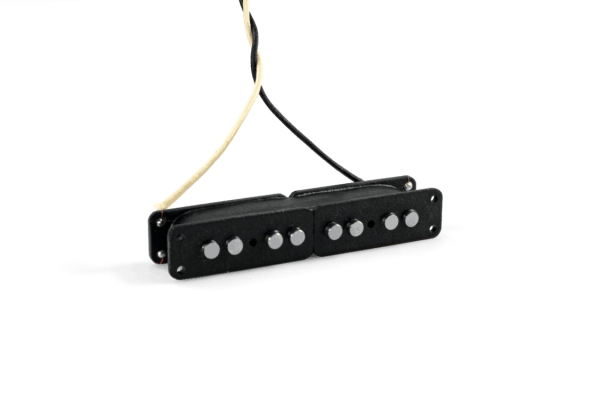
There are plenty of side-by-side jazz bass hum cancelling pickups..... but they don't quite sound like a single coil.
Here's a good example of the Lindy Fralin ones which are described on their website as sounding a little thicker than their single coils.
It really is just a Pbass pickup without the two halves being staggered.
Split-Jazz-Bass-e1567793712766-600x400.png
Not really. The only P in one pickup that I know and even then they say it is just an approximation are the Delano Quad coils (SBC-E). With a switch you can emulate the staggered position, however you still have the other coils exerting magnetic influence even when turned off.

PS - They also have the dual coil in line humbucker is a Jazz format - JSBC. That may be the closest to a P in a J that I know.
 
  • Like
Reactions: Alessandro Cruz
Have tried both stacked and side by side versions. Neither type sounds like a single coil to my ears. The DiMarzio model J sounds like a compressed, brighter P bass and the mongrel stacked pickup sounds kind of like a J only with less character. Quiet, but bland.

The DiMarzio Model J is one of the darker versions of a split coil J. It's not designed to try to sound like a normal J. It's middy and wooly. For a normal Jazz tone without noise you want the Ultra Jazz or the Area J, if you're shopping DiMarzio.
 
  • Like
Reactions: jamro217
You are missing some subtle, but very important points in your understanding of the theory involved here. For starters, series vs parallel has nothing to do with the scoop - that is all due to combining two pickups at different places.

Your other conclusions are also not true, when applied to split coils, but I’ll leave out the explanations for brevity.

That’s all a little weirdly different from what I’ve heard about wiring things parallel and series, and what people say about split coils and the like. I haven’t experimented with different pickups and tried experimental rewiring things etc. to know for sure myself.
 
Very good analogy ^

OP, I'm sure it has been stated somewhere in the following 4 pages of replies, but your best bet if that's your goal is either the stacked singles or (gulp) active pickups. :bag:
Thanks, but I only started the thread out of pure curiosity. As usual, here on TB the snowball starts and every input brings something really concrete and informative, to the discussion! Doing some maintenance on basses, I reminded that on one of my two J clones I have a standard Bartolini J on the neck but a very strange Bartolini on the bridge: it has lots of wires and it seems to be made by different bobbins grouped. I cannot exactly recall how many (I assembled it more than 20 years ago), but when it arrived at home (bought second hand unseen for a few euros: what can be wrong...) I realized that it was a weird, never seen before, pickup. I mounted it and it works. Signal seems a bit weaker vs. the neck one, but it is ok...