• TalkBass has been independent since 1998. Add your voice.
    Create a free account to reply to discussions, view embedded media, and browse with fewer display ads.
    Join freeLog in
    Want zero display ads or expanded classifieds tools? Compare plans.

Squier Owners Club

This works perfectly, but make sure to ground the shielding tape or shielding paint that's in the control cavity for it to work properly. My advice is still, If you don't have some hum issue, don't add shielding. Don't fix what ain't broke. :D My opinion only, but it's worked for me.

It's all grounded at the bridge (connected to the ground of the jack) usually, through a wire that runs from under the bridge to one of the pots grounds, that's in turn, connected to the rest of the shielding via the PG/cavity shield. This is how it's done on all modern P's, at least.
 
Last edited:
  • Like
Reactions: BlueTalon
The aluminum pickguard is not ferrous, so it imparts no change to the magmatism of the pick up. It is conductive and does impart a shielding effect like shielding tape or paint. It is grounded through the sleeve of the output jack and the nuts and washers used. This is the same as the shielding tape used under the pots and jacks on PVC pickguards. The effects of the shielding is much less noticeable as the split coils of a Precision pickup is humbucking already. Also, the pots and jack are barely affected by RF interference, as there are no coils to pickup the RF waves.
Rheostats, not always, but commonly use copper coils to adjust voltage flow. These coils can be inductive to RF interference. Potentiometers (pots) normally use carbon as the resistive material. The carbon is nowhere near as sensitive to RF signals. Shielding isn't needed in control cavities, but doesn't hurt, as long as the hot wires aren't grounding out on the shielding.
 
The aluminum pickguard is not ferrous, so it imparts no change to the magmatism of the pick up. It is conductive and does impart a shielding effect like shielding tape or paint. It is grounded through the sleeve of the output jack and the nuts and washers used. This is the same as the shielding tape used under the pots and jacks on PVC pickguards. The effects of the shielding is much less noticeable as the split coils of a Precision pickup is humbucking already. Also, the pots and jack are barely affected by RF interference, as there are no coils to pickup the RF waves.
Rheostats, not always, but commonly use copper coils to adjust voltage flow. These coils can be inductive to RF interference. Potentiometers (pots) normally use carbon as the resistive material. The carbon is nowhere near as sensitive to RF signals. Shielding isn't needed in control cavities, but doesn't hurt, as long as the hot wires aren't grounding out on the shielding.
Good explanation! Many thanks!

Also, and a bit to my embarrassment, I completely forgot about the connection between the output jack and the top of the pickguard. My bad! :facepalm: It just goes to show that I'm more of a J-guy than a P-guy. (Talk about a "blind-spot"! :whistle:)
 
  • Like
Reactions: C Stone and jglunt
Does the pickguard being metal effect the tone of the bass at all?


Yeah I will have a play with it at some point. I'm sure as I progress i'll start to look at pedals and effects :roflmao:


Frankly some bass-players avoid pedals like the plague whereas most guitarists use pedals of some number & variety. This is because usually a guitarist is the one effecting multiple effects in a song/performance whereas a bass player is sometimes just playing bass. I play in two bands with only one guitarist so end up taking on the middle-ground between bass & guitar (rhythm/colour) so I have a 'healthy' pedal train.

This collection was used for a recent recording session - L-R; BBE Sonic Stomp (tone-shaping filter - always on), Electro Harmonics B9, BOSS RV-6 Reverb(always on), MXR d.i.+, BOSS TR-2 Tremolo, MXR Bass Chorus Deluxe, BOSS CS-2 Compressor/Expander (always on), MXR Bass Fuzz Deluxe, and BOSS TU-2 tuner.

Pedals are a wild and whacky universe. I would recommend using/buying one only when you want/need a/that specific sound/tone.

upload_2024-4-5_18-9-55.jpeg
 
  • Like
Reactions: SeaDunk
Does the metal reach through past the PVC to the electronics? I could be mistaken, but was under the idea that to achieve proper sheilding, one had to have the electronics wrapped up with little/no gaps.

For guitar/bass shielding, the goal is to create a compartment that is all shielded with carbon paint, copper or aluminum tape. (or a combination) Star-grounding is the next step - grounding (soldering) a wire to each pu cavity and control cavity into one ground connection at the jack. Shielding the pg (around the pu openings) & control plate (at least to the overlap) is also part of this. No matter how thorough your shielding - singles will inevitably 'hum' - no way around that unless you go split-coil/hum-cancelling.
 
Good explanation! Many thanks!

Also, and a bit to my embarrassment, I completely forgot about the connection between the output jack and the top of the pickguard. My bad! :facepalm: It just goes to show that I'm more of a J-guy than a P-guy. (Talk about a "blind-spot"! :whistle:)

My '66 P bass has no bridge ground. Never had. Also, it only has a floor-mounted copper plate and thin aluminum pg under-layer. Grounding in 1966.
 
Last edited:
  • Like
Reactions: Malak the Mad
For guitar/bass shielding, the goal is to create a compartment that is all shielded with carbon paint, copper or aluminum tape. (or a combination) Star-grounding is the next step - grounding (soldering) a wire to each pu cavity and control cavity into one ground connection at the jack. Shielding the pg (around the pu openings) & control plate (at least to the overlap) is also part of this. No matter how thorough your shielding - singles will inevitably 'hum' - no way around that unless you go split-coil/hum-cancelling.
With respect, the circuitry in a P bass isn't complex enough to require a star ground (or a J bass either, for that matter). Essentially, the shielding of the cavity is the center of the "star" in a star ground. It doesn't matter where you connect to it, electrically it's the same point.
 
With respect, the circuitry in a P bass isn't complex enough to require a star ground (or a J bass either, for that matter). Essentially, the shielding of the cavity is the center of the "star" in a star ground. It doesn't matter where you connect to it, electrically it's the same point.
An audio / video engineer friend of mine says simply, "A ground is a ground." I don't try to solder a bunch of wires to that Itty bitty tab on a jack. I run a ground wire from the jack to the back of a pot, usually the tone pot since that's the closest. Then, I run one from that pot across to another pot, etc. That way, each pot is grounded, and that gives me convenient places to ground things like the bridge, the pickups, and the shielding. It's simple. It works.
 
An audio / video engineer friend of mine says simply, "A ground is a ground." I don't try to solder a bunch of wires to that Itty bitty tab on a jack. I run a ground wire from the jack to the back of a pot, usually the tone pot since that's the closest. Then, I run one from that pot across to another pot, etc. That way, each pot is grounded, and that gives me convenient places to ground things like the bridge, the pickups, and the shielding. It's simple. It works.

he’s right. I do the same. A ground is a ground, whether it’s cars, basses or houses electricity doesn’t change how it works.
 
  • Like
Reactions: jglunt
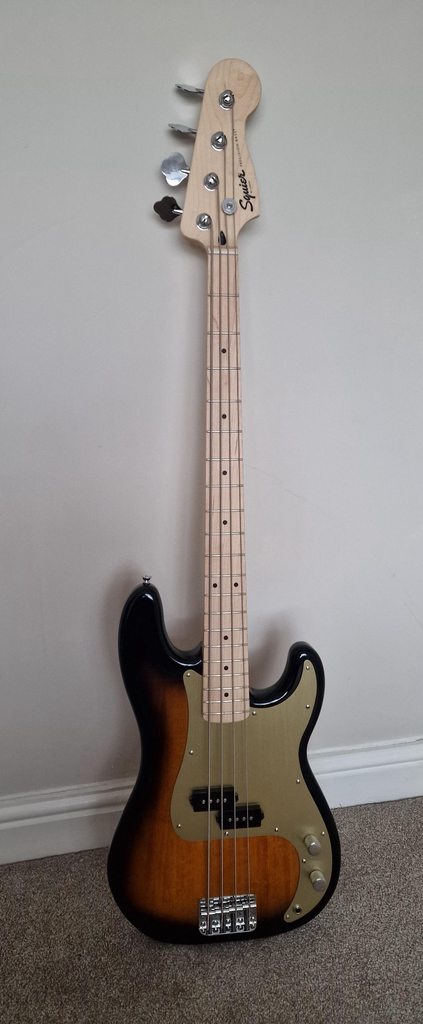
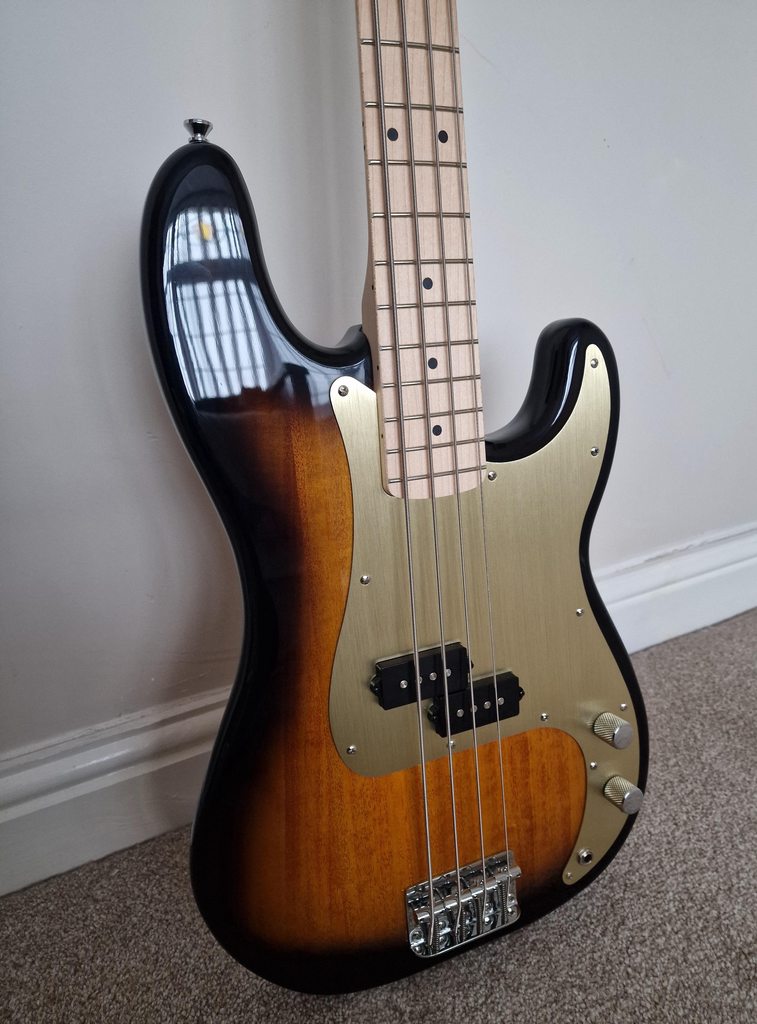
Off the back of the recommendations from @blr2 & @MadJack for a Alu Gold Pickguard for the Sonic Precision, I went and ordered one off Amazon. Arrived today. It was a bit sharp around the edges, but a light rub of sandpaper took the sharp edges off. Fitted spot on, required no filing or anything. It came with Gold screws but I used the original chrome ones for the classic look

K2ipmk3h.jpg

fadVAJSh.jpg
 
Off the back of the recommendations from @blr2 & @MadJack for a Alu Gold Pickguard for the Sonic Precision, I went and ordered one off Amazon. Arrived today. It was a bit sharp around the edges, but a light rub of sandpaper took the sharp edges off. Fitted spot on, required no filing or anything. It came with Gold screws but I used the original chrome ones for the classic look

K2ipmk3h.jpg

fadVAJSh.jpg
Looks great! Like a '57 when they were new! :thumbsup:
 
  • Like
Reactions: SeaDunk
I just pulled my Squier '51 Precision, Tele style, down off the wall today after too long hanging there. Tuned it, plugged it in after noodling on other Squiers and a Fury that I have, I gave it a short run. I know when I bought it, we worked on the action and got it right, but I was somewhat taken back by what this bass sounded like. The other basses sounded great with the amp set like it was, but this Tele was trebly, scratchy, and you could hear every scratch that my finger made against the strings. I don't know what pickup these basses come with, but I'm ONLY looking for that deep, fat country bass sound with the treble almost all the way rolled off on the bass. What do I need to change to to get the sound like the 70's CV I have that sounds great. I'm ready for a change, but don't know what I need...thanks for your help.
 
  • Like
Reactions: C Stone
I just pulled my Squier '51 Precision, Tele style, down off the wall today after too long hanging there. Tuned it, plugged it in after noodling on other Squiers and a Fury that I have, I gave it a short run. I know when I bought it, we worked on the action and got it right, but I was somewhat taken back by what this bass sounded like. The other basses sounded great with the amp set like it was, but this Tele was trebly, scratchy, and you could hear every scratch that my finger made against the strings. I don't know what pickup these basses come with, but I'm ONLY looking for that deep, fat country bass sound with the treble almost all the way rolled off on the bass. What do I need to change to to get the sound like the 70's CV I have that sounds great. I'm ready for a change, but don't know what I need...thanks for your help.
With Fender 9050 flats you should be able to get more thump just give ‘em time to break in or TI flats should tame that ‘51, they can be crispy critters. :thumbsup:
 
Thanks for your advice, but I'm interested in a pickup change to get the sound I want. I only play country, and a little bluegrass now and then, and I don't want to wait for strings to break in. No more than I play, I want it ready when I go for it. I am using Fender black tapewounds on all my basses and I really like them.
 
  • Like
Reactions: C Stone

Latest posts