
Going a bit off topic here, but while we are on it. Most, if not all, of these commercially available products contain anything between 85 to over 95 % liquid paraffin (mineral oil). While this doesn't harm your dark wood board, it doesn't do it any good either. You can easily formulate your own (at about the same price) that will be much better, and I'm not talking about some cooking oil.

Enjoy the benefits of a premium membership!
Upgrade Account
-
TalkBass has been independent since 1998. Add your voice.
Create a free account to reply to discussions, view embedded media, and browse with fewer display ads.
Join free Log in
Want zero display ads or expanded classifieds tools? Compare plans.
You are using an out of date browser. It may not display this or other websites correctly.
You should upgrade or use an alternative browser.
You should upgrade or use an alternative browser.
Squier Owners Club
- Thread starter Bassplayer_479
- Start date
-
- Tags
- club
More options
Who Replied?
- Jun 30, 2010
- 49,591
- 221,978
- Disclosures
- musician/artist/owner - Gildaxe
Going a bit off topic here, but while we are on it. Most, if not all, of these commercially available products contain anything between 85 to over 95 % liquid paraffin (mineral oil). While this doesn't harm your dark wood board, it doesn't do it any good either. You can easily formulate your own (at about the same price) that will be much better, and I'm not talking about some cooking oil.
Philip Kubicki told me years ago (on the phone) that you can use baby-oil to nourish the fb wood. The point is to keep the wood from drying out which will potentially lead to shrinkage & warping of the neck.

Baby oil is 100 % purified mineral oil. Yes, you can use it, but all the claims about nourishing and wood care is complete BS. At least it's cheaper than guitar products, although it's still way overpriced. Even cheaper is pure mineral oil from the drugstore. If you insist to use it, at least don't waste your cash on fretboard oils, get this instead.Philip Kubicki told me years ago (on the phone) that you can use baby-oil to nourish the fb wood. The point is to keep the wood from drying out which will potentially lead to shrinkage & warping of the neck.
- Jun 30, 2010
- 49,591
- 221,978
- Disclosures
- musician/artist/owner - Gildaxe
Baby oil is 100 % purified mineral oil. Yes, you can use it, but all the claims about nourishing and wood care is complete BS. At least it's cheaper than guitar products, although it's still way overpriced. Even cheaper is pure mineral oil from the drugstore. If you insist to use it, at least don't waste your cash on fretboard oils, get this instead.
...and you are?
You are making me to write something that I normally wouldn't, but here it goes, who am I:...and you are?
I have a PhD in chemistry (since 2001 in chemistry of cellulose), and currently work as a manager for R&D and formulation for a medium size European company. Nothing to do with guitars though. However, being in my position, I have access to thousands of formulations for all sorts of consumer products, including the ones in question here.
I've played bass since late 80's, and learned to set and maintain my instruments. I've had in total about 25 instruments for the past 35 years. I'm not a luthier, but I can perform some simple operations, like fret leveling, crowning, cutting nuts, changing tuners PUs, pots... Throughout the years I've got a collection of good quality tools and some knowledge to do it.
That's who I'm in short, and who are you?
Last edited:

Perhaps you don't like writing about yourself, but I think a lot of people here will appreciate knowing these things about you.You are making me to write something that I normally wouldn't, but here it goes, who am I:
I have a PhD in chemistry (since 2001), and currently work as a manager for R&D and formulation for a medium size European company. Nothing to do with guitars though. However, being in my position, I have access to thousands of formulations for all sorts of consumer products, including the ones in question here.
I've played bass since late 80's, and learned to set and maintain my instruments. I've had in total about 25 instruments for the past 35 years. I'm not a luthier, but I can perform some simple operations, like fret leveling, crowning, cutting nuts, changing tuners PUs, pots... Throughout the years I've got a collection of good quality tools and some knowledge to do it.
I was asked.Perhaps you don't like writing about yourself, but I think a lot of people here will appreciate knowing these things about you.

Guitar Honey is a mineral oil based formula and blended with high grade mineral spirits as a cleaner, it works fantastic for that, the boards I have
used this product on look much better.
It also already comes bottled with a micro-mister! lol. I think I paid $4.99
and it goes a long way. Just not at all worried about a pinching a few pennies.
used this product on look much better.
It also already comes bottled with a micro-mister! lol. I think I paid $4.99
and it goes a long way. Just not at all worried about a pinching a few pennies.

Attachments

As an eBay Associate, TalkBass may earn a commission from qualifying purchases.
- Jun 30, 2010
- 49,591
- 221,978
- Disclosures
- musician/artist/owner - Gildaxe
You are making me to write something that I normally wouldn't, but here it goes, who am I:
I have a PhD in chemistry (since 2001 in chemistry of cellulose), and currently work as a manager for R&D and formulation for a medium size European company. Nothing to do with guitars though. However, being in my position, I have access to thousands of formulations for all sorts of consumer products, including the ones in question here.
I've played bass since late 80's, and learned to set and maintain my instruments. I've had in total about 25 instruments for the past 35 years. I'm not a luthier, but I can perform some simple operations, like fret leveling, crowning, cutting nuts, changing tuners PUs, pots... Throughout the years I've got a collection of good quality tools and some knowledge to do it.
That's who I'm in short, and who are you?
I will get back with you after discussing this with a journeyman luthier here on tb -
I will get back with you after discussing this with a journeyman luthier here on tb -
Sure, but this is not very important. As I wrote above, treating your FB with mineral oil will not harm it (as long as you don't apply too often), just paying for nothing. Besides, you don't have to trust me or any "journeyman luthier", ask seasoned woodworkers. Haven't heard any of them using mineral oil, but then again, who am I to know...
- Jun 30, 2010
- 49,591
- 221,978
- Disclosures
- musician/artist/owner - Gildaxe
Sure, but this is not very important. As I wrote above, treating your FB with mineral oil will not harm it (as long as you don't apply too often), just paying for nothing. Besides, you don't have to trust me or any "journeyman luthier", ask seasoned woodworkers. Haven't heard any of them using mineral oil, but then again, who am I to know...
Hah! As if a journeyman luthier is not a seasoned woodworker. You're cracking me up!
Last edited:

I kinda like the baby oil idea. Think of how sweet it will make your bass smell, or your fretting hand, or the inside of your case or gig bag. Every time you open that case, you'll get to experience that sweet, fresh scent again. Your music room will smell like the baby changing station in a Walmart between the baby oil on the fretboard of the bass hanging on the wall and the numerous farts that have been ripped in there.
If he/she is, then he/she wouldn't use mineral oil on unfinished wood. AGAIN, this is not important. The vast majority of unfinished FB guitar owners have never oiled their boards, and nothing bad had happened to their instruments for decades. Even if you are in the minority who oil the board, you shouldn't do it more often then twice a year. In fact, there are probably more instruments that have been harmed by overdoing it, than not doing it.Hah! As if a journeyman luthier is not a seasoned woodworker.
- Jun 30, 2010
- 49,591
- 221,978
- Disclosures
- musician/artist/owner - Gildaxe
If he/she is, then he/she wouldn't use mineral oil on unfinished wood. AGAIN, this is not important. The vast majority of unfinished FB guitar owners have never oiled their boards, and nothing bad had happened to their instruments for decades. Even if you are in the minority who oil the board, you shouldn't do it more often then twice a year. In fact, there are probably more instruments that have been harmed by overdoing it, than not doing it.
Ok.., I'll admit to being misinformed as many people apparently are. But.., after being graciously educated by a luthier extraordinaire - (woodworker/metalsmith/fabricator/bass-builder - many people on tb know who I'm talking about) - I now know.
The real reason oiling a fb is not necessary is because there's no such thing as a "bare wood" fingerboard on an instrument built by any manufacturer or small builder. They would be nuts to send an instrument out with no treatment at all on the fingerboard. A fingerboard that looks like it's bare wood has been coated with a penetrating, hardening sealer of some kind. It sinks down into the pores and hardens, and the excess is wiped off the surface. If you build an instrument, or put on a new fresh fingerboard, you must give it a coat or two of penetrating sealant. Most apply it after the final sanding, before putting in the frets. If you don't, there's a high risk that the fingerboard will swell up and crack when it gets out in the field. This application of the penetrating sealant is one-time and permanent. It does not need to be refreshed regularly. The only time it should be applied to an existing instrument fingerboard is if you have done a re-surfacing and taken some material off.
Not both wrong - both lacking information specific to the craft.

Sorry for the shameless post, I figured y'all would want to know...
The real reason oiling a fb is not necessary is because there's no such thing as a "bare wood" fingerboard on an instrument built by any manufacturer or small builder. They would be nuts to send an instrument out with no treatment at all on the fingerboard. A fingerboard that looks like it's bare wood has been coated with a penetrating, hardening sealer of some kind.
Don't know about the boutique/luthier instruments, but the rosewood FB on ordinary production ones are untreated. The way a brand new board like this absorbs liquids is the proof.
PS: There is no such thing like "penetrating hardening sealer" that would leave a surface that looks and acts (i.e. absorbs liquids) as untreated. Besides, such treatment is not needed.
So the Sonic arrived today. Everything seems in order. I can’t be too picky about an entry level instrument but very impressed so far. I haven’t owned a fretted bass in over thirty years(!) so it’s a bit different to play. Liking the 1.5 neck so far. Gotta source a pickguard though.
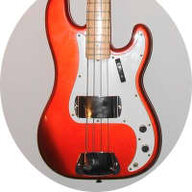
NBD. Picked this up at my local GC yesterday. It looks like it was mfg. by Taiwanese Yako in 2018. Is that correct? Are the knobs and PG add-ons?
Attachments


Last edited:


