

I bought myself a Squier VM Telecaster Bass as an after-Christmas project. Here are the results:
1) The bass has a 32-inch scale. My hands don’t like 34-inch scale anymore. This raises issues with strings. The GDA strings are my favorite Fender 9050 45-60-80. I like them even better on this bass as the shorter scale causes them to have the same lowered tension as a conventional bass tuned down to Eb, making them easier on the hands. Note the A string wraps right to the edge of the speaking length at the post, but not further. But for the E string I had to use a DR Legend stainless steel flat 105, as it was the only flat wound E string I could find that was stainless (not chrome or nickel), proper scale for the bass, and 105 gauge. Fortunately, the tone coordinates well enough, so I bought a spare. Yes, La Bella makes medium scale flat wound strings, but the “old school” tone of La Bellas is the opposite of the growl of the 9050’s. But I might try them as some point.
2) Narrowed bridge spacing. The bridge, even though styled as a ’51 style bridge with brass saddles, is narrower: @ 2 1/8 inches G-E rather than the vintage 2 1/2, which is preferable for my right hand. But because of this, the string spacing over the pickup is narrower, and I could not find anybody to make me a split coil ’51 style humbucking pickup. The physics and required coil geometry for the tone just aren’t gonna happen.
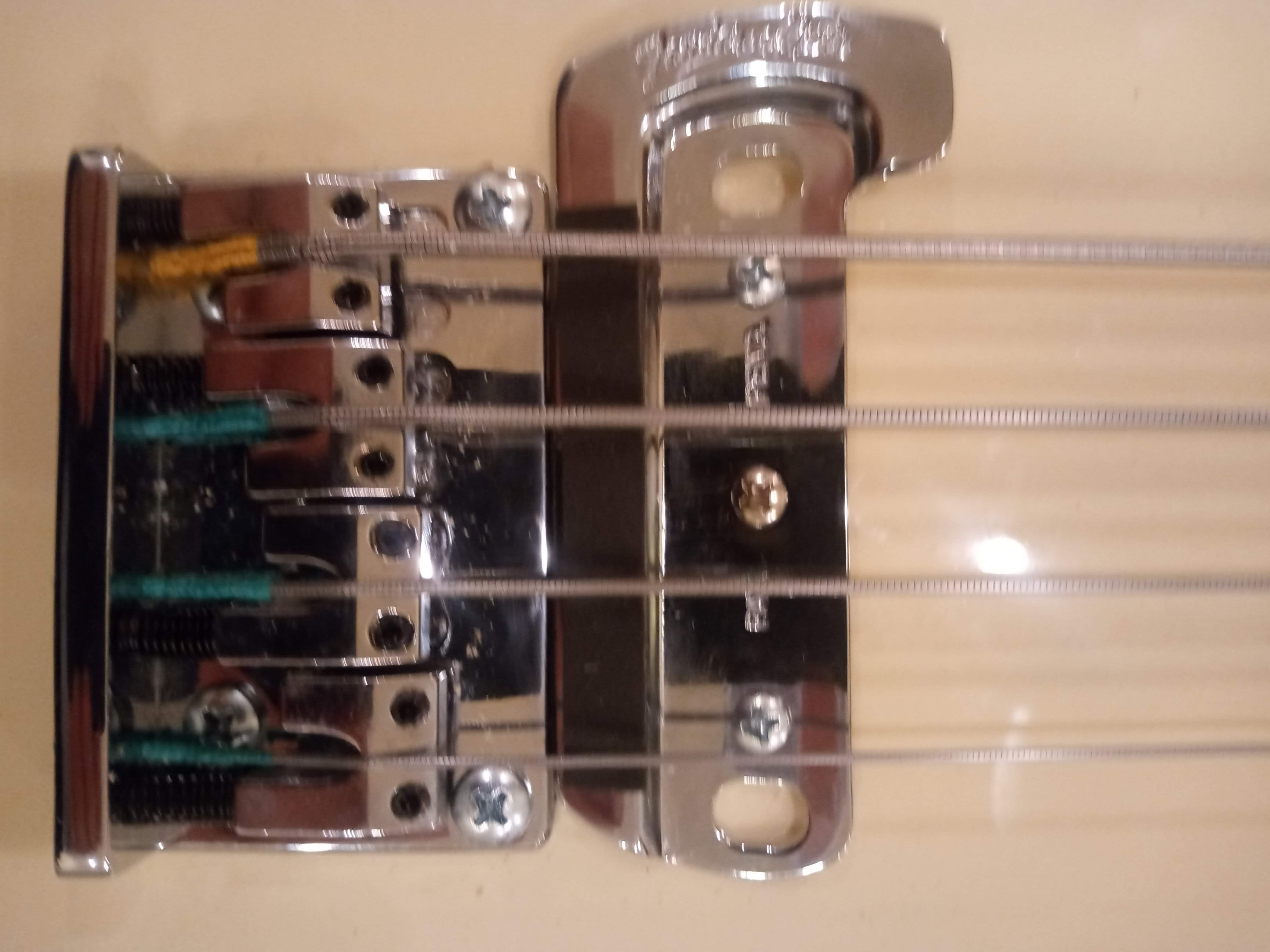
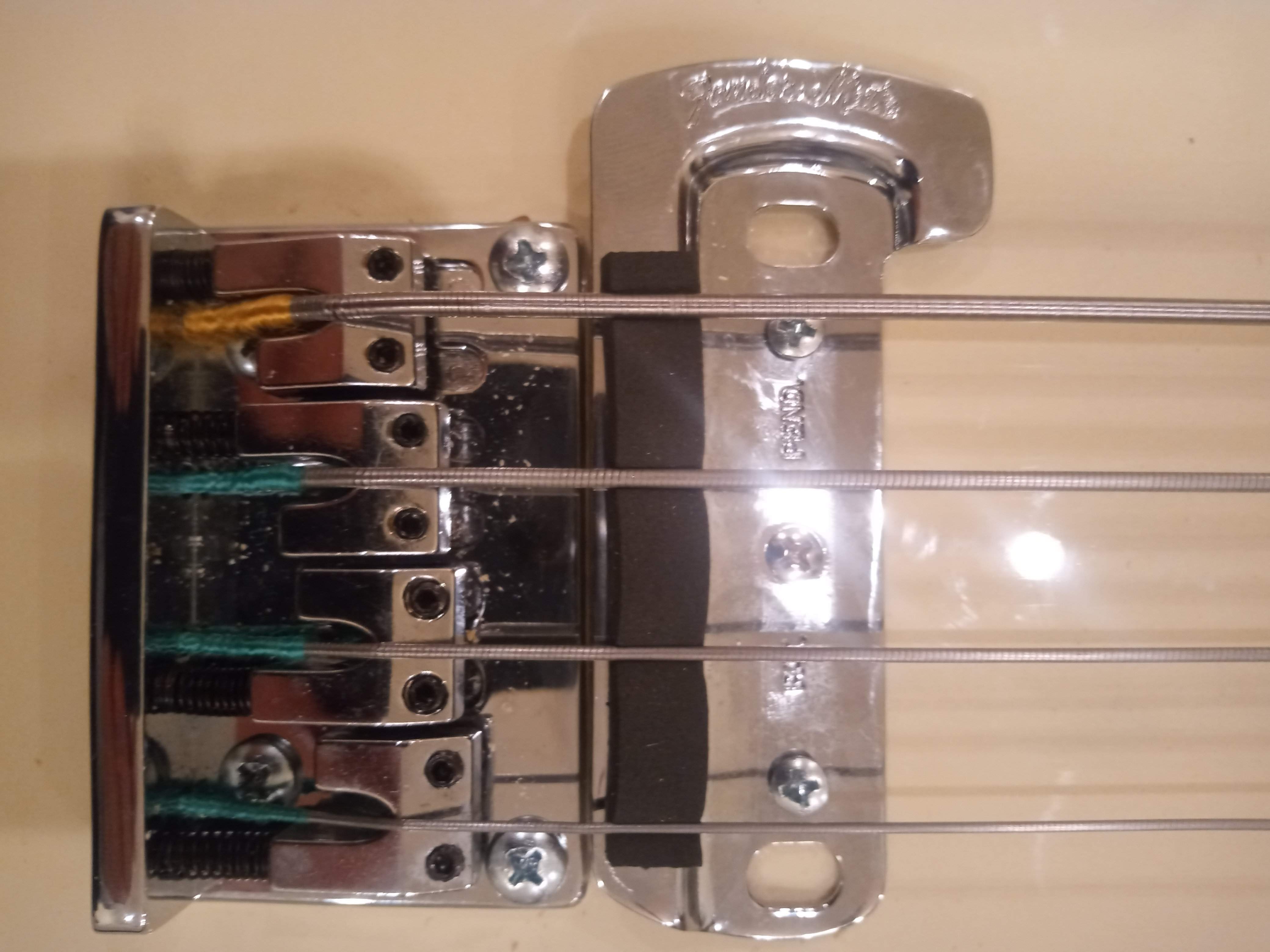
3) The mute. After reading this thread Installing a Jaguar mute on a P-Bass | TalkBass.com I had to have a mute. I found Fender reproduction parts at a reasonable cost.
4) The wiring on this bass is original. The three tones are really, really, good and different: 1) the dub tone actually has character, not just thump; 2) the conventional V-T setting is very versatile; and 3) the baritone is more than just a simple bass cut in-line capacitor, and to my ears contours the midrange to make the setting a true baritone.
5) The Poplar body has just enough more mids than an alder body to bring out the tone of the growly Fender 9050 flats without going nasal. When these strings die a decade or two from now, I might go with Ernie Bass stainless flats, which have a similar, but more subdued character.
6) I do not own any instrument for “collector” value or “vintage” value. To me, all my instruments must be ready to gig as required or desired. So I changed out the bridge for this one: 4 String Bass Bridge For Bass Guitar L Shape Saddle 18mm Spacing Chrome 634458184885 | eBay . The G string grooves in the plate only come out so far, dictating a placement that resulted in having to trim the intonation screws and springs on the A and E string saddles for the saddles to go back far enough. Yes, I drilled for oversized mounting screws so I could lock that bridge down and have maximum sustain.
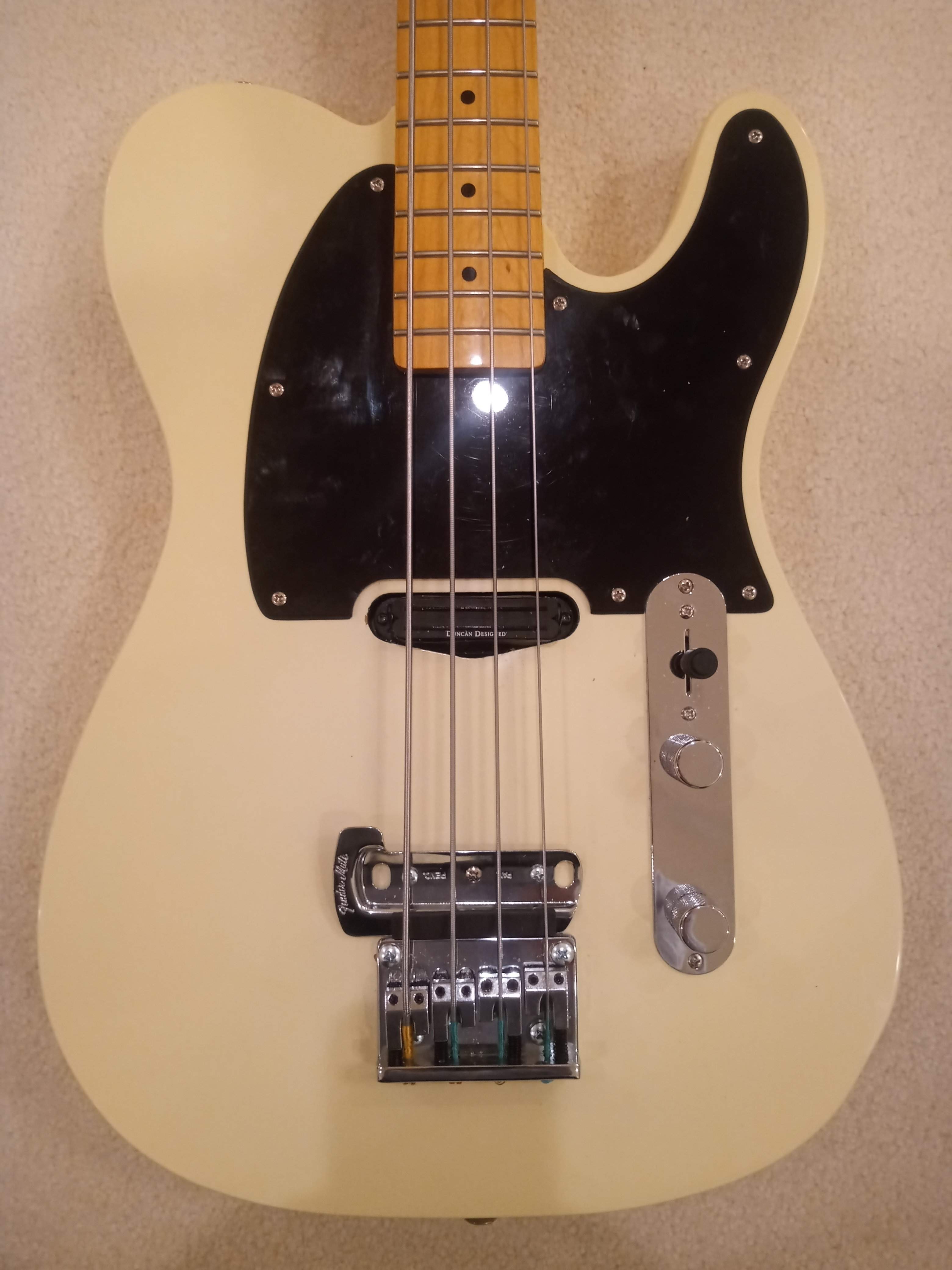
7) The pickup. I wondered why the stock pickup pole pieces are spaced E-G 1 15/16 inches, instead of the 2 inches actual measured string spread at that point. It turns out the Duncan Designed ’51 style bass pickup is not a purpose-designed pickup just for that model bass, despite the name. After research, I found it is a Vista-Tone bass pickup with a different name printed on the top of the bobbin. Compare the two: same pickup visually, same bobbins, same single coil with @ 9 kohms’ worth of wire; same diameter pole pieces spaced the same. The only difference I can find is the label: “Duncan Designed” rather than “Vista-Tone.” No, CBS style corporate recycling is not dead.
8) Those who have seen my posts over the years will confirm that I advocate a rails-type humbucking Strat pickup as the standard replacement for deficient MusicMaster and Bronco pickups, a relatively simple swap as they are the same size. I put my money where my mouth is: I found a used Duncan Designed version of a Hot Rails on-line inexpensively. It has about 12 kohms’ worth of wire on it, so it also has a little bit of mid push, but not so much that the desirable growl of the 9050 flats becomes nasal, hard or forced.
9) Neck. My neck is great. It is a slab neck with essentially zero run-out of the grain. You can see the end grain freckles in a straight line all the way from the nut to the butt on both edges, with tight rings when you look at the end of the butt, which show it is a well-made stable neck carved out of a great piece of wood. It fits my hand better with a 1.7 inch wide nut and 2.38 inch wide butt, which is, of course, wider than a J-bass or some P-Basses at the nut, and narrower than 2.5 inch Fender standard at the butt. Why 1.7 at the nut? Hmmm. I did some reverse math, and that is approximately the width of a P-bass at the first fret, which is two inches from the nut on a 34-inch scale.
10) Some of the earlier posts in the mute thread talk about the foam rubber damping the strings either too much or too little. The plate that I bought has a crown radius formed into the edge for the foam that matches the fretboard of the bass, keeping the damping even. Others may not. And to get the balance just right, as set forth in post #13 on that thread, the height of each of the two outboard screws can be raised or lowered to raise or lower either side of the mute to the desired amount of damping.
Well, there you have it: the realization in one instrument of many of the design elements I advocate in good passive 4-string bass design. Two niggles: 1) the bass would benefit from a reversed headstock to obviate any issues about using regular long scale strings; and 2) the poplar body is heavier than I would like. But the body weight does keep the bass from having neck dive with stock tuners. So, I will not be changing out the tuners for Hipshot Ultralites, as I have done on most of my other basses.
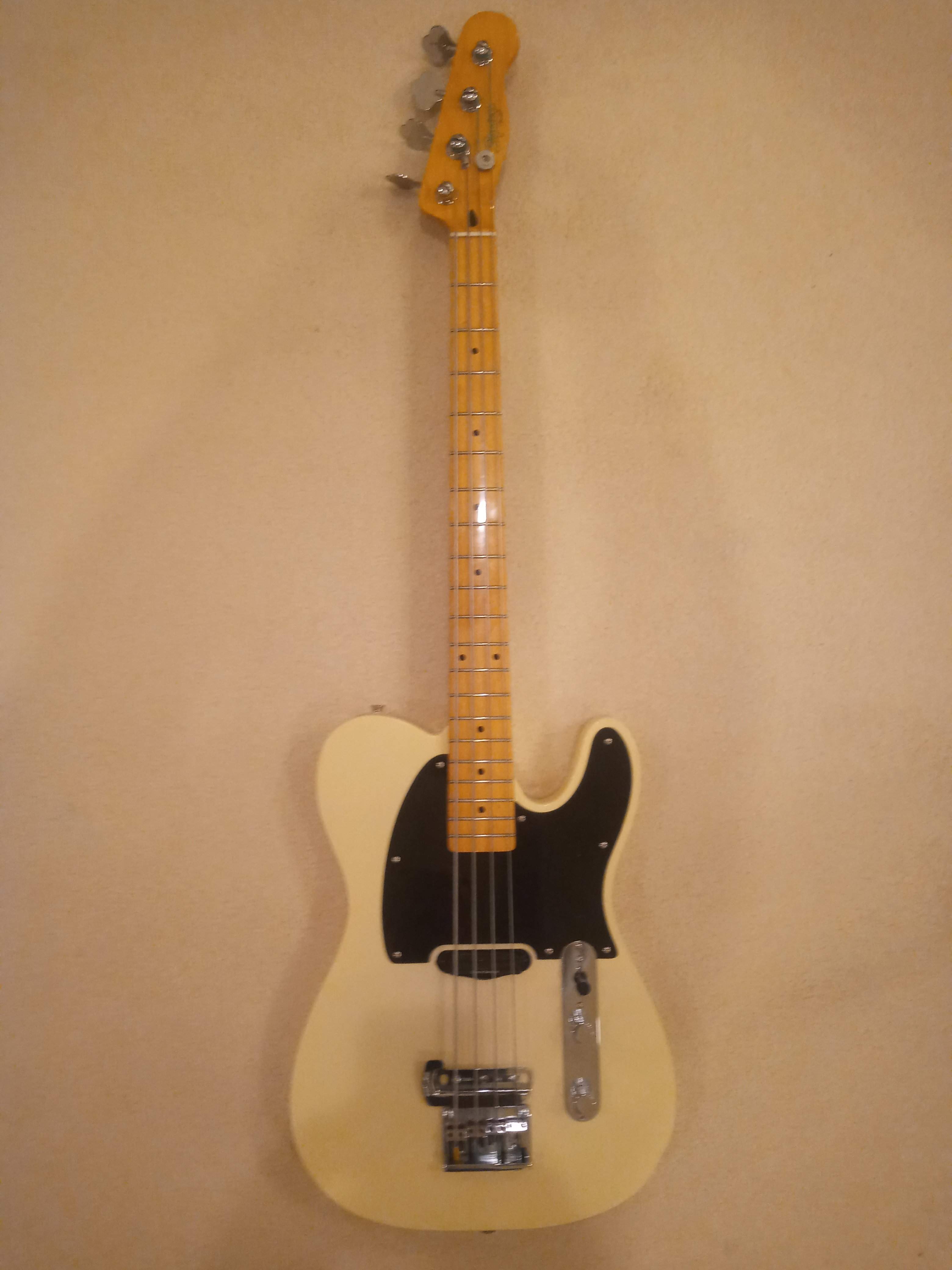
1) The bass has a 32-inch scale. My hands don’t like 34-inch scale anymore. This raises issues with strings. The GDA strings are my favorite Fender 9050 45-60-80. I like them even better on this bass as the shorter scale causes them to have the same lowered tension as a conventional bass tuned down to Eb, making them easier on the hands. Note the A string wraps right to the edge of the speaking length at the post, but not further. But for the E string I had to use a DR Legend stainless steel flat 105, as it was the only flat wound E string I could find that was stainless (not chrome or nickel), proper scale for the bass, and 105 gauge. Fortunately, the tone coordinates well enough, so I bought a spare. Yes, La Bella makes medium scale flat wound strings, but the “old school” tone of La Bellas is the opposite of the growl of the 9050’s. But I might try them as some point.
2) Narrowed bridge spacing. The bridge, even though styled as a ’51 style bridge with brass saddles, is narrower: @ 2 1/8 inches G-E rather than the vintage 2 1/2, which is preferable for my right hand. But because of this, the string spacing over the pickup is narrower, and I could not find anybody to make me a split coil ’51 style humbucking pickup. The physics and required coil geometry for the tone just aren’t gonna happen.
3) The mute. After reading this thread Installing a Jaguar mute on a P-Bass | TalkBass.com I had to have a mute. I found Fender reproduction parts at a reasonable cost.
4) The wiring on this bass is original. The three tones are really, really, good and different: 1) the dub tone actually has character, not just thump; 2) the conventional V-T setting is very versatile; and 3) the baritone is more than just a simple bass cut in-line capacitor, and to my ears contours the midrange to make the setting a true baritone.
5) The Poplar body has just enough more mids than an alder body to bring out the tone of the growly Fender 9050 flats without going nasal. When these strings die a decade or two from now, I might go with Ernie Bass stainless flats, which have a similar, but more subdued character.
6) I do not own any instrument for “collector” value or “vintage” value. To me, all my instruments must be ready to gig as required or desired. So I changed out the bridge for this one: 4 String Bass Bridge For Bass Guitar L Shape Saddle 18mm Spacing Chrome 634458184885 | eBay . The G string grooves in the plate only come out so far, dictating a placement that resulted in having to trim the intonation screws and springs on the A and E string saddles for the saddles to go back far enough. Yes, I drilled for oversized mounting screws so I could lock that bridge down and have maximum sustain.
7) The pickup. I wondered why the stock pickup pole pieces are spaced E-G 1 15/16 inches, instead of the 2 inches actual measured string spread at that point. It turns out the Duncan Designed ’51 style bass pickup is not a purpose-designed pickup just for that model bass, despite the name. After research, I found it is a Vista-Tone bass pickup with a different name printed on the top of the bobbin. Compare the two: same pickup visually, same bobbins, same single coil with @ 9 kohms’ worth of wire; same diameter pole pieces spaced the same. The only difference I can find is the label: “Duncan Designed” rather than “Vista-Tone.” No, CBS style corporate recycling is not dead.
8) Those who have seen my posts over the years will confirm that I advocate a rails-type humbucking Strat pickup as the standard replacement for deficient MusicMaster and Bronco pickups, a relatively simple swap as they are the same size. I put my money where my mouth is: I found a used Duncan Designed version of a Hot Rails on-line inexpensively. It has about 12 kohms’ worth of wire on it, so it also has a little bit of mid push, but not so much that the desirable growl of the 9050 flats becomes nasal, hard or forced.
9) Neck. My neck is great. It is a slab neck with essentially zero run-out of the grain. You can see the end grain freckles in a straight line all the way from the nut to the butt on both edges, with tight rings when you look at the end of the butt, which show it is a well-made stable neck carved out of a great piece of wood. It fits my hand better with a 1.7 inch wide nut and 2.38 inch wide butt, which is, of course, wider than a J-bass or some P-Basses at the nut, and narrower than 2.5 inch Fender standard at the butt. Why 1.7 at the nut? Hmmm. I did some reverse math, and that is approximately the width of a P-bass at the first fret, which is two inches from the nut on a 34-inch scale.
10) Some of the earlier posts in the mute thread talk about the foam rubber damping the strings either too much or too little. The plate that I bought has a crown radius formed into the edge for the foam that matches the fretboard of the bass, keeping the damping even. Others may not. And to get the balance just right, as set forth in post #13 on that thread, the height of each of the two outboard screws can be raised or lowered to raise or lower either side of the mute to the desired amount of damping.
Well, there you have it: the realization in one instrument of many of the design elements I advocate in good passive 4-string bass design. Two niggles: 1) the bass would benefit from a reversed headstock to obviate any issues about using regular long scale strings; and 2) the poplar body is heavier than I would like. But the body weight does keep the bass from having neck dive with stock tuners. So, I will not be changing out the tuners for Hipshot Ultralites, as I have done on most of my other basses.
Last edited:
As an eBay Associate, TalkBass may earn a commission from qualifying purchases.


