• TalkBass has been independent since 1998. Add your voice.
    Create a free account to reply to discussions, view embedded media, and browse with fewer display ads.
    Join freeLog in
    Want zero display ads or expanded classifieds tools? Compare plans.

Steinberger Club

For all those who can't read German, here is an English review of the fretless CR5, including sound samples:

PremierGuitar

Interesting fact: two out of three reviews I've read so far falsely state a wooden fretboard… it's phenolic, and I think this sheds some light on the psychological aspects of those "no plastic, only ebony for me" naysayers ;)

Bernd

According to the NS Design site, it is ebony:

"The fingerboard is ebony, with a 35" scale and familiar 15" radius. "
 
According to the NS Design site, it is ebony:

"The fingerboard is ebony, with a 35" scale and familiar 15" radius. "

Wow, now that's surprising me. According to the PDF flyer they had published in March this year it's phenolic, but I see that they have also updated this PDF brochure. It also says ebony now. So now I need to go home and make a few scratches into my fretboard for an indepth analysis…

Maybe I'll be able to find out what the current truth is.

Bernd
 
So now I need to go home and make a few scratches into my fretboard for an indepth analysis…

Maybe I'll be able to find out what the current truth is.

Bernd

Following the link to the 2013 NAMM Ned explains the "now more affordable" axe, is there other than Czech made?
Maybe that would explain changes in material, but i guess ebony would cost more than phenol...
Or is it more expensive to work it out? On Carbon-stuff it is!
 
Following the link to the 2013 NAMM Ned explains the "now more affordable" axe, is there other than Czech made?

The Czech made (= "CR") instruments already ARE the more affordable ones. I think he refers to the USA (custom) made NS-US basses (by Jon Kelsey). Currently there is no more affordable line of instruments.

Maybe that would explain changes in material, but i guess ebony would cost more than phenol...
Or is it more expensive to work it out? On Carbon-stuff it is!

I don't think costs are an issue, the price difference wouldn't be that big, if there is one at all. Continued availability might be an issue the other way around. But Gibson has a hard time to sell these Richlite guitars to the crowd of traditionalists. I personally would actually prefer the phenolic version. Comparing my up to 30 year old Steinbergers to pure wood guitars of the same age confirms I'm right, but I'm only one among a few others… :D

Edit: earlier sources like NoTreble also say phenolic… maybe they changed it? I'll find out.

Bernd
 
Are those Jon Kelsey's also Radius,

Yes, but you can order custom options. And pay more :)

and why does NS change from plastic to wood?
Rather hard to understand, but NS was always changing this'n'that on his gear...
Maybe he's just keeping up tradition. :D

The last thing Ned wants is to keep up a tradition without a good reason. If they really changed it (which is currently unconfirmed), then just on popular demand. "Now if a Steinberger was all wood and looked like my Fender Jazz Bass, I'd buy it…" ;)

Bernd
 
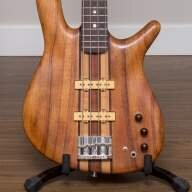
Hello I'd like tO share my Steinberger XP2 pictures.
Thanks Bon Ruiz

SteinbergerXP2BonRuiz.jpg


hrz1.jpg


Dis-0398.jpg


Image0407.jpg
 
Are those Jon Kelsey's also Radius, and why does NS change from plastic to wood?
Rather hard to understand, but NS was always changing this'n'that on his gear...
Maybe he's just keeping up tradition. :D


So, I've got the answers, and I was awfully wrong. The fretboard is ebony, on all US and CR basses. My only excuse: the marketing materials, website and several publications have also been wrong until recently.

Meanwhile everything says "ebony", and now you don't only know about people who take a phenolic board for ebony, now you also know one who did it the other way around ;)

More news: the 4-string version will be introduced on NAMM, the 6-string won't at this time.

Bernd
 
This has been a long and difficult struggle (not going to repeat the whole story here), but finally: I've been able to stock up on inch-sized screws used on Steinbergers. Boring news for those of you living in USA, but a major leap for us in Europe ;)

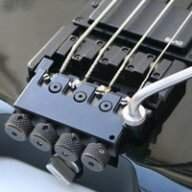
My screw collection now contains all the screws shown below. So if any of you Steinie owners in Europe miss one of these screws, here is your chance to get one without all the weird and odd things happening when trying to order screws in USA…

And for the others: maybe this pic is a little bit of helpful information, as it is pretty difficult to find info about all the screws found on Steinies:

Steinberger_screws.jpg


Bernd
 
Very well done Bernd, thank you very much!
For the american screw system is a real pita.
For the XL it needs 5 sizes of Allans, for L the it's 8 (!)
I wonder why on this otherwise very genius conception. :scowl:

The L:
Pegs + Controls.............3/64
Pegs (lateral on thread)...0.05
Tuningblock (top & joint).7/64
Tuningblock (side 2x*)....3/32
Saddles.........................1/16
Body-Cover....................5/64
Set Screws Head-Piece....5/32
Pivot Strap-Pins..............1/8
Pups.............................Philips
Battery Cover.................Philips

The XL:
Pegs (Axial on thread).....Philips
Controls.........................1/16
Tuningblock (Body-Joint)..5/64
Tuningblock (Side 1x*)....5/64
Saddles.........................5/64
Body-Cover....................7/64
Pups.............................1/16
Battery Cover (!)............3/32
Pivot Strap Pins..............3/32

*Clamping saddles
 
With all those imperial dimensions, the wide 5 bridge features metric tuning rods. A quote from bgstainless.com:
The threaded rod for the Wide Jaw is a common 4mm/40 threaded rod
The Wide jaws will work with the following series basses:
• Steinberger Wide 5 string bass and later model Steinbergers made in Nashville
• Spirit bass with Steinberger bridge
• Hohner Jack bass with Steinberger bridge
 
With all those imperial dimensions, the wide 5 bridge features metric tuning rods. A quote from bgstainless.com:

Hmmm… I think it is possible that this is somewhat misleading information. "4-40" is the imperial thread size that has been originally designed and used on all Steinberger tuners. That's where the "1:40" tuner ratio comes from (40 turns to move 1 inch). They switched to metric with the later tuners, all guitar bridges have an M3 thread. On my bass jaws (4-string) the thread is M3.5. The length is about 40 mm.

So I'm not sure what BGS actually says here…

Bernd