• TalkBass has been independent since 1998. Add your voice.
    Create a free account to reply to discussions, view embedded media, and browse with fewer display ads.
    Join freeLog in
    Want zero display ads or expanded classifieds tools? Compare plans.

Stereo wire vs quarter inch: Where to use what?

Buy a quality speaker and instrument cable that use name brand cable and connectors (Switchcraft, Neutrik, GLS).

Avoid the discount Amazon and eBay items as they have been the leading cause of amplifier and speaker manufacturer customer service issues (mimicking or causing actual amp and speaker failures).

Especially avoid the no name stuff from China that's marketed by the big cable vendors that have super cheap prices, many failures have been traced back to these vendors.

Companies like Rapco, Horizon, ProCo, Conquest, Audiopile all make quality cables and cable assemblies.
 
Maybe this will clarify some of the OP's confusion...
cables.jpg

Believe me when I say that not everyone understands the terminology when it come to correct cabling. I recently bought a pair of studio monitors from GC and when I asked for a pair of balanced line cables to connect them with the sales guy says "Oh... you mean stereo cables?" :(
 
when I asked for a pair of balanced line cables to connect them with the sales guy says "Oh... you mean stereo cables?" :(

A TRS connector can be used as part of a stereo cable, so easy to see where confusion can come in.
I would guess that TRS connectors used as stereo connectors are actually pretty common, especially in the DJ/karaoke, live sound world.
Similar to the "mini" or "aux" connector (just bigger) used on headphones and music players, which is almost always used as a stereo cable.

Pretty common (more common?) to see a XLR style connector used for balanced cables - like say to hook up monitors / powered speakers as part of a PA system - although a lot of soundboards have 1/4" TRS outputs. And a lot of monitors/ powered speakers have XLR/TRS combo jacks.

Not saying you are wrong, just saying it's easy to see how confusion can happen.
Invalid Link Removed
 
The current doubles.
The voltage is limited by the rails of the amplifier’s output section.
Power calculations need to be performed using using z not R. It is a non linear function that is frequency dependent.

Yes, I know all that, but a safety agency is concerned with the voltage hazard, and connectors and such will be based off of that, not the actual power delivered at a certain frequency to a reactive speaker load.
 
Buy a quality speaker and instrument cable that use name brand cable and connectors (Switchcraft, Neutrik, GLS).

Avoid the discount Amazon and eBay items as they have been the leading cause of amplifier and speaker manufacturer customer service issues (mimicking or causing actual amp and speaker failures).

Especially avoid the no name stuff from China that's marketed by the big cable vendors that have super cheap prices, many failures have been traced back to these vendors.

Companies like Rapco, Horizon, ProCo, Conquest, Audiopile all make quality cables and cable assemblies.
Intex cables are my cable of choice. Intexcables.com only because they inscribe your name on the plug ;)
 
  • Like
Reactions: BooDoggie
This is one reason why its a very good idea to use exclusively speakons for speaker cables. Using jacks was and is always a bad idea, and using XLR, as was fashionable for a while, not much better.
At one time, there wasn't much choice in speaker connectors before speakons were developed. Originally there was 1/4", binding posts, banana plugs and jacks, and as higher power connections were required, XLR was used in some instances. Later Alcatel / Amphenol EP series plugs were developed, a jumbo XLR sort of connector.
 
OK, thanks everyone. It looks like I have been using a TRS cable rather than a speaker cable to go from my head to my cab.

I will purchase a speaker cable. I'm ordering it as soon as I finish this post.

Curious to know if you think this will have damaged my head or my cab? Should I expect to hear a difference when I hook up my head and cab using a good speaker cable?

Thanks again!
 
Curious to know if you think this will have damaged my head or my cab? Should I expect to hear a difference when I hook up my head and cab using a good speaker cable?

Probably not.

Think of it like driving without ever changing your tires. Your car still works, but it’s not safe. And the more often you drive and longer you wait, the more the risk is increased... and eventually something will go wrong.

The longer you use your amp and the harder you push it with the wrong cable, the more the risk is increased.

Did you damage your car by not changing the tires? Maybe. Will the car work better / will you notice a difference when you do rotate the tires. Maybe (depending on how bad your tires were). But maybe not in both cases.

Point is, you should rotate your tires and use the correct cable.

Reminds me, I need to take care of some work in my truck I’ve been putting off:rollno:
 
I'm pretty sure that I am using a speaker cable between my head and my cab. This cable is thicker than others and it is written "Neutrik" on it.
Neutrik is a brand, not a type, so don't go by that to determine what kind of cable it is.

I have a question: I know from reading the above that it is important for my instrument cable to be a short as possible in order to prevent signal loss. Is this the case for speaker cables too? Should they be as short as possible?
Up to a reasonable length for the intended application, it doesn't matter, but it is always good practice to keep the cable runs as short as practical.
 
  • Like
Reactions: BooDoggie
OK, thanks to all of you. I understand.

All right, I ordered two speaker cables from GLS. One for use and one for backup. GLS is one of the cables that was mentioned in this thread as being from a good company.

Looking back, I got that TRS cable when I bought my previous amp. The salesman told me that this is what I needed. I guess he was lost too, much like me.

No, I never felt the TRS cable get hot when I plugged in my amp. I never detected anything wrong. But I certainly don't want to take the chance of messing up my head or anything else.

Thanks again, everyone! I appreciate it!

John
 
Yes, I know all that, but a safety agency is concerned with the voltage hazard, and connectors and such will be based off of that, not the actual power delivered at a certain frequency to a reactive speaker load.
Going back to the original comment about “ higher voltages “ require larger gauge wire- that’s the error. Speaker wire is larger because of current not voltage.
Speaker will never see higher voltages than the rails will allow, otherwise clipping occurs. Power calculations deal with current and impedance. There are no lethal voltages present at the speaker terminals.
I asked SteveIII what amps put out more than 50V rms- I don’t think they exist.
Not necessary to achieve high power—-
And would create a dangerous situation.
Most amps I’ve repaired have 30V rails.
Maximum peak to peak audio signal would be 60 V.
 
The salesman told me that this is what I needed. I guess he was lost too, much like me.

That sucks, because you are trusting that that person knows what they are doing.
Happening more and more these days... the death of expertise.

Good on you for asking, and getting things sorted out.
Seems like "trust but verify" is becoming more and more important these days.
 
Intex cables are my cable of choice. Intexcables.com only because they inscribe your name on the plug ;)

I looked at their site and find 2 disturbing things that come up regularly when troubleshooting amps for "failures" that have nothing to do with the amps themselves.

1. Unplated brass, bronze or copper, like they show on their plug's tip and sleeve will always oxidize (when I use the term oxidize, I mean chemically react with oxygen as well as with sulfates and chlorides) which can result in intermittent connections. IMO and IME, any reactive metals like the above should always be plated with hard nickle to reduce this issue. I can't tell you the number of intermittent issues we have traced back to unplated brass connectors (makes no difference which brand). ALL pro audio connectors used in the live sound, broadcast and recording industries are plated for this reason. What's kind of ironic is that the Belden 8412 cable uses plated/tinned conductor stands to improve performance of the shield as well as to improve solderability and protect the conductors from the effects of the rubber insulation (which has some mild corrosive properties). For telephone use, it's not (as much of) a problem because the voltages are high enough to punch through these oxide layers though that doesn't mean they were problem free. The voltages in common instrument and line level audio applications are nowhere near high enough voltage to accomplish this reliably.

2. 1/4" Connector tip shape does not conform to the audio industry standard. The tip shape used is from the telephone industry patch bay and differs from what has been used in the audio industry for the last 50 years. The reason for the difference is that the jacks used in the telephone industry (and some adapted for the recording industry) use a different type of contact geometry (angle of attack) and the more blunt, rounded tip can catch the leading edge of the contact wrong and fold the jack contact over or twist the contact arm (ruining the jack). This was a lot more common 30+ years ago when these plugs were repurposed by folks trying to save money as patch bay (switchboard) installations were being ripped out and these plugs were available surplus. There are reasons the name brand, main stream manufacturers design things the way they do.

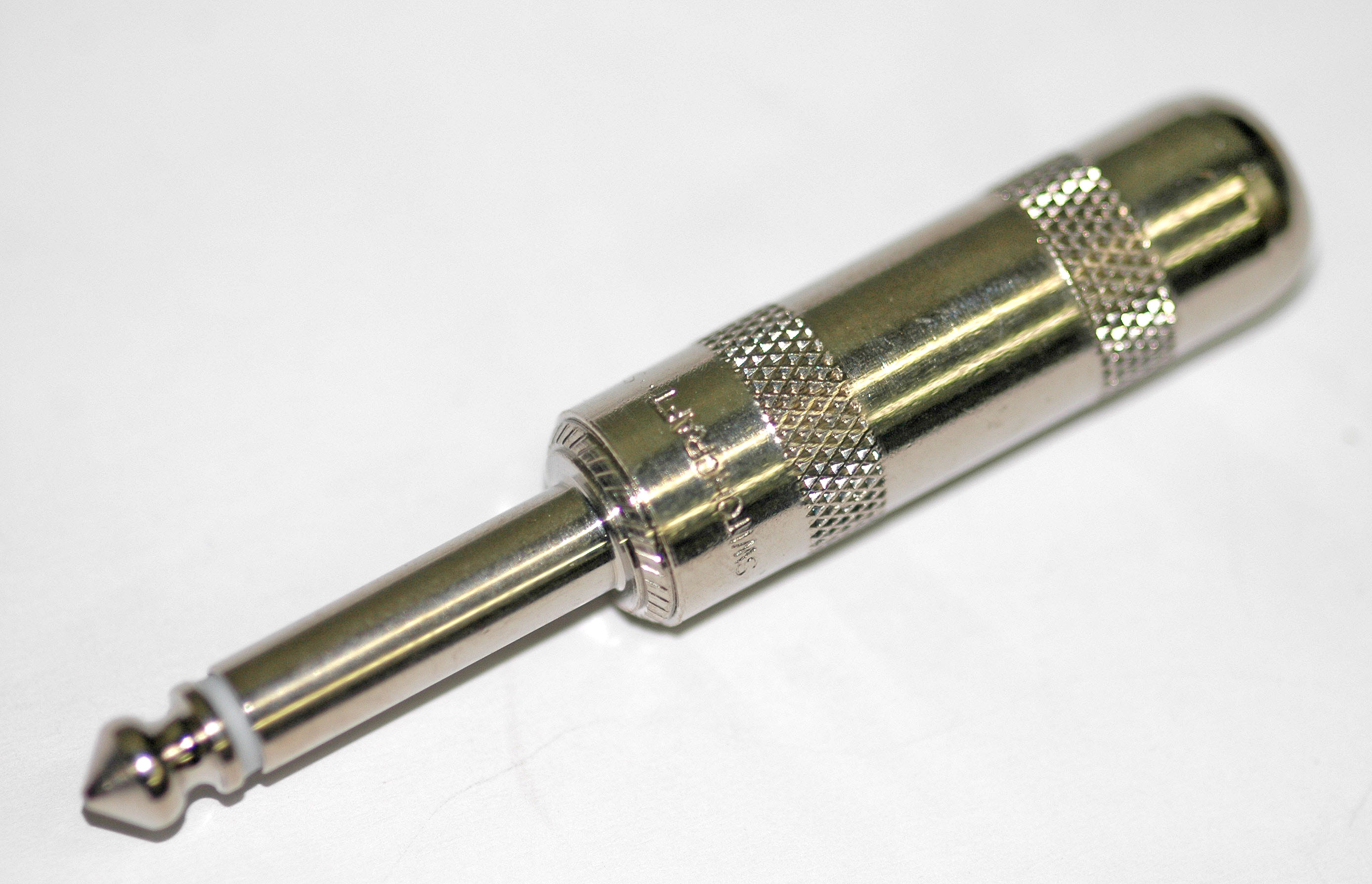
Correct tip shape for audio:
TS_0.25inch_mono_plug.jpg


Correct tip shape for telephone and some military applications (incorrect for audio):
s-l640.jpg


3. Using 8412 wire with one of the two wires removed, and promoting the "coaxial" nature of the wire as a feature is obviously questionable from an amp designer's perspective. A coaxial configuration will always have a higher capacitance per foot, and that capacitance is less lossy which makes it more troublesome. Some amplifiers can become unstable and oscillate (sometimes fatally) under a capacitive load which is why many amplifier manufacturers warn against it and why many of us design specific protection circuits into our amplifiers to protect against it.

I hope this helps with the understanding behind WHY manufacturers of audio equipment recommend or recommend against using certain things.
 
.... IMO and IME, any reactive metals like the above should always be plated with hard nickle to reduce this issue. I can't tell you the number of intermittent issues we have traced back to unplated brass connectors (makes no difference which brand). ALL pro audio connectors used in the live sound, broadcast and recording industries are plated for this reason.

Andy,,, shoot us straight. Nickel or gold. Does it matter? Is it worth the extra cost (like $1 or something) when buying a connector to "upgrade" to gold?
 
Going back to the original comment about “ higher voltages “ require larger gauge wire- that’s the error. Speaker wire is larger because of current not voltage.
Speaker will never see higher voltages than the rails will allow, otherwise clipping occurs. Power calculations deal with current and impedance. There are no lethal voltages present at the speaker terminals.
I asked SteveIII what amps put out more than 50V rms- I don’t think they exist.
Not necessary to achieve high power—-
And would create a dangerous situation.
Most amps I’ve repaired have 30V rails.
Maximum peak to peak audio signal would be 60 V.

The GBE-1200 swings over 75VRMS into 8 ohms. The Subway 800 series swings about 55VRMS into 8 ohms and the Shuttle/Streamliners swing almost 60VRMS into 8 ohms.

Andy,,, shoot us straight. Nickel or gold. Does it matter? Is it worth the extra cost (like $1 or something) when buying a connector to "upgrade" to gold?

Generally Nickle will actually perform better for plugs and jacks, though for headers and interconnects that remain static gold has an advantage. For plugs, in general I would recommend nickle no matter what the price difference.

Also, Nickle is generally plated much heavier than the gold is, and gold is generally plated over nickle anyway. The nickle is necessary for 2 reasons, the first being to prevent copper migration into the gold and the second reason is for base hardness and adhesion.
 

Latest posts