• TalkBass has been independent since 1998. Add your voice.
    Create a free account to reply to discussions, view embedded media, and browse with fewer display ads.
    Join freeLog in
    Want zero display ads or expanded classifieds tools? Compare plans.

Stereo wire vs quarter inch: Where to use what?

Generally Nickle will actually perform better for plugs and jacks, though for headers and interconnects that remain static gold has an advantage. For plugs, in general I would recommend nickle no matter what the price difference.

Also, Nickle is generally plated much heavier than the gold is, and gold is generally plated over nickle anyway. The nickle is necessary for 2 reasons, the first being to prevent copper migration into the gold and the second reason is for base hardness and adhesion.

Great stuff. Thanks, Andy!!!!!
 
Last edited:
My yorkville ap 2020 has 90 volt rails.
Voltage is like pressure. At infinite resistance there is no current flow regardless of voltage. The resistance or impedance determines the current flow within the limits of the amplifier. Thats why some amps are 2 ohm stable and some are not.
Still under 50Vrms correct?
Non lethal
 
90 divided by 1.414 is 63 volts rms max. And @agedhorse mentioned 2 amps that have more than 50 volts rms at the output.
He said :
The GBE-1200 swings over 75VRMS into 8 ohms. The Subway 800 series swings about 55VRMS into 8 ohms and the Shuttle/Streamliners swing almost 60VRMS into 8 ohms.
 
Going back to the original comment about “ higher voltages “ require larger gauge wire- that’s the error. Speaker wire is larger because of current not voltage.
Speaker will never see higher voltages than the rails will allow, otherwise clipping occurs. Power calculations deal with current and impedance. There are no lethal voltages present at the speaker terminals.
I asked SteveIII what amps put out more than 50V rms- I don’t think they exist.
Not necessary to achieve high power—-
And would create a dangerous situation.
Most amps I’ve repaired have 30V rails.
Maximum peak to peak audio signal would be 60 V.
There are many professional power amps that will swing more than 50 volts RMS. That's 312W RMS across an 8 ohm load, not a huge power house by modern standards.
 
Last edited:
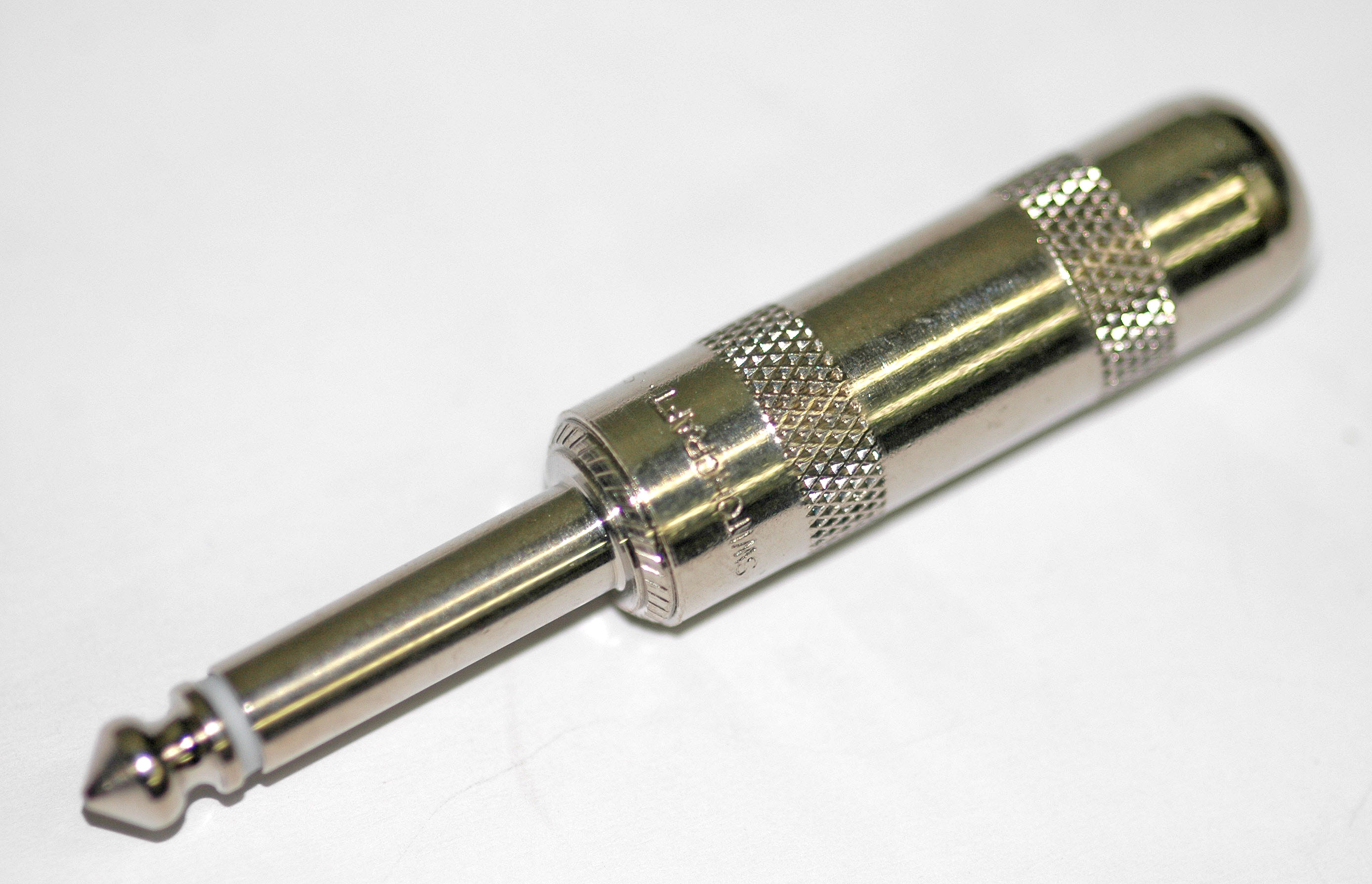
2. 1/4" Connector tip shape does not conform to the audio industry standard. The tip shape used is from the telephone industry patch bay and differs from what has been used in the audio industry for the last 50 years. The reason for the difference is that the jacks used in the telephone industry (and some adapted for the recording industry) use a different type of contact geometry (angle of attack) and the more blunt, rounded tip can catch the leading edge of the contact wrong and fold the jack contact over or twist the contact arm (ruining the jack). This was a lot more common 30+ years ago when these plugs were repurposed by folks trying to save money as patch bay (switchboard) installations were being ripped out and these plugs were available surplus. There are reasons the name brand, main stream manufacturers design things the way they do.

Correct tip shape for audio:
TS_0.25inch_mono_plug.jpg


Correct tip shape for telephone and some military applications (incorrect for audio):
This is the reason why many cheap off-shore connectors will damage Switchcraft jacks; they "hook" on the tip contact and bend it when trying to remove the plug from the jack.
 
  • Like
Reactions: agedhorse
There are many professional power amps that will swing more than 50 volts RMS. That's 312W RMS across an 8 ohm load, not a huge power house by modern standards.
The question is— is it lethal?
If the ac audio is swinging between 90 volt rails, is its potential reaching 50Vrms?
In reference to earlier post that started this discussion—- the voltage is not the reason for speaker wire needing to be heavy gauge.
 
The question is— is it lethal?
If the ac audio is swinging between 90 volt rails, is its potential reaching 50Vrms?
In reference to earlier post that started this discussion—- the voltage is not the reason for speaker wire needing to be heavy gauge.
Yes, with 90v rails you can potentially have at least 50 volts rms across the load
Yes, it can be lethal if it breaks through the epidermal layers, or if the skin is wet or sweating.
 
Yes, a pair of 90V rails can swing over 50VRMS and over 100VRMS if bridged.

For audio signals, this kind of a voltage can certainly be felt, though because of dynamics is unlikely to be fatal... though like in power electrical it's sometime not the shock the causes injury but collateral damage such as falling off of a ladder.

There are special regulations that apply to audio signal voltages in EN60065 safety regs.
 
Your pictures show cables with 1/4" tip, ring, sleeve (TRS) at both ends, which means they are stereo connections (left channel, right channel, shield). These are not appropriate for your setup. Put them away or find someone who needs them: you don't.

You should only be using instrument cables with tip and sleeve (TS) at both ends from your bass to your amp, and through any devices you might use between the two, such as your Line 6 wireless.

You should only be using balanced speaker cables (either 1/4" or Speakon, depending on your equipment) between the amplifier and the speaker. These are not the same as the wire used for hooking up stereo speakers, so don't use that. Get the right ones at a local music store.

You should always refer to your user manuals for the amplifier and speakers, as they often have drawings and descriptions of the correct cabling to use.

Hold on a minute...

1. TRS is used for stereo connections as well as for balanced line level connections and for insert connections (mostly in pro audio)

2. There is no such thing as balanced speaker cables, unless you are using a description that got lost in translation somewhere.
 

Latest posts