• TalkBass has been independent since 1998. Add your voice.
    Create a free account to reply to discussions, view embedded media, and browse with fewer display ads.
    Join freeLog in
    Want zero display ads or expanded classifieds tools? Compare plans.

String through body or bridge?

I just had to run through bridge instead of body, which I normally do. In resetting up my Lakland Skyline I had to pull the B string bridge adjuster back to the point that the through body would have caused quite a bend in the string at the point of contact with the bridge. I made the decision to go through the bridge in order to keep the string from that radical bend. Bottom line. I heard no difference. Didn't feel one either.
 
  • Like
Reactions: Dave Neal
I’m contemplating a 32” scale bass build. If I decide to install a thru body bridge it’ll be because the extra inch or so would possibly increase my options for strings that fit. My non thru body Mustang’s string options are limited because of the 30” scale length.
Now that actually makes sense to go thru body on a 32". I can't tell a lick of difference sonically but opening up your string options a bit would be nice.
 
  • Like
Reactions: zoonose
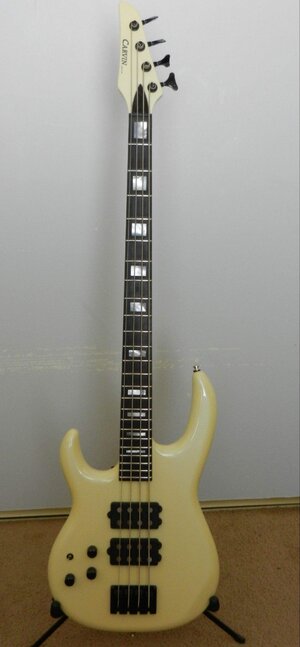
Carvin LB-20 1.JPG I'd have to agree with JimmyM. That would be my only reason to string a bass thru-body. This '96 Carvin LB-20 is the only bass I have where that's an option. It's nothing deliberate; it just worked out that way. In the spirit of scientific inquiry, when I re-strung it after I got it, I strung it thru-body - once. The results?
1. I heard no difference whatsoever, compared to top loading the bridge. But, everyone's ears are different; if you say you can, I'll certainly believe you...:rolleyes:
2. It was a labor intensive (trying to keep the strings from twisting), royal PITA.
Since I heard nothing to recommend my stringing the bass that way in the future, or make me want to go thru all that nonsense again? I top loaded it, and it's been top loaded ever since...:cool:
 
Last edited:
I have this Kawai Rockoon 5 string. It has a Schaller bridge and I swapped in EMGs. Anyways, for some reason the manufacturers included the option for the B and E to be strung through-body, but not A, D or G. So I take them up on it and just do B & E, because it seemed cool. There’s a real noticeable difference between them. Through body (B & E) is more resonant, loud and clear. Through bridge (A, D & G) is weaker.

Friends and guitar techs have picked up the bass and said “hmmm... that’s weird... these lower strings are different.... oh they’re through body! Why only those two?”

I didn’t notice it at first because I was just starting out. But then I started to hear it.

I had in mind to drill holes for the other 3 strings. Although it ended up that I just bought a nice Fender & don’t play the Kawai anymore.

If I ever pick up the Kawai, I’ll usually have forgotten about it and wonder why I don’t play this nice bass anymore. Then I rediscover the string difference because of through body. *And I’ll notice specifically because they sound different.*

Not doubting those who say there’s no difference: different basses, bridges, woods, etc. I’m just saying there’s a significant difference on this bass.
 
Hi to everybody, a long time silent user here. Came across this thread since I‘m about to buy a medium scale 32“ 5 String and I wondered which strings would fit.
String through body will increase the number usable strings massively since extra length is needed to go through the body.

Nevertheless, I noticed a difference between top loaded and string through body - but especially for lower tunings. I have the impression that there is fewer movement (left to right) of the string on the saddle when plucking the string when going string through body. What makes the impression that it is a tighter or better responding string. I assume that a part of the energy of the plucking is going into some kind of friction on the bridge. This is reduced by using string through since the angle is more acute and bigger part of the string pressure is going to press the string against bridge and body and is not lost in friction caused in the plucking direction.

I have no proof or calculation for this - just my impression.
 
Hi to everybody, a long time silent user here. Came across this thread since I‘m about to buy a medium scale 32“ 5 String and I wondered which strings would fit.
String through body will increase the number usable strings massively since extra length is needed to go through the body.

Nevertheless, I noticed a difference between top loaded and string through body - but especially for lower tunings. I have the impression that there is fewer movement (left to right) of the string on the saddle when plucking the string when going string through body. What makes the impression that it is a tighter or better responding string. I assume that a part of the energy of the plucking is going into some kind of friction on the bridge. This is reduced by using string through since the angle is more acute and bigger part of the string pressure is going to press the string against bridge and body and is not lost in friction caused in the plucking direction.

I have no proof or calculation for this - just my impression.

Seriously...Find a string that you like with the correct winding length and do a decent install irrespective of whether you're stringing thru-bridge or thru-body. This will have a far greater impact on string response and virtually eliminate any problems with action, intonation, and tuning.

Riis
 
Not quite Easter yet but time to resurrect this anyway. So I think there are more notable differences in the GHS video in the players pluck and fret techniques than there should be for an accurate assessment of the sound differences?
That being said there was little else I noticed in this thread in the way of physical evidence. However as much as my mechanical mind likes the string through body idea I think a browse of the Ray Ross threads shows substantial evidence from people who know physics and metallurgy that string thru body is a bad idea for the strings sake. According to them the sharper the break angle over the saddle the more damage to the string core the sooner you have a dead sounding set of strings. If true ... And I believe it is ... Then there should be at least a faint audible difference. Personally I own a Ross bridge and I have 2 notable differences now .
1. The strings sound more resonant in a piano sort of way and hold sustain tone of the initial note quality a little longer. Positive difference
2. The strings feel floppier. Negative difference
I string through bridge on all my basses in hopes of better string life and with little or on notable sound difference except for the Ross bridge which I like except for the looser feel. I'm not familiar with this bass that the bridge comes loose on but it must just be a POS because the Ross puts more screw pulling force out than anything on the market and it's mounting screws were smaller and barely snugged up on the el cheapo soft body bass I installed it on. And it hasn't budged. For those of you really worried about which is best I'd suggest reading into the Ray Ross mega thread about the break angle physics. As for me I take the easy road if it leads the same place.
 
  • Like
Reactions: Vinny_G