

Enjoy the benefits of a premium membership!
Upgrade Account
-
TalkBass has been independent since 1998. Add your voice.
Create a free account to reply to discussions, view embedded media, and browse with fewer display ads.
Join free Log in
Want zero display ads or expanded classifieds tools? Compare plans.
You are using an out of date browser. It may not display this or other websites correctly.
You should upgrade or use an alternative browser.
You should upgrade or use an alternative browser.
String through body or bridge?
- Thread starter adivin
- Start date
More options
Who Replied?
It's a build I'd originally done back in the early 90's and did a complete revamp in 2014. It features a Warmoth neck & custom made semi hollow body by a now dearly departed friend.Bass
Makeover Complete, Frankenstein's Facelift...


Interesting. I didn't know this. Any pics of an early 50s string thru fenders

It didn't make a difference on my Cirrus. No high-mass bridge, either, just those finger bridges(1 per string).
Beautiful. I've looked at a number of these and never noticed that. Thanks to you both for the pics

No. If you think about it, it cannot. Raising the tension of a given string also raises the pitch of the string. Given that you are still tuned to the same note, the tension had to remain the same.Thanks. Does it affect string tension at all?
Last edited:

Of the many basses I've owned none were string through until recently. I picked up a Fender AP 2 and it came with the strings installed through the body. The thing I've found that's an issue is that on each saddle there are grooves E & A have 3 and D & G 4 so you can adjust the string distances from each other and the edge of the fretboard. I have other basses that have this type of bridge with grooved saddles and through the bridge and it's not hard to move from one groove to another while in tune however, with the string through it holds the strings so tight I have to detune by quite a bit just to move from one groove over which I consider a pain in the butt. Tone difference or not when I change these strings they will not be going through the body again! Rant over.
I literally just strung my bass through the body for the first time and I don't hear a difference or notice anymore or less sustain. The only difference I think I feel is maybe more string tension and maybe it feels like the bass body vibrates a little more but I think its in my head. I think people just like the concept of string through. Its known to be on more premium basses and its just more knick knacks on your instument.If this has been discussed lately, forgive me. For the first time, I have a bass that gives me the choice to string it through the body or bridge. What are the pros and cons here, if any. If this has been discussed and you can point me to the thread, that's cool.


It's time for the monthly thread on this again?
No difference in any way. None. Try a REAL test. String the E and D through the body, the A and G top-load. Play it until the strings are dead. When you restring, reverse the top-load/string-through so that the E and D are top-load and the A and G are through the body. That way you've eliminated EVERY variable. And when you do that you'll find it makes absolutely no difference, despite the people with no understanding of phyiscs, or the advertising people who say otherwise.
I used to be one of those who swore there was a noticeable difference in feel and sound until I did that very side-by-side experiment (on two Laklands). The facts forced me to change my mind on this one. The only reasons I still string through the body are that it keeps the ferrules from falling out, and it won't mar the finish where the strings go into the bridge plate. Both reasons have nothing to do with sound or feel.
John

If this has been discussed lately, forgive me. For the first time, I have a bass that gives me the choice to string it through the body or bridge. What are the pros and cons here, if any. If this has been discussed and you can point me to the thread, that's cool.
I've owned alot of string through body , through bridge, over saddles , over nut , to tuners.
I've never heard of an either through body only or through bridge only choice.
Anyway string through body or bridge is your decision to make , after all , It's your bass right.
Trust your ears , not opinions.
If ya know what I mean .


String through on short or medium scale widens the possibilities for string choices if nothing else.

Important note: La Bella flat wound strings are not suitable for use on instruments that require through-body stringing.
[Invalid or Expired Link Removed]
Yeah, that caught my attention too, but I think it's to avoid damaging the strings. I can see how bending a flatwound would me more stressful on the string due to the flat edges.
Perhaps that's some LaBella advice to avoid the strings from breaking. I wouldn't want to be closer to a bass with a string popping out!
And I just realized I replied an internet comment almost 15 years later, LOL.Important note: La Bella flat wound strings are not suitable for use on instruments that require through-body stringing.
[Invalid or Expired Link Removed]
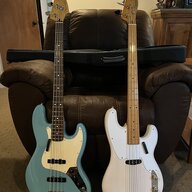
those old fender basses were strung through the body since 1951.Those heavy LaBella flats that so many people (not just Jamerson) used on old Precisions certainly don't have a reputation for pulling bridges out of the bodies...
John

Turnaround
Commercial User
Until Fender decided that going through the bridge was better.those old fender basses were strung through the body since 1951.
Until Fender decided that going through the bridge was better.
Then I wonder why Fender brought the string thru body option back on many of their higher end models?


