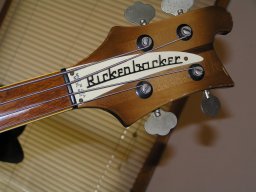
I don't know about you, but I was just thankful there wasn't a jigsaw, drill or router in the video. I shudder to think of the potential carnage inflicted by this dimwit on that poor bass.

TalkBass has been independent since 1998. Add your voice.
Create a free account to reply to discussions, view embedded media, and browse with fewer display ads.
Join free Log in
Want zero display ads or expanded classifieds tools? Compare plans.

A perfect 4th is the same interval as an inverted 5th. A to E is a fifth. E to A is a fourth.I don't understand where the 4th comes in.
You are correct, I was up too lateA 4th from E is A natural.

If it sounds ruined, it's ruined.How do you know if you've put a witness point in the speaking length of the string, and ruined the string?
My strings settled in long ago, but I've been tweaking my action, and therefore, relief and intonation many times. As a result, I've brought the saddles backwards and forwards by various amounts. I can't hear any changes from the initial sound, but how would a ruined string present itself? Buzzy?If it sounds ruined, it's ruined.
Buzzy, won't intonate properly, overly dull - in any number of ways that just don't sound right. But if you aren't having any of those problems, it's not ruined.My strings settled in long ago, but I've been tweaking my action, and therefore, relief and intonation many times. As a result, I've brought the saddles backwards and forwards by various amounts. I can't hear any changes from the initial sound, but how would a ruined string present itself? Buzzy?
Buzzy, won't intonate properly, overly dull - in any number of ways that just don't sound right. But if you aren't having any of those problems, it's not ruined.
In my case it doesn’t matter - they are both the same. That’s because I use a light touch.When you're tuning, do you tune to the attack or decay?

whereas i tend to bang on them a little. i'll tune to the attack, that's where most of the pitch recognition happens.When you're tuning, do you tune to the attack or decay?
that's usually my first clue that they're not as good a musician as they think they areThe player told me that he was particularly sensitive to tuning irregularities

this is possibly the best and simplest explanation of the curse of equal temp i've seen in a long time!In simple terms, perfect fifths don’t beat. But if you stack perfect fifths all the way around you don’t come back to an octave of your original tone.
So we make fifths beat a little bit to get the octaves clean.
This is one of the reasons string quartets and a capella groups sound a little freakishly “in-tune”. They sing non-beating fifths.
this is the reason short scale basses sound "tubby" and the reason why i personally don't like the sound of 5-string basses; the harmonics are just not as close to the fundamental as they are on regular basses within their more ideal pitch range.in addition to intentionally setting the strings “out of tune” to obtain an “equal temperament” tuners have to push them even more or less out of tune to balance those overtones and compensate for inharmonicity.
What does all this have to do with the OP?
Well, its very possible that the “out of tuneness” your DB playing customer was hearing might have been overtones if those were fresh round wounds on that electric bass and not necessarily a product of equal temperament.
this is the reason short scale basses sound "tubby" and the reason why i personally don't like the sound of 5-string basses; the harmonics are just not as close to the fundamental as they are on regular basses within their more ideal pitch range.
that low B on 5-strings especially, even at 35" scale length it just has an inherently sour character, it's just too short for its thickness and tension.


