
Enjoy the benefits of a premium membership!
Upgrade Account
-
TalkBass has been independent since 1998. Add your voice.
Create a free account to reply to discussions, view embedded media, and browse with fewer display ads.
Join free Log in
Want zero display ads or expanded classifieds tools? Compare plans.
You are using an out of date browser. It may not display this or other websites correctly.
You should upgrade or use an alternative browser.
You should upgrade or use an alternative browser.
Strings for a 24.5” scale bass
- Thread starter faivy
- Start date
More options
Who Replied?

Good luck...I had a Supro "Pocket Bass" for a while and couldn't find anything. Once those basses (Carvin had some, too) vanished in the late 60s, so did the string sets. I cut down some 30" scale strings and used those but they were really floppy. So much so that I was sometimes bending notes just by fretting them.

By the time I got my wreck of a Supro pocket bass the tuners had been changed to regular bass tuners which makes it possible to use pretty much any round wounds. Since this scale is like using a capo at the 5th fret of a 34" scale a .125 B as an E string works perfectly tension-wise. If it still had the little guitar tuners I'd be hitting up Newtone Strings or maybe String Joy for a custom set.

Search Gold Tone microbass flatwound strings. I believe they are made by LaBella. They work great on my Kent (Teisco).
MBLS MicroBass LaBella Flat Wound Strings
MBLS MicroBass LaBella Flat Wound Strings

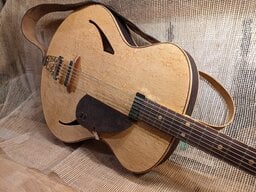
Not 100% sure, but you might try Kalium.Hi all
I recently picked up a Mosrite 350 stereo bass and I’m looking for suggestions on strings that would fit


Nix on the Taylor (actually D'Addario) EXPPBB190GS strings, and other alternatives like the LaBella CB40-BE's.The Taylor GS Mini bass is 23.5" scale, so strings made for that bass may work. I have also cut longer strings to use on short basses and that has never been a problem. I currently play a Journey Overhead Bass that has an odd scale length of 27" and cut strings work great.
Those are coated bronze-wound strings with a nylon rope core, like the wound strings on a classical guitar. They don't produce a useable magnetic field for an electric bass like the Mosrite.
Gotta stick to steel core strings with magnetic pickups...
Nix on the Taylor (actually D'Addario) EXPPBB190GS strings, and other alternatives like the LaBella CB40-BE's.
Those are coated bronze-wound strings with a nylon rope core, like the wound strings on a classical guitar. They don't produce a useable magnetic field for an electric bass like the Mosrite.
Good info. Did not know this. Thx.
This is my Kent that has the Gold Tone microbass flatwounds on it. These are normal steel-core flats.
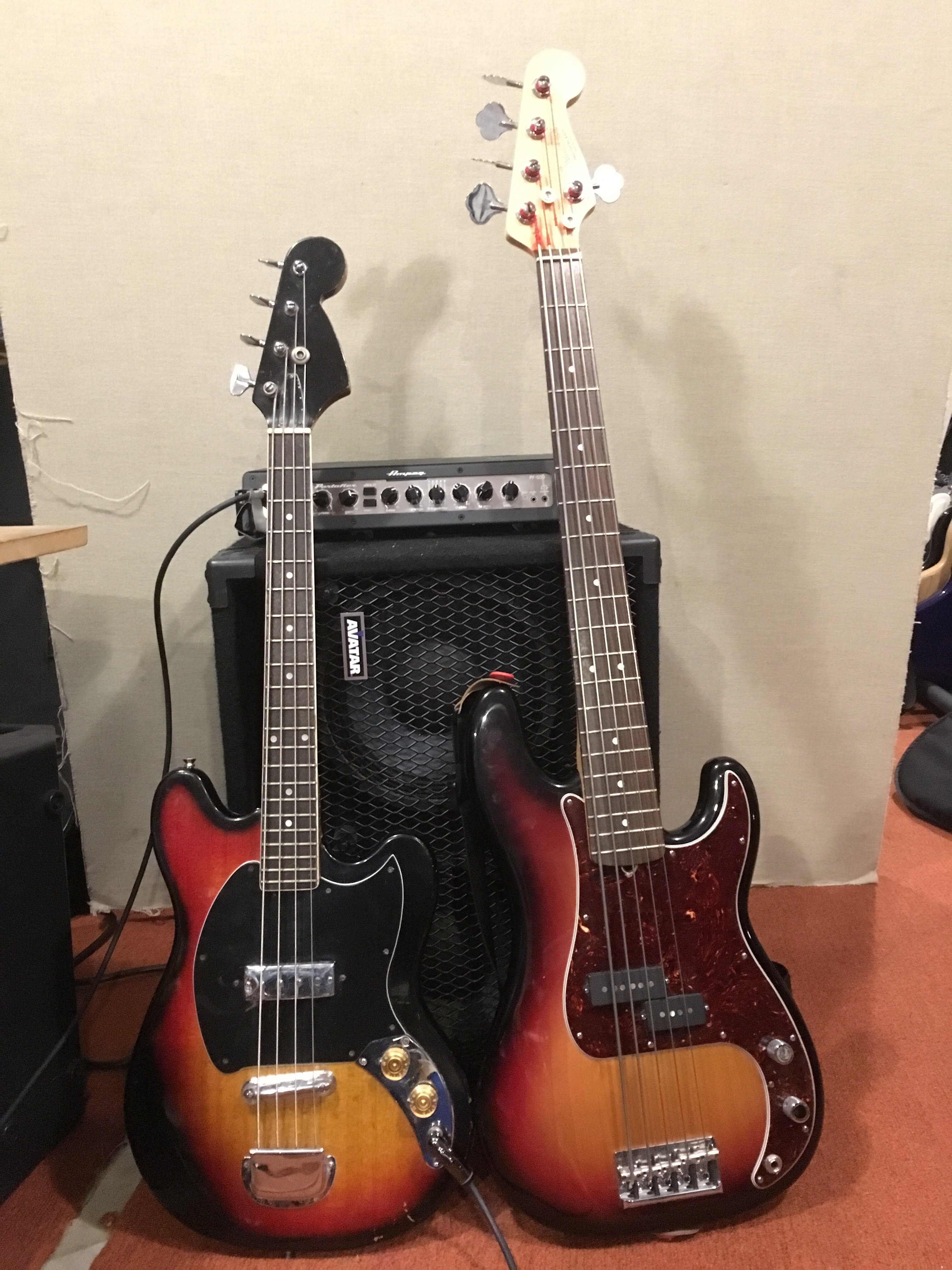


No, those are 30" scale and strings wound even longer because of the amount of string taken up behind the bridge saddle due to the tremolo system.Would like the bottom four strings from a Bass VI set maybe work? No clue, but kind of intrigued by this situation.
I just ordered a set of these to try the bottom 4 on a Glarry 25.5" bass I just got. I know that at standard tuning they'll need a lighter touch to not go to flop town, but I'm curious if the winding length will work.
The problem with the Mosrite and Supro 24-25" scale basses is the guitar tuners. The post is too small to drill out the hole to accommodate a .100 let alone a .125. From a collectability perspective putting on a set of Hipshot mini cloverleafs is kinda asinine. From a playability perspective not putting them on is asinine.

I'll let y'all in on this... I discovered these a few years back.

Under $20 too.
Under $20 too.

[Some of what follows has already been touched upon, and is in that case meant as a summary rather than lack of recognition.]
There are essentially two problems with guitar scale bass strings.
1- Gauges, for which there are two approaches
--- increase gauges up to those typically used for the lowest four of standard 5-string basses. In practice, their low B becomes your low E. This gives you normal bass tension. On the other hand, the lowest string(s) will have less clarity and more of a chorusy component in the tone, especially up the neck;
--- use normal gauges, for less tension, and often keeping to the lighter side of the spectrum (say, 40-95 max). This restores clarity but yields a different playing experience, with a lot less tension. It's not just a matter of it meeting one's preference: the plucking hand touch needs to be controlled in order for the strings not to smash on the frets, and also for the pitch envelope upon the attack - which normally goes sharp, then flat, then Goldi - to be reined in.
Most guitar-scale acoustic basses go a step further and use nylon-core strings, which are more flexible and pitch-stable: they still require a light touch not to flop around, though. These are non-magnetic (silver-plated copper winding on a nylon core) and strictly for piezo pickups; however, there are now
- nylon-core flatwounds that work with magnetic pickups thanks to their metal winding
(Galli UXB910C aka Invalid Link Removed, 23" scale version, 26.5" winding length, gauges 60-80-100-130;
[Invalid or Expired Link Removed], 25.6" winding, gauges 41-54-75-100;
note that the above does NOT apply to the new Aquila Flat Spirals, which are copper flatwound on a synthetic core, and are therefore non-magnetic; also note the aforementioned two approaches both represented here, with one set having fat gauges to compensate for the reduced scale, the other sporting normal gauges), or
- metal-on-metal strings with very thin cores
(Invalid Link Removed, roundwound, and JC106TB, flatwound: gauges 45-105, made for the Tiny Boy electric mini-bass), or
- others with extra-flexible braided/stranded/rope-cores (also Dogal; unfortunately only available in long scale - the Jonas Hellborg signature sets, Invalid Link Removed roundwound and Invalid Link Removed flatwound - and uke-bass scale - UBS162, made for the Big Island electric ukulele bass).
2- Fitment. Past a certain gauge (080 in my experience), strings can break when directly wound upon the tuning post, because the stiffer they are, the less they like sharp bends. The risk is somewhat reduced the more inherently flexible a string is (roundwound, thin core), the larger the tuning post is, and the lesser the tension (ensured by lower gauge, shorter scale or both), but it's there. Ideally, to avoid the above you need at least the low E (and A, if it's fat) to taper between nut and post. However, since guitar-scale basses aren't common (except parlor-size acoustics, as mentioned above, but most of them use nylon-core strings, as also mentioned), there aren't many sets that fit them correctly.
Two that do are the [Invalid or Expired Link Removed] (roundwound, 65-125; made for the original Fernandes Pie-Zo bass, aka Nomad Bass), and the La Bella MBLS (aka MBSLS on the eBay; made for the Gold Tone MicroBass, flatwound, 49-109, 28" winding).
Alternatives are
--- manually unwinding them to length (better if secured with solder or heat-shrink tubing so that they don't get unwound further);
--- with the thin-gauge approach, as outlined above (a max 095 low E), one could try and maybe get away with having the unmodified string wound at full gauge on to the post;
--- ordering custom-length strings from manufacturing companies that offer such a service: Newtone Strings in the UK, Pyramid in Germany (the only one that makes custom flats and nylon tapewounds, besides rounds). Both ship worldwide;
--- modifying the instrument to accept more standard-length bass strings. In your case, this would entail replacing the trapeze tailpiece with a bass 4-string stopbar positioned at the butt of the body, even at 45° right on the body rounding, next to the strap button: if the new length from there to the E-string tuning post amounted to 32.5, this would allow you to use commonly-available short-scale strings, 32" from ball-end to start of taper. From that point on, you'll be able to decide if you prefer light, heavy or somewhere in between.
Or, you could add string-through-body ferrules, also at an appropriately far position.
________

There are essentially two problems with guitar scale bass strings.
1- Gauges, for which there are two approaches
--- increase gauges up to those typically used for the lowest four of standard 5-string basses. In practice, their low B becomes your low E. This gives you normal bass tension. On the other hand, the lowest string(s) will have less clarity and more of a chorusy component in the tone, especially up the neck;
--- use normal gauges, for less tension, and often keeping to the lighter side of the spectrum (say, 40-95 max). This restores clarity but yields a different playing experience, with a lot less tension. It's not just a matter of it meeting one's preference: the plucking hand touch needs to be controlled in order for the strings not to smash on the frets, and also for the pitch envelope upon the attack - which normally goes sharp, then flat, then Goldi - to be reined in.
Most guitar-scale acoustic basses go a step further and use nylon-core strings, which are more flexible and pitch-stable: they still require a light touch not to flop around, though. These are non-magnetic (silver-plated copper winding on a nylon core) and strictly for piezo pickups; however, there are now
- nylon-core flatwounds that work with magnetic pickups thanks to their metal winding
(Galli UXB910C aka Invalid Link Removed, 23" scale version, 26.5" winding length, gauges 60-80-100-130;
[Invalid or Expired Link Removed], 25.6" winding, gauges 41-54-75-100;
note that the above does NOT apply to the new Aquila Flat Spirals, which are copper flatwound on a synthetic core, and are therefore non-magnetic; also note the aforementioned two approaches both represented here, with one set having fat gauges to compensate for the reduced scale, the other sporting normal gauges), or
- metal-on-metal strings with very thin cores
(Invalid Link Removed, roundwound, and JC106TB, flatwound: gauges 45-105, made for the Tiny Boy electric mini-bass), or
- others with extra-flexible braided/stranded/rope-cores (also Dogal; unfortunately only available in long scale - the Jonas Hellborg signature sets, Invalid Link Removed roundwound and Invalid Link Removed flatwound - and uke-bass scale - UBS162, made for the Big Island electric ukulele bass).
2- Fitment. Past a certain gauge (080 in my experience), strings can break when directly wound upon the tuning post, because the stiffer they are, the less they like sharp bends. The risk is somewhat reduced the more inherently flexible a string is (roundwound, thin core), the larger the tuning post is, and the lesser the tension (ensured by lower gauge, shorter scale or both), but it's there. Ideally, to avoid the above you need at least the low E (and A, if it's fat) to taper between nut and post. However, since guitar-scale basses aren't common (except parlor-size acoustics, as mentioned above, but most of them use nylon-core strings, as also mentioned), there aren't many sets that fit them correctly.
Two that do are the [Invalid or Expired Link Removed] (roundwound, 65-125; made for the original Fernandes Pie-Zo bass, aka Nomad Bass), and the La Bella MBLS (aka MBSLS on the eBay; made for the Gold Tone MicroBass, flatwound, 49-109, 28" winding).
Alternatives are
--- manually unwinding them to length (better if secured with solder or heat-shrink tubing so that they don't get unwound further);
--- with the thin-gauge approach, as outlined above (a max 095 low E), one could try and maybe get away with having the unmodified string wound at full gauge on to the post;
--- ordering custom-length strings from manufacturing companies that offer such a service: Newtone Strings in the UK, Pyramid in Germany (the only one that makes custom flats and nylon tapewounds, besides rounds). Both ship worldwide;
--- modifying the instrument to accept more standard-length bass strings. In your case, this would entail replacing the trapeze tailpiece with a bass 4-string stopbar positioned at the butt of the body, even at 45° right on the body rounding, next to the strap button: if the new length from there to the E-string tuning post amounted to 32.5, this would allow you to use commonly-available short-scale strings, 32" from ball-end to start of taper. From that point on, you'll be able to decide if you prefer light, heavy or somewhere in between.
Or, you could add string-through-body ferrules, also at an appropriately far position.
________
Do you have them? I've been wanting to confirm the winding length of the lowest strings (from ball-end to where they taper) for AGES. My understanding is they're around 31", which is too long for the OP's bass. However, if you have them at hand and can measure them, it would be greatly appreciated!I'll let y'all in on this... I discovered these a few years back.
Under $20 too.
Last edited:
I’ve got an EB 9-string set coming on Tuesday so I’ll share some measurements,
In the meantime, I might try shortening and unwinding some strings to fit my 25.5” bass.
Newtone’s prices for custom strings seem very reasonable.
In the meantime, I might try shortening and unwinding some strings to fit my 25.5” bass.
Newtone’s prices for custom strings seem very reasonable.

It's all about how brittle the particular string design is. Flats are often too brittle to cut. Some rounds are too brittle to cut, and some rounds are fine to cut to size. The EB-9 set above is what I used successfully in the past. The gauges are fat enough to cut down slack, and the overall design is soft enough to cut without it exploding later.


