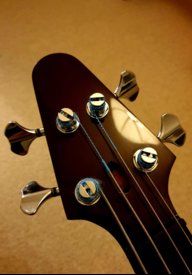
Finished sanding the fretboard and wiped a coat of oil on it. Just need to cut the slots a bit deeper then I can get some frets in.


Enjoy the benefits of a premium membership!
Upgrade Account
-
TalkBass has been independent since 1998. Add your voice.
Create a free account to reply to discussions, view embedded media, and browse with fewer display ads.
Join free Log in
Want zero display ads or expanded classifieds tools? Compare plans.
You are using an out of date browser. It may not display this or other websites correctly.
You should upgrade or use an alternative browser.
You should upgrade or use an alternative browser.
Super-lightweight P bass build
- Thread starter Flying B
- Start date
More options
Who Replied?

I got the side dots glued in today.

Here's a question for anyone who's still listening. After radiusing the fretboard, obviously the slots are not deep enough at the edges where it gets thinner. Do you guys cut them deep enough at the edges and have them over depth in the middle? Previously I've just used a hand saw to deepen the edges so that the slot is more of a curve, but I could just put it back on the slotting saw and cut them all straight.
Here's a question for anyone who's still listening. After radiusing the fretboard, obviously the slots are not deep enough at the edges where it gets thinner. Do you guys cut them deep enough at the edges and have them over depth in the middle? Previously I've just used a hand saw to deepen the edges so that the slot is more of a curve, but I could just put it back on the slotting saw and cut them all straight.
Yes, I saw them over depth in the middle and have a for a long time. I think ideally if you have a curved slot that matches your board curvature, then you are getting a little more thickness of your fretboard under the fret which improves the strength a bit, but no idea on how critical that is (or not). There may be more engineering reasons to have the slot match the curve of which I'm not aware.I got the side dots glued in today. View attachment 7157689
Here's a question for anyone who's still listening. After radiusing the fretboard, obviously the slots are not deep enough at the edges where it gets thinner. Do you guys cut them deep enough at the edges and have them over depth in the middle? Previously I've just used a hand saw to deepen the edges so that the slot is more of a curve, but I could just put it back on the slotting saw and cut them all straight.


I’ve got a couple of 1/4” Craftsman routers from the 1970s (made by Ryobi, I think) and they’re good machines but you definitely have to respect their limitations.I think I'd be more comfortable if I had a router with the larger 1/2" shank. But my janky little router table uses a Craftsman router with a 1/4" collet and it doesn't seem to be removable to insert a 1/2" collet. It just kinda freaks me out every time I use a tall router bit with a 1/4" shank.
Given their limited power and 1/4” chuck, I consider them to be about equal to modern trim routers in capacity. Little bites with little bits is the way to go. For big bits and/or big cuts I use a 1/2” chuck because, like you, I get nervous using big cutters with small shafts.
The nice thing about those old Craftsman routers is that they occupy a nice space between modern trim routers and bigger 1/2” routers; heavier and more stable than a trim router and not as torquey as a bigger machine. For smaller cuts, as long as the wide base isn’t a problem, they’re pretty comfortable to use. …and you can find them all day long for $10 at yard sales.
I use Stew-Mac’s fret slot saw which has the depth stop on it so my fret slots are of uniform depth around the radius of the board.I got the side dots glued in today. View attachment 7157689
Here's a question for anyone who's still listening. After radiusing the fretboard, obviously the slots are not deep enough at the edges where it gets thinner. Do you guys cut them deep enough at the edges and have them over depth in the middle? Previously I've just used a hand saw to deepen the edges so that the slot is more of a curve, but I could just put it back on the slotting saw and cut them all straight.
You certainly don’t need that tool, though; you can cut a strip of plexi to sit on the side of the blade of your slotting saw and attach it with spring clamps.
Last edited:
I drilled some holes in the headstock in today's lunch break.

Note to future self, drill those holes before the fretboard goes on, when everything is still flat.
I didn't get anything done on the bass today but I did manage to dig out my fret saw and a bit of clear plastic so I made a depth stop for it.

A dull couple of half-hours checking, endeepening, and cleaning the fret slots and it's now ready for fretting, although it will have to wait until I go back to work next week.
The depth guide on the saw kind of worked, but I put it on the wrong side so it was blocking my view, and also I should've sanded it smooth and rounded it over, as it started leaving marks on the fretboard. So I pulled it off and just did them by eye checking as I went.

To be honest,a simple line scribed on the saw to show the cutting depth would be fine.
The depth guide on the saw kind of worked, but I put it on the wrong side so it was blocking my view, and also I should've sanded it smooth and rounded it over, as it started leaving marks on the fretboard. So I pulled it off and just did them by eye checking as I went.
To be honest,a simple line scribed on the saw to show the cutting depth would be fine.

May I suggest Sharpie, or the UK equivalent (permanent marker). If you want to be fussy, Sharpie, and then treat it like metalworker's layout dye and scribe your line in it.
After a little time off from this build to work on other projects I finally got back to it today. Started putting some frets in.

Got a chance to try out these new fret nippers. I've been using a cheap pair of cutters which I ground the end flush but they kept chipping out, these are much nicer. They will cut stainless too.

Got a chance to try out these new fret nippers. I've been using a cheap pair of cutters which I ground the end flush but they kept chipping out, these are much nicer. They will cut stainless too.

Thanks! Yeah that real life stuff can be a real buzz kill.I missed all this with real-life stuff. Very cool build.
I got the frets filed flat on the ends and then bevelled them. I'm not in love with the stripey headstock, it feels like a bit too much along with the jazzy fretboard. I'm veering towards a walnut veneer on the headstock to tie it in with the body, thoughts?


I agree that the stripey headstock means that there are too many patterns on the bass.
I like the idea of tying in the headstock with the body so that the fingerboard pops more.
I like the idea of tying in the headstock with the body so that the fingerboard pops more.
Agree!I agree that the stripey headstock means that there are too many patterns on the bass.
I like the idea of tying in the headstock with the body so that the fingerboard pops more.
After a lot of umming and ahhing I made a clamping caul on the belt sander, then glued the veneer on the headstock.



Cleaned off the excess with a router and redrilled the tuner holes. Still need to dig around for the truss rod access, but I'm much happier with how it's looking.

