• TalkBass has been independent since 1998. Add your voice.
    Create a free account to reply to discussions, view embedded media, and browse with fewer display ads.
    Join freeLog in
    Want zero display ads or expanded classifieds tools? Compare plans.

Switching basses and getting used to different basses

I have played 34 scale fretted and fretless for decades. I can switch between either pretty easily. Some have P traditional baseball bat necks and some are thinner. I believe it’s what is referred to as “nut width” but I’ve never measured. I also picked up a short scale that has a very narrow neck, feels like the same neck as my Les Paul. I noticed first couple months my left hand had to adjust to the increased finger bends. I also play violin so it reminds me more of that than the stretched position of a standard bass. Not being facetious when I say I have no idea the actual neck and nut size or string spacing. I can tell there are differences, just doesn’t concern me. Started violin in 2nd grade so that, cello, basses, guitars, baritones, mandolin (which I am terrible at) all have different scales and sizes.
 
  • Like
Reactions: dzcandemir
Three things I must adjust to, so I just avoid basses with these characteristics.
- string spacing at the nut. (I like normal to wide; I avoid jazz basses neck width)
- top strap button location in relation to the frets. This pertains to how far you reach to the frets.*
-The first knob has to be volume. Some basses put the blend first. If you are switching between basses, you don't want to be concentrating on which knob is volume.
*I like a strap button location close to the 12th fret. When I play basses with much shorter horns, or strap buttons on the back side, my hands naturally settle on the wrong fretboard dots. I can start playing a whole step off, and everything just feels terrible. For me it's very helpful for the first fret to be the same reach on different instruments. (bridge saddle location plays a part too)

I'm with you on the upper strap button placement/reach issue, and unfortunately learned about it during a gig, when I switched from a DiPinto Belvedere semi-hollow to my Fender Jazz. The DiPinto had a short upper horn and strap button around the 16th fret, so my left hand naturally went to the wrong position to start the next track. I was totally confused for a few terrifying seconds playing about a step down, but I recovered before any serious damage was done...I think. ;) I wasn't aware of the issue because I had never switched basses during rehearsal, but once I figured this out I could switch between the DiPinto and my Fenders without problems.

Now I avoid that strap button placement because I dislike the long reach when standing. I can adjust, but I simply don't want to adjust to less comfortable ergonomics. I made a strap button extender for the DiPinto that helped, but not enough to keep it when my SB-2 did the deep and heavy thing just as well. (I sold the DiPinto to a dude who was about 6' 3", and the reach didn't bother him at all.) I could probably adjust to 35" scale too, but have no interest unless it's a fanned-fret bass with only the lower strings at a longer scale.

I had no issue adjusting to a five-string. Before I bought one, I envisioned how I would play my band's tracks on a five, and I think those mental exercises may have helped. I've always been able to switch between fours and fives without problems other than an occasional few seconds of adjustment if I've gone a long time without switching. I've always rotated my basses for rehearsals to prevent issues if I have to switch during a show, but I've decided it's better to keep two fives around because some projects require one. (And maybe, just maybe because it's a good reason for more basses! :D)
 
  • Like
Reactions: dzcandemir
I switch up routinely, for no other reason than because I love all my basses and different ones inspire me at different times. There are also sound differences, and the fact that only two of them feel comfortable for me to use my fingers on (I'm pretty exclusively a pick player).

I expected to have a lot more trouble switching, but I don't. I started on a Jazz and a full-width P nut does feel odd to me, so I avoid those. But I can swap back and forth between my super-skinny JP90 and my late-70s Rick with no trouble at all. Which surprises me.
 
  • Like
Reactions: dzcandemir
I've been a multi-instrumentalist since i was a kid, so it's probably different to me, but switching between bass guitars is a couple seconds mental adjustment before I start playing. I've got a variety pack of narrow and wide nuts, thin and thick necks, fretted and fretless, and 4-, 5- and 6-strings.

Of course the caveat is that I'm not any good, so I guess being able to switch easily just means I suck the same on any instrument without adjustment time.:woot:
 
Hey fellow TBers. This question goes out to people who play multiple basses regularly. I recently acquired a precision bass. It took me about a couple of months to fully adjust. I still get hand pains sometimes if I play for too long. On the other hand I’ve played a jazz bass for almost a decade and needless to say I’m the most comfortable on the jazz. But at this point I’ve played my P exclusively since I got it and I’m pretty much used to it I would say. Do you have challenges switching from bass to bass? I assume it’s pretty normal but can be unnecessarily annoying. Additionally I’m looking to add a 5 stringer to my arsenal. I’m eyeing Ibanez ehb fanned frets. Any tips on getting used to a 5 stringer from experienced folk out there? Thank you.

I've had some similar problems in the past - specifically with a P bass causing me pain. I would get wrist and arm pain if I played it for any extended period.
Didn't feel like I needed to "power though it," and didn't feel like I needed to adjust my technique after years and years...
At the time I was playing a Jazz an a Tele bass too, and no pain from either one of those.
I decided that it was the neck profile - my Jazz (narrow nut) and tele (wide nut) both had a chunky profile - thick front to back. Well, the P bass was kind of wide and flat.
Now I have a P bass with a chunky neck, and I love it - zero pain.

So for me, it's all about finding what you like, what is comfortable, and what works for you and going with that.
 
  • Like
Reactions: dzcandemir
Hey fellow TBers. This question goes out to people who play multiple basses regularly. I recently acquired a precision bass. It took me about a couple of months to fully adjust. I still get hand pains sometimes if I play for too long. On the other hand I’ve played a jazz bass for almost a decade and needless to say I’m the most comfortable on the jazz. But at this point I’ve played my P exclusively since I got it and I’m pretty much used to it I would say. Do you have challenges switching from bass to bass? I assume it’s pretty normal but can be unnecessarily annoying. Additionally I’m looking to add a 5 stringer to my arsenal. I’m eyeing Ibanez ehb fanned frets. Any tips on getting used to a 5 stringer from experienced folk out there? Thank you.

For me, the tactile feel of different basses forces me to think and play differently, which I believe is a good thing.
 
I've had some similar problems in the past - specifically with a P bass causing me pain. I would get wrist and arm pain if I played it for any extended period.
Didn't feel like I needed to "power though it," and didn't feel like I needed to adjust my technique after years and years...
At the time I was playing a Jazz an a Tele bass too, and no pain from either one of those.
I decided that it was the neck profile - my Jazz (narrow nut) and tele (wide nut) both had a chunky profile - thick front to back. Well, the P bass was kind of wide and flat.
Now I have a P bass with a chunky neck, and I love it - zero pain.

So for me, it's all about finding what you like, what is comfortable, and what works for you and going with that.

That’s very interesting. My precision is wide and flat too. I don’t power through any kind of pain it’s usually soreness around bed time and nothing too crazy. I like that it is different as GrapeBass mentioned. Some discomfort may be a part of adjusting I guess.
 
  • Like
Reactions: hennessybass
Some basses are just less comfortable for your hands. I love my precision bass, but I had to try several to find the one that works for me. The wide chunky neck that most have didn’t work for me, as it’d cause my wrist some grief. Now that I found the bass that’s comfortable, switching back and forth isn’t an issue at all. Also, don’t expect to be able to play the same way, or as well, on every bass. I can play licks on my fretless foundation that I can’t play on my p bass, and licks I can play on my p bass that I could never pull off on my Hofner clone. Different basses lend themselves to playing in different ways.
 
  • Like
Reactions: dzcandemir
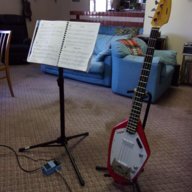
I have recently added a 5er to my arsenal and this took a little time to get used to. The tighter string spacing and extra string proved a bit tricky for a little while when using a plectrum. My main issue when using fingers is that the low B can sound out of not muted properly. I spent a while perfecting the floating thumb technique. Well worth persevering with if you ask me.
 
  • Like
Reactions: dzcandemir
String spacing seems the obstacle for me, but takes only about 10 minutes of warmup to adjust then I’m good to go. Sometimes I switch between 4, 5, and 6 string basses 34” and 35” during the same practice session. After rotating once between them the 10 minute thing pretty much goes away, even with the Dingwall.
 
  • Like
Reactions: dzcandemir
I have recently added a 5er to my arsenal and this took a little time to get used to. The tighter string spacing and extra string proved a bit tricky for a little while when using a plectrum. My main issue when using fingers is that the low B can sound out of not muted properly. I spent a while perfecting the floating thumb technique. Well worth persevering with if you ask me.
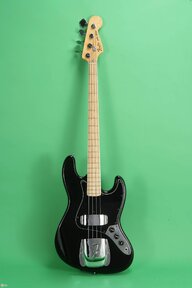
Good to hear. I started off with floating right hand 10 years ago. Thanks for sharing your experience. I suspect I will have some trouble E string not being the first string when looking down.
 
  • Like
Reactions: P-Belly Evans
I practice on the bass that requires more effort. The more accurate I get with the "harder to play" bass then it makes the "go play for people" bass easier to handle and faster (provided I don't get careless). I think of the "harder" bass as the musical equivalent of a fungo bat. It works for me. I have a 5-string and I treat it as a different instrument altogether, not a 4-string with an extra string. It has its own place in the music universe.
 
  • Like
Reactions: dzcandemir
To me, it's more about the strings. I play big flats most of the time, but when I am asked to play in that Marcus Miller 80's type slap style I have a bass set up with skinny rounds. Every time I play it, it feels like a set of guitar strings to me, with no resistance. Then when I go back, the flats feel like bridge cables and I have to rebuild left hand strength.