The problem is to find a nice balance of reliability, power, and distortion.
I got the impression from the same post (
http://www.talkbass.com/forum/showthread.php?t=461363), that it was the current handling capacity of the components in the power section and not the effect of heat that limits use of the amp to a 4 ohm load.
So does that mean that the SWR power section is more robust, or does Dave Funk and Dave Nordschow's concerns have more to do with sound in the context of THD as mentioned by Kjung?
Cheers,
Duff2
First, you need to listen to guys that know what they're talking about. There's been so much positive response to Thunderfunk amps (and not just the bass stuff) that there's many shills on TB that purposely plant posts casting doubt about my products or making strange comments about how they sound, or work, yet they don't own one, never heard one, and are only guessing at the technical stuff.
This 2-ohms "heavy duty" arguement keeps coming up, and I'll have to post a FAQs to do a long explanation, but the whole idea that 2-ohm operation is a matter of making the amp "better" is pure B.S. I've explained this before, so I'll make it short.
OPERATING VOLTAGE = MAXIMUM POWER OUTPUT
CURENT CAPACITY = LOAD
WATTS = Volts x Current (Amps)
TRANSFORMER RATED IN VA, NOT Watts!!!! (It has to do with phase.)
1. The design starts with a maximum power decision. That equals the operating volts, as the amp must throw volts to push a current through a load (speaker).
2. The load determines how much current the amp must deliver.
A 2-ohm load gets full current at a lower voltage, so the design parameter at #1 gets lowered. Now it has poor performance at 4 and 8-ohms. Remember, there's only ONE POINT where the amp is balanced between load, current, and power.
3. The transformer is only so big.
End of design story.
There is NO SUCH THING as an amp that operates just as well at 2-ohms as it does at 4-ohms, or 8-ohms. The exception is digital amps, and tube amps which have an output transformer that has 2-4-8 and 16-ohms taps. Try running you Fender Deluxe at 2-ohms and tell me how good it sounds.
Here's an analogy. You have a car that has a three-speed transmission. It's designed to run 60 mph at 4,000 rpm in third gear. You ask me if you can run the car at 60 mph in FIRST gear. Sure, YOU can, but I wouldn't. How long do you want the car to last? "Why doesn't it run at 60 mph in ANY of the three gears? Maybe it needs to be Heavy Duty?" If you need to run at 2-ohms, you have the wrong cabinets. You reject that answer because you don't want to buy the right cabs. That's not my fault. This other brand says they can run all day long in first gear at 60 mph and YOU BELIEVE THEM! hahahahahaha I tell you the truth and get grief for it.
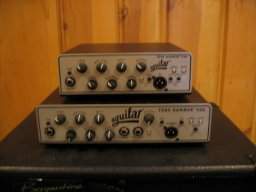
So, I designed the TFB750-A to peak at 4-ohms and still handle a 2-ohm load. It does it fine. But you don't want to hear that if I did it "right" it would do 750-watts at 2-ohms, 400-watts at 4-ohms, and 200-watts at 8-ohms. Now all the guys with 8-ohm cabs are mad that THEY bought the wrong cabs. This whole argument is a loser. It has NOTHING to do with an "additional" capability. We designed it for maximum power at 4-ohms, and designed it with a heavy duty output section to survive being "abused" by a 2-ohm load. If you're running a 2-ohm load, don't worry about it, but if you want that best balance of power, tone, and reliability, I'd run it at 4-ohms. Sorry, I can't lie to you and tell you the laws of physics have been suspended so you can run around town in first gear and get the same mpg.