
Enjoy the benefits of a premium membership!
Upgrade Account
-
TalkBass has been independent since 1998. Add your voice.
Create a free account to reply to discussions, view embedded media, and browse with fewer display ads.
Join free Log in
Want zero display ads or expanded classifieds tools? Compare plans.
You are using an out of date browser. It may not display this or other websites correctly.
You should upgrade or use an alternative browser.
You should upgrade or use an alternative browser.
Techniques for a More Efficient Fretting Hand?
- Thread starter Matthew_84
- Start date
More options
Who Replied?
Great suggestions. Another would be to just try to play as comfortably and relaxed as possible for what works, and don't think about it so much, let your fingers do what makes sense to play the notes. Like anything else, practice and focus on "playing" and sounding good; muscle memory will take care of the rest. I suppose I play with a lot of the ideas and methods that these kind folks have said in place, but have never put much thought into it.
Being in a 3-piece band I add a lot of grace notes, 5ths below (2nd finger, 1st for the fifth,back to the 2nd,) walking, double stopping and "chord" permutations (adding 5ths and octaves in various combinations and sequences, like a guitar player picking, wanging and chunging) but it's all done fairy comfortably and without much thought. Barring with the 1st finger even lets you hammer on the 5ths and octaves once you get used to it; that does take extra pressure, but it's only occasionally. And it's a of of fun!
One nice thing about learning to play with just enough force to get the notes to sound right is that your thumb isn't squeezing the neck nearly as hard (it has to equal your fretting pressure,) so it makes sliding your hand up and down easier, which in turns means you can concentrate on how your sound is and get less tired. You relax, and that lets you pay better. It's a circle.
I think people tend to think if they are playing faster they must fret harder, but the opposite is actually true.
For what it's worth, after a four hour gig my hands really feel fine, so there must be something right about it. As long as it sounds good and you aren't in any pain, it must be OK.
And an interesting note; your callouses show how your are playing! On a 1-5 callous scale playing flat wounds I have: between the center and top edge of thumb nearer the joint is at a 2 against the neck, a little in the cup between thumb and first finger at the first finger base (that actually just holds the neck up, no other force against it the first finger tip is a 4 at about a 45 degree angle below the plain of the nail and a little closer to the next finger rather than centered on the tip; the second is a 5 same location, 3rd is a 1 and 4th a 2. The second finger pad is broader, and the 3rd and 4th more on the tips. So they are about where they should be, you can tell I angle my hand across the fretboard a bit rather than having it perfectly parallel, otherwise I get wrist issues.
If you have a callous where it shouldn't be, you're probably doing something wrong.
Of course the 1st finger on my right hand has a callous of about a 12 and the second is about an 8...
Being in a 3-piece band I add a lot of grace notes, 5ths below (2nd finger, 1st for the fifth,back to the 2nd,) walking, double stopping and "chord" permutations (adding 5ths and octaves in various combinations and sequences, like a guitar player picking, wanging and chunging) but it's all done fairy comfortably and without much thought. Barring with the 1st finger even lets you hammer on the 5ths and octaves once you get used to it; that does take extra pressure, but it's only occasionally. And it's a of of fun!
One nice thing about learning to play with just enough force to get the notes to sound right is that your thumb isn't squeezing the neck nearly as hard (it has to equal your fretting pressure,) so it makes sliding your hand up and down easier, which in turns means you can concentrate on how your sound is and get less tired. You relax, and that lets you pay better. It's a circle.
I think people tend to think if they are playing faster they must fret harder, but the opposite is actually true.
For what it's worth, after a four hour gig my hands really feel fine, so there must be something right about it. As long as it sounds good and you aren't in any pain, it must be OK.
And an interesting note; your callouses show how your are playing! On a 1-5 callous scale playing flat wounds I have: between the center and top edge of thumb nearer the joint is at a 2 against the neck, a little in the cup between thumb and first finger at the first finger base (that actually just holds the neck up, no other force against it
the first finger tip is a 4 at about a 45 degree angle below the plain of the nail and a little closer to the next finger rather than centered on the tip; the second is a 5 same location, 3rd is a 1 and 4th a 2. The second finger pad is broader, and the 3rd and 4th more on the tips. So they are about where they should be, you can tell I angle my hand across the fretboard a bit rather than having it perfectly parallel, otherwise I get wrist issues.If you have a callous where it shouldn't be, you're probably doing something wrong.
Of course the 1st finger on my right hand has a callous of about a 12 and the second is about an 8...

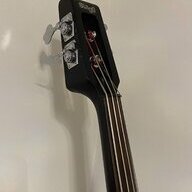
I've noticed some improvements in my fretting hand and just thought I'd update this thread in case anyone runs across it in the future.
Since I started this thread, I've been doing a lot of holding multiple notes at once (such as if I play a lot of roots to b7's and back, I'll keep my index on the b7 while I fret the root with my middle finger, and just lift the middle finger when I want to play the b7 again) and I notice it helps make my playing so much more cleaner. And not just less string noise (which there is), but there's also just less work in general for my fretting hand, and it's easier to play faster passages for me.
Thanks again everyone!
Since I started this thread, I've been doing a lot of holding multiple notes at once (such as if I play a lot of roots to b7's and back, I'll keep my index on the b7 while I fret the root with my middle finger, and just lift the middle finger when I want to play the b7 again) and I notice it helps make my playing so much more cleaner. And not just less string noise (which there is), but there's also just less work in general for my fretting hand, and it's easier to play faster passages for me.
Thanks again everyone!

Here's something that gets pushed to the side in regards to the fretting hand.
I've always said this in essence.
Some may disagree.
I've always said this in essence.
Some may disagree.

Here's something that gets pushed to the side in regards to the fretting hand.
I've always said this in essence.
Some may disagree.
Quick summary of a nearly nine minute video, "Don't choke the chicken." Something to keep in mind is lot's of top players change their technique depending upon the requirements of the music. So in reality there are times when choking the chicken is fine.
IMHO the most important point is you need to practice good technique so it's available when you need it.
Yeah don't take that as gospel. There are drawbacks and potentially nasty ones too to the low wrist technique, the main one being a greatly increased risk of RSI's over a long period of time. Especially if the bass is in an awkward position, like in the Pino Palladino case where the neck is nearly level with the floor, trying to keep the wrist down and the thumb behind the neck can do a lot of damage to the wrist long-term and hurt like hell too.
If you gig a lot, the "baseball bat" thing can be a godsend in terms of pain and fatigue, and many players are awesome when choking the chicken. Eg. Jack Bruce:
Billy Sheehan is another chicken-choker who can play at a virtuoso level.
Course, in saying that, the wrist low thing is what I have to do to be able to play with any facility at all, so I go to great lengths to make sure I don't have to bend it too hard. Usually meaning taking pains to treat neck dive, etc....
L
If you gig a lot, the "baseball bat" thing can be a godsend in terms of pain and fatigue, and many players are awesome when choking the chicken. Eg. Jack Bruce:
Billy Sheehan is another chicken-choker who can play at a virtuoso level.
Course, in saying that, the wrist low thing is what I have to do to be able to play with any facility at all, so I go to great lengths to make sure I don't have to bend it too hard. Usually meaning taking pains to treat neck dive, etc....
L
Yeah don't take that as gospel. There are drawbacks and potentially nasty ones too to the low wrist technique, the main one being a greatly increased risk of RSI's over a long period of time. Especially if the bass is in an awkward position, like in the Pino Palladino case where the neck is nearly level with the floor, trying to keep the wrist down and the thumb behind the neck can do a lot of damage to the wrist long-term and hurt like hell too.
If you gig a lot, the "baseball bat" thing can be a godsend in terms of pain and fatigue, and many players are awesome when choking the chicken. Eg. Jack Bruce:
Billy Sheehan is another chicken-choker who can play at a virtuoso level.
Course, in saying that, the wrist low thing is what I have to do to be able to play with any facility at all, so I go to great lengths to make sure I don't have to bend it too hard. Usually meaning taking pains to treat neck dive, etc....
L
I agree that bending the wrist too much can lead to repetitive stress injuries. How high you wear the bass is an important factor to consider. What I find is to raising the bass tends to increase the amount of bend in the plucking wrist and lowering the bass tends to increase the amount of bend in the finger wrist. Apply the Goldilocks principle and find the appropriate compromise based on your playing needs rather than how it looks and you should be fine. Course if you're only going to play easy bass parts, feel free to drop the bass as low as you want to look cool and choke the chicken.
I was a working pro for many years. I often rehearsed with couple of different ensemble during the day and then played with third ensemble in the evening. My goal was to maintain good technique, but sometimes when I was fatigued from a long day, or using an instrument that I was not used to playing then I would sometimes allow my hand to collapse when the music allowed. For example I sometimes played an 6-string NS Design electric upright that actually had a convex channel in the back of the neck. Theoretically this was supposed to make it easier to play, but since it involved different muscles than my normal upright I found it was harder on my hand.
Here's some images so you get the idea of the neck shape.
I think we can all agree that Billy Sheehan is a bit of a freak. In these videos his left hand seems to change shape and posture quite frequently, so I am not sure it's fair to qualify him as a chicken choker. He does have one position where he wraps his thumb over the top of the neck though. I believe he is actually fretting notes with his thumb so I would consider this an extended/alternate technique.

...don't listen to any of us unless we're Jaco, McCartney, Jamerson, Geddy Lee or Ron Carter... if your hand feels uncomfortable playing, experiment... no one method is better than another... folks love to pontificate around here...
I agree that bending the wrist too much can lead to repetitive stress injuries. How high you wear the bass is an important factor to consider. What I find is to raising the bass tends to increase the amount of bend in the plucking wrist and lowering the bass tends to increase the amount of bend in the finger wrist. Apply the Goldilocks principle and find the appropriate compromise based on your playing needs rather than how it looks and you should be fine. Course if you're only going to play easy bass parts, feel free to drop the bass as low as you want to look cool and choke the chicken.
I was a working pro for many years. I often rehearsed with couple of different ensemble during the day and then played with third ensemble in the evening. My goal was to maintain good technique, but sometimes when I was fatigued from a long day, or using an instrument that I was not used to playing then I would sometimes allow my hand to collapse when the music allowed. For example I sometimes played an 6-string NS Design electric upright that actually had a convex channel in the back of the neck. Theoretically this was supposed to make it easier to play, but since it involved different muscles than my normal upright I found it was harder on my hand.
Here's some images so you get the idea of the neck shape.
View attachment 3802843 View attachment 3802844
I think we can all agree that Billy Sheehan is a bit of a freak. In these videos his left hand seems to change shape and posture quite frequently, so I am not sure it's fair to qualify him as a chicken choker. He does have one position where he wraps his thumb over the top of the neck though. I believe he is actually fretting notes with his thumb so I would consider this an extended/alternate technique.
Agreed on all points.
I did about 95% of my gigging with a rickenbacker 4001 and a 4003s, one of the most unergonomic basses ever made. I love ricks, but you do have to "adapt" to play one all night over and over again. I sewed some huge weights into my strap down where it connected to the bottom strap loc - that helped keep the neck up but it didn't cure it entirely. And at the time I hadn't yet discovered the floating thumb so I was doing the bent wrist thing on the right hand with the thumb solidly sitting on either the rear pickup edge or the E string.
If I had to gig with a rick again I'd do the weights thing again in a heartbeat to preserve my left hand, but I'd demand more breaks from the band too
 .
.But having said everything I said, I can't play at all if I choke the chicken. I have to do the delicate, "proper", lower wrist technique with the thumb on the back of the neck or I literally can't even play a simple country line. So when playing standing up, I need an ergonomic situation.
The most ergo bass for playing "properly" like that was my Carvin Brian Bromberg unlined FL. Even as a 5 string, that was the most comfortable bass I've ever played, both standing up and sitting. I'm going to get another one one day, but that next one will be a 4 string with a bare maple fingerboard on it and the "Hard As Nails" finish. Soon as I have the extra funds and the extra time to wait for it to be built, anyway. Assuming Kiesel doesn't quit making it before then.......
L
Agreed on all points.
I did about 95% of my gigging with a rickenbacker 4001 and a 4003s, one of the most unergonomic basses ever made. I love ricks, but you do have to "adapt" to play one all night over and over again. I sewed some huge weights into my strap down where it connected to the bottom strap loc - that helped keep the neck up but it didn't cure it entirely. And at the time I hadn't yet discovered the floating thumb so I was doing the bent wrist thing on the right hand with the thumb solidly sitting on either the rear pickup edge or the E string.
If I had to gig with a rick again I'd do the weights thing again in a heartbeat to preserve my left hand, but I'd demand more breaks from the band too
But having said everything I said, I can't play at all if I choke the chicken. I have to do the delicate, "proper", lower wrist technique with the thumb on the back of the neck or I literally can't even play a simple country line. So when playing standing up, I need an ergonomic situation.
The most ergo bass for playing "properly" like that was my Carvin Brian Bromberg unlined FL. Even as a 5 string, that was the most comfortable bass I've ever played, both standing up and sitting. I'm going to get another one one day, but that next one will be a 4 string with a bare maple fingerboard on it and the "Hard As Nails" finish. Soon as I have the extra funds and the extra time to wait for it to be built, anyway. Assuming Kiesel doesn't quit making it before then.......
L
My first bass was a 4001 which had a bit of neck dive. I still have the bass but it has been Frankensteined. One of the mods was to install one of the original 2-Tek bridges which were quite heavy. The neck dive is pretty much fixed. The other mod was Alembic pickups. It's an interesting bass but doesn't sound anything like a Ric. If I could go back in time, I would tell myself to leave the bass stock.

-Keep the wrist as parallel to the neck as you can.
The problem with advice like this is that "parallel" or "perpendicular" is too easily misunderstood. there are multiple axes along which things can be understood as parallel. And the geometric terms relate lines on a plane, not wrists and bass necks in 3d space. Orientations 3D space is quite hard to precisely describe in plain English. Pictures or video are necessary to be accurate.
Last edited:


