The best $100 I spent on a compressor was for the Ampeg Optocomp. Sounds great, but not like a Cali. I have both and get more use out of the Ampeg due to size and power requirements.I don't think you will find a compressor that gets close to this performance at the $112 budget.
But if I'm wrong, please let me know!

Enjoy the benefits of a premium membership!
Upgrade Account
-
TalkBass has been independent since 1998. Add your voice.
Create a free account to reply to discussions, view embedded media, and browse with fewer display ads.
Join free Log in
Want zero display ads or expanded classifieds tools? Compare plans.
You are using an out of date browser. It may not display this or other websites correctly.
You should upgrade or use an alternative browser.
You should upgrade or use an alternative browser.
Testing Compressors: Cali, Smoothie, Empress, Diamond, Keeley, FEA, Darkglass, Doc Lloyd, Lusithand & more
- Thread starter scubaduba
- Start date
More options
Who Replied?

Same..I had a Diamond but wanted something that would work oon an active Stingray and/or when i wanted less coloring, so I grabbed an Opto Comp. For the price it certainly is a great grab and go compressor.The best $100 I spent on a compressor was for the Ampeg Optocomp. Sounds great, but not like a Cali. I have both and get more use out of the Ampeg due to size and power requirements.

It needs to be quiet - that would appear to eliminate the EBS in tubism mode...as the consensus seems to be it’s a the biggest noisemaker on the list.
EBS loyalist here...for probably about 15 years. Is there better out there? Probably, but that part of my chain (first) is pretty perfect for what I look for (and yes, I use tubism).
If I try something else, will I change? Most certainly...but so far, I've been able to control myself when it comes to compression

Do you find it noisey thru a DI?EBS loyalist here...for probably about 15 years. Is there better out there? Probably, but that part of my chain (first) is pretty perfect for what I look for (and yes, I use tubism).
If I try something else, will I change? Most certainly...but so far, I've been able to control myself when it comes to compression
Well done bass compressor comparison video to contribute to the rabbit hole:
Do you find it noisey thru a DI?
No. I have a fairly old black label one.
Anyone try a Walrus Deep Six? I read Scuba’s review just checking to see if you guys use one or have used one.

New version of the Keeley Bassist Comp here:
Bassist Compressor - Custom Shop LTD Edition - Robert Keeley
I think it's limited. A limited limiter. Go figure.
Bassist Compressor - Custom Shop LTD Edition - Robert Keeley
I think it's limited. A limited limiter. Go figure.

Thoughts on the Becos CompIP Mini One Pro Compressor:
The folks at Becos in Romania are back at it again with another new compressor pedal. This time, a more simple-to-use mini compressor for those either not needing a lot of controls or preferring less knobs to mess with. But this is no dumbed-down device. No, its a great little compressor that functions well and still includes a five LED gain reduction meter and dry/wet mix parallel compression option.
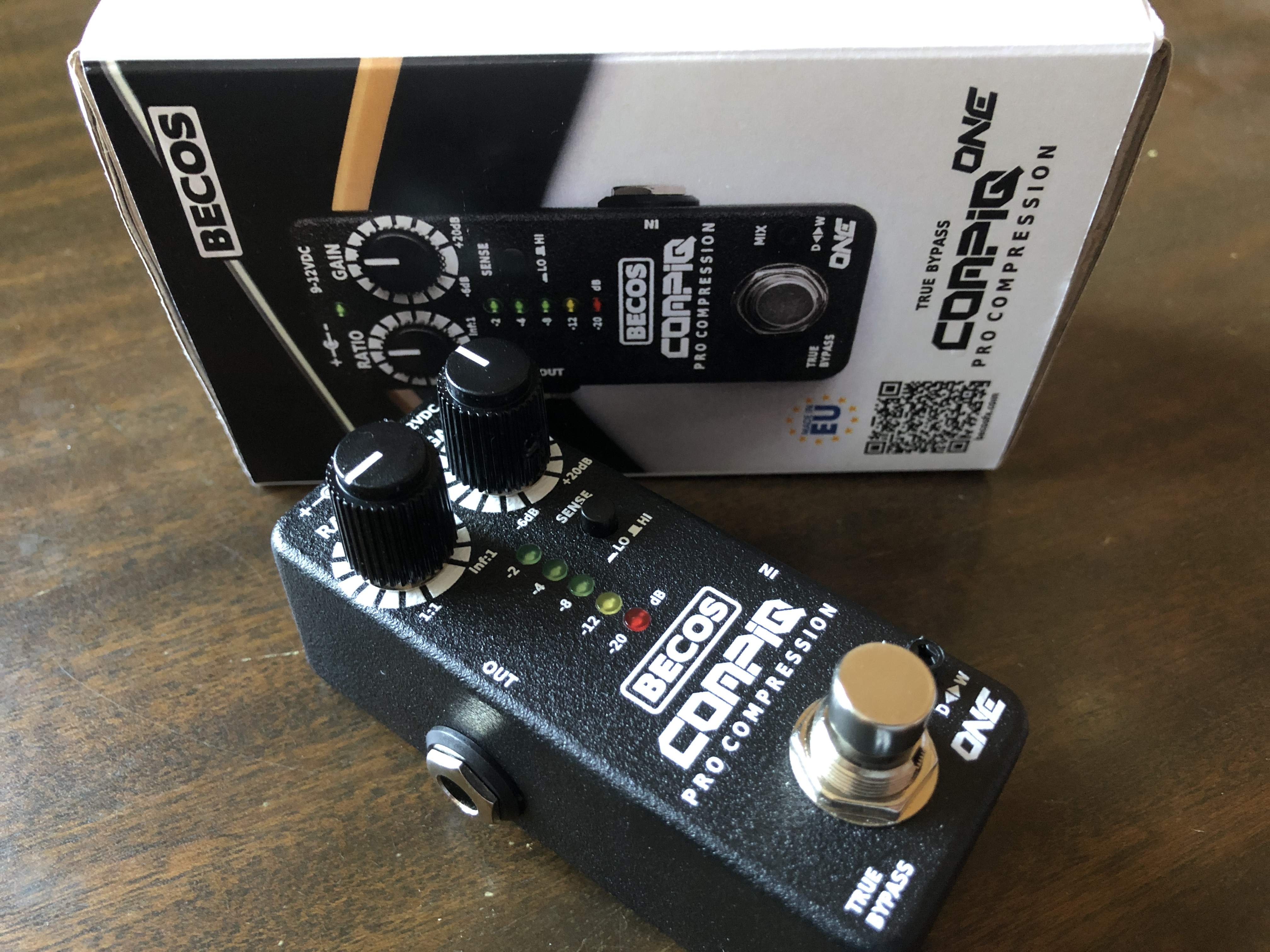
I am pretty fond of the Becos CompIQ MINI Pro Compressor reviewed earlier. I said it "may be little, it is not short on features. The team at Becos managed to cram a whole lot of versatility into a small form factor." While the Becos CompIQ Mini One doesn't have the same features under the hood it is the same Blackmer® VCA type compressor with FET active circuitry and WIMA audio capacitors. Basically the exact same circuit, just without so many controls.
There are three knobs and one push button on the face of the compressor. There is also an inside trimmer. More on that later.
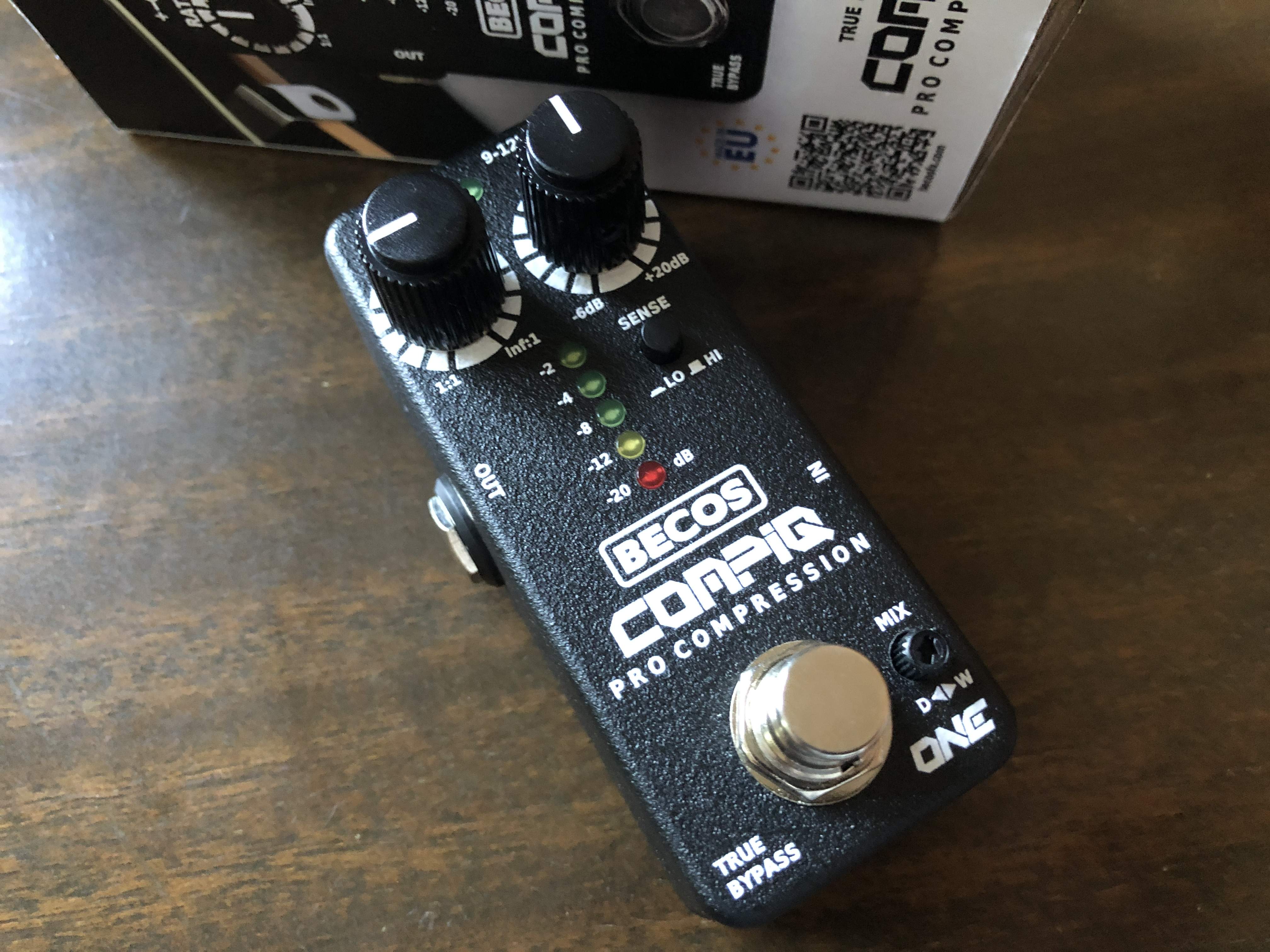
The Ratio knob sets how much the audio signal is going to be compressed after it passes above the set threshold. It shares the same continuous range as the Mini Pro starting from 1:1 (no compression applied) to Infinite:1 (basically limiting). At 9:00 you are roughly in the space of 2:1 ratio. At noon, more like 4:1. At 3:00 things are pretty squishy at around 10:1 ratio. The full range is useable and at higher settings makes for a pretty good limiter.
The Gain knob is there to make up the gain as you increase compression. As is expected, the higher you turn the gain, the more noise is introduced to the signal. Adjusting wet dry mix (small knob adjacent to footswitch) can help mitigate added noise. It is not an overly noisy compressor, but it is definitely not as quiet as others on the market. There is plenty of gain on tap.
The Wet Dry mix dial mounted on the right side on the top of the pedal adjacent to the foot switch and allows you to blend as much or little of your clean signal with the output compressed signal. In the middle, the mix is 50/50. When set to 100% dry (all the way counter clockwise), the CompIQ Mini One Pro acts like a buffer. This is a very useful design and I really like the dial set between noon and 1:00. I'd say there is enough variability in the range to satisfy anybody.
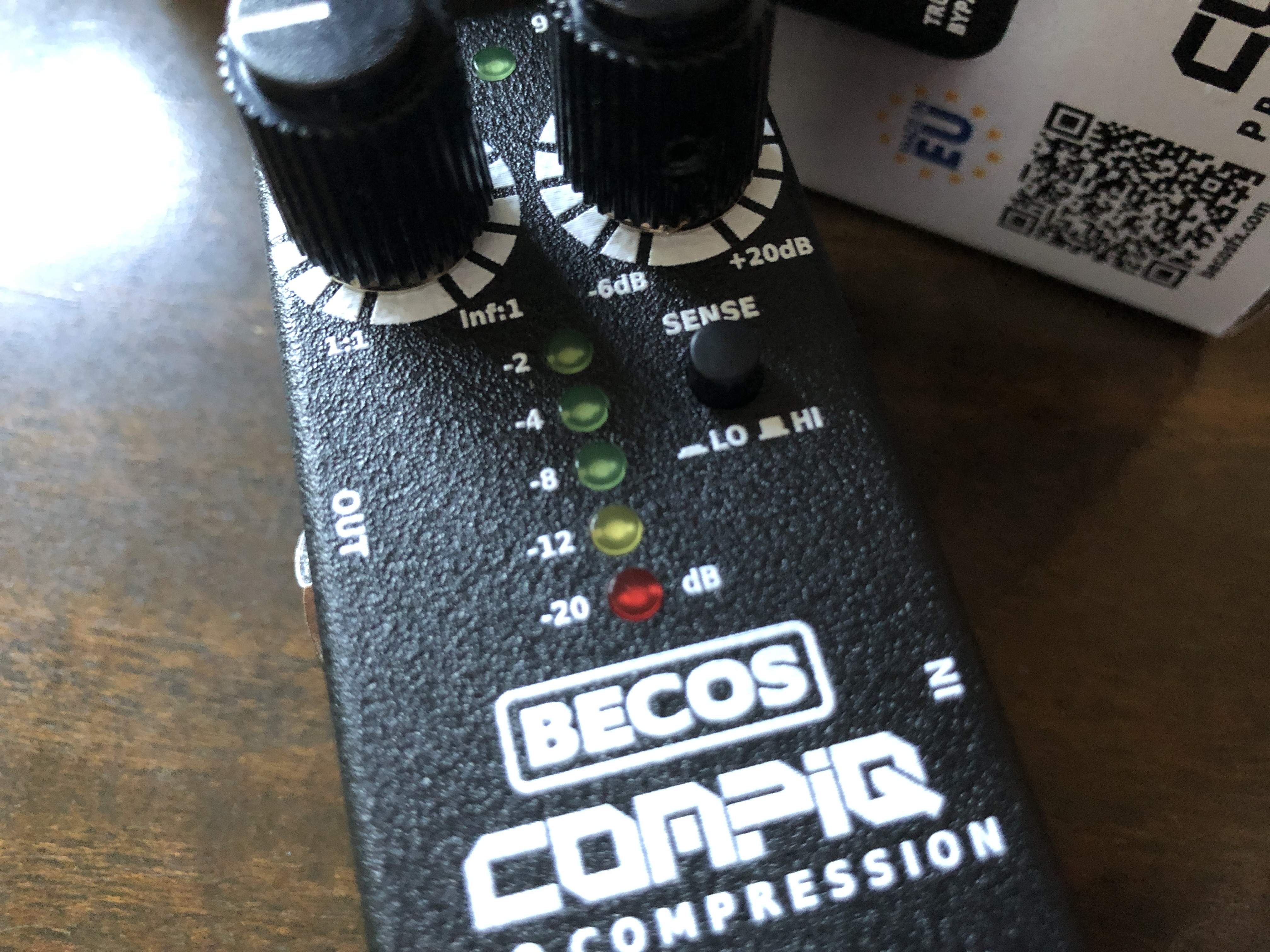
The Sense button is a type of threshold control. It controls the level at which the compression is applied. Compression is only applied to the portion of the signal that goes above the threshold. There are two preset levels. Switched down is the Lo setting fixed at -40dBu and is suitable for very weak instrument signals. In this setting the signal kicks in immediately. The Hi setting is user controlled by a trimmer inside the pedal with a range of -40dBu to +10dBu. (See picture below showing red trimmer dial in upper left.) With the inside trimmer set to noon it is 30dBu. The Hi setting is more for higher output instruments. I much preferred how the compressor reacted and felt in the Hi setting with all 5 of my basses. But if you have a very weak passive bass, the Lo setting might be just what you need. I would personally rather have an exterior Threshold dial but for the target audience I bet most will never touch the inside trimmer. However, if you do you will be met with a lot of control. It's a trade off. Less dials on the outside, but at least you can manipulate the threshold to some degree.
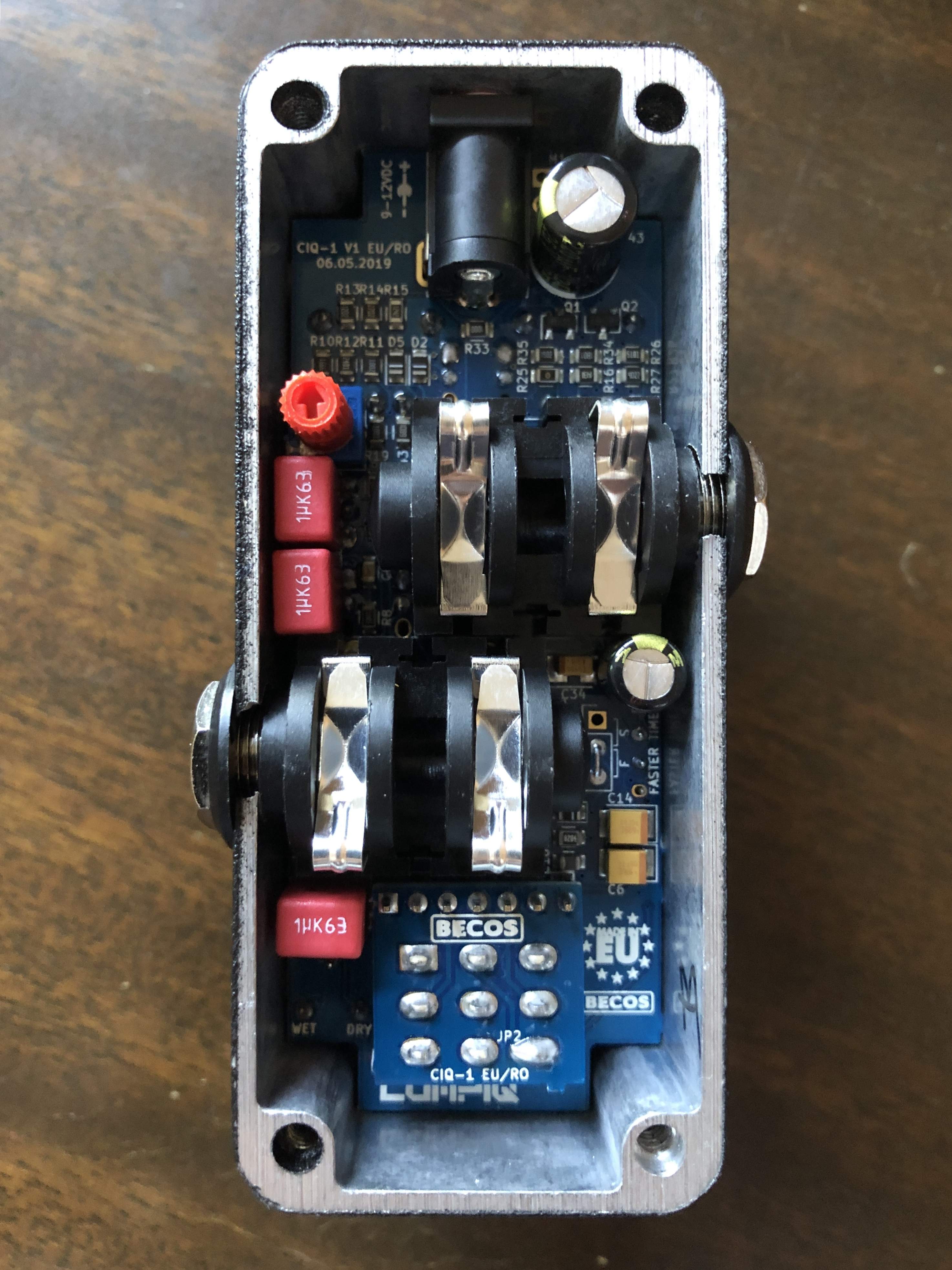
There is no control of attack and release timing. The Mini One Pro offers dynamic processing of attack and release timing. This means that short transients are handled with faster timings, while steady signals get slower timings. It works well as it reacts to your playing dynamics. The timings are approximately 10-15ms for attack time and 200-220ms for release time. Attack time is the amount of time it takes before the compressor kicks in. Release is the amount of time the compressor takes to "let go", or return to normal audio level.
There are many other compressors on the market that handle attack and release this way including the Keeley Bassist. That brings up a good point. In many ways the Becos Mini One Pro has a lot in common with the Keeley. Differences include the fact that the Becos trades a Threshold dial for a push button and internal trimmer. But you also get a 5 LED gain reduction media that is far superior to the Keeley Bassist's single LED. The Becos also adds the comprehensive Dry/Wet signal dial. The Becos is also smaller. Both have an inherent transparent quality.
The Mini One Pro has a soft compression knee which means it has a subtle application of compression.
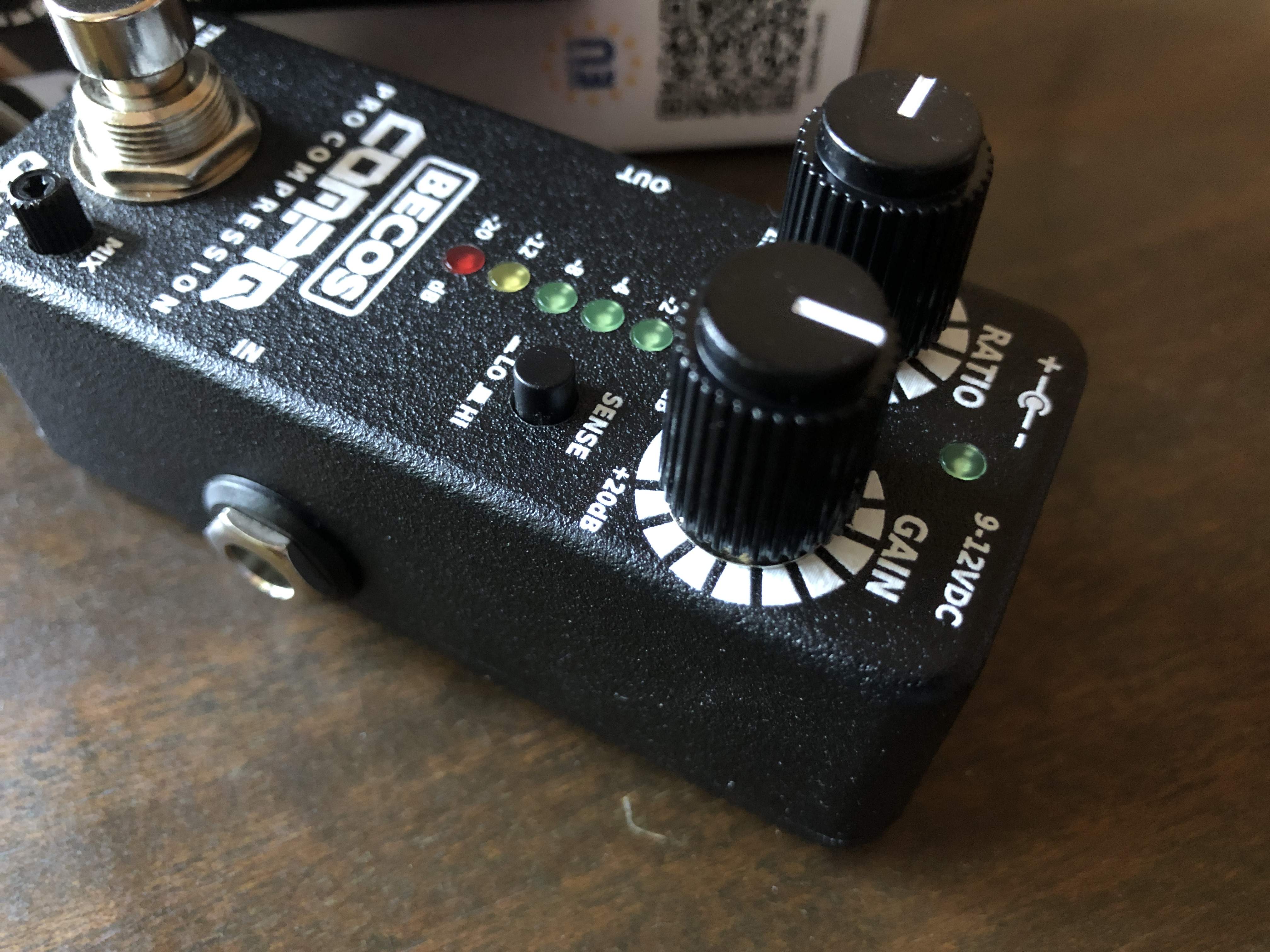
This isn't a compressor that is going to impart some sort of flavor or coloration to your tone. It is not a "tone magic" device but does a great job of subtle compression all the way to harder limiting action. Like the previous Becos compressors I reviewed I didn't notice any loss of highs or lows. I had no issues with any of my basses and never had concern about headroom.
Did I miss the amount of controls of the Becos CompIQ Mini Pro (notably the full Threshold Knob, Soft vs. Hard Knee control, and Attack/Release timing switch)? Yes and no. For what it is, the Mini One Pro is a remarkable little tool. I personally like having more control of threshold as I use many different basses. On the other hand, I suspect the target audience is more the set-and-forget crowd. I've really come to like this one. Its simplicity is its strength.
If you are considering the Keeley Bassist, the Becos CompIQ Mini One Pro is also worthy of your consideration. The Mini One Pro is well built, looks great, and performs well. It doesn't really make your tone bigger or fatter but it does compression really well.
The footswitch is true bypass.
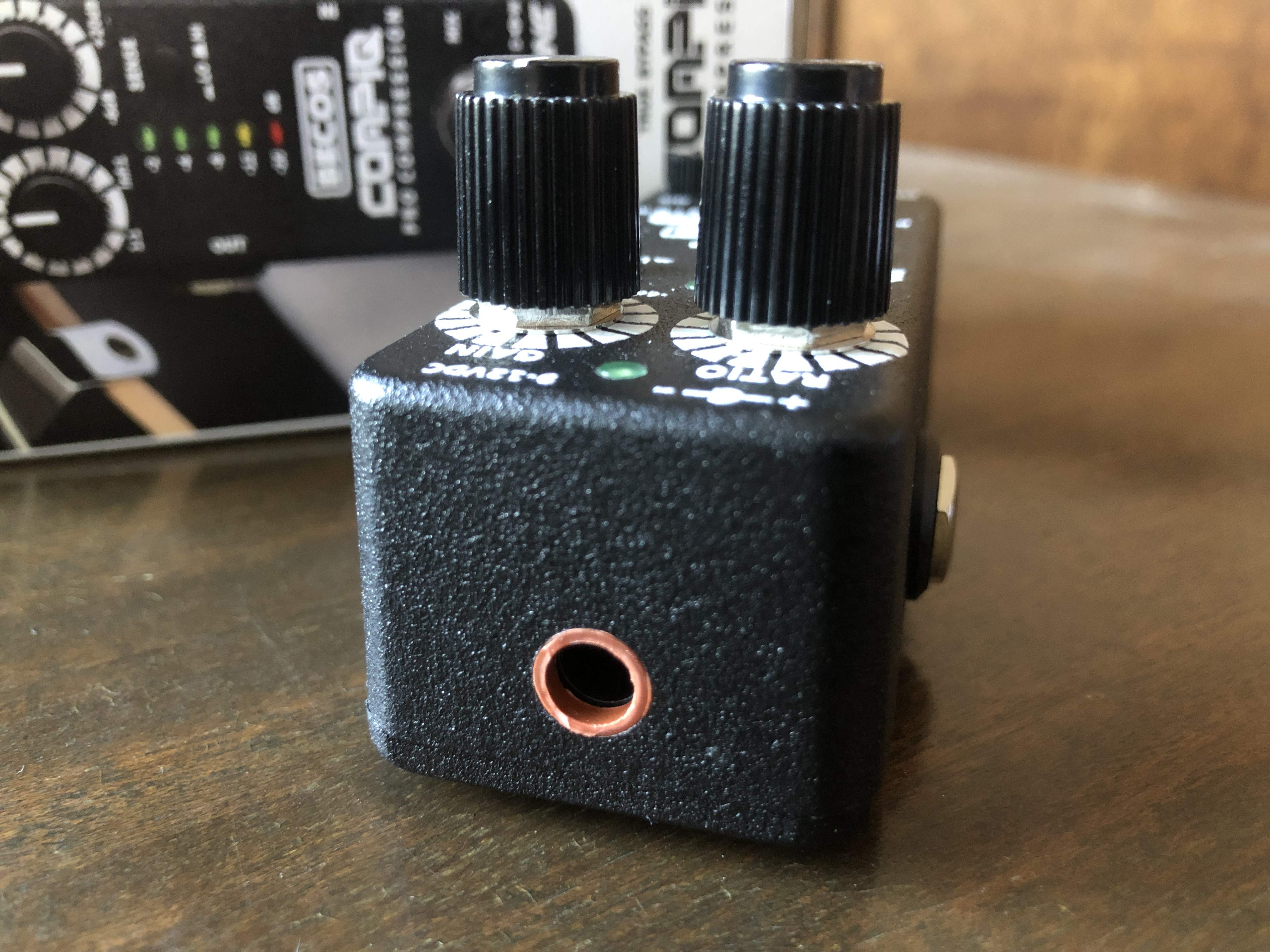
The pedal operates with a voltage of 9 - 12 VDC but there is no noticeable difference running at 9 volts vs. 12 volts. Using a barrel longer than 12mm will work much better with Becos compressors.
The retail price of the Becos Mini One Pro $156 which is priced similarly to the Becos Mini Pro at $168 which has more controls. Both are a tremendous value. Hey, sometimes simple is better.
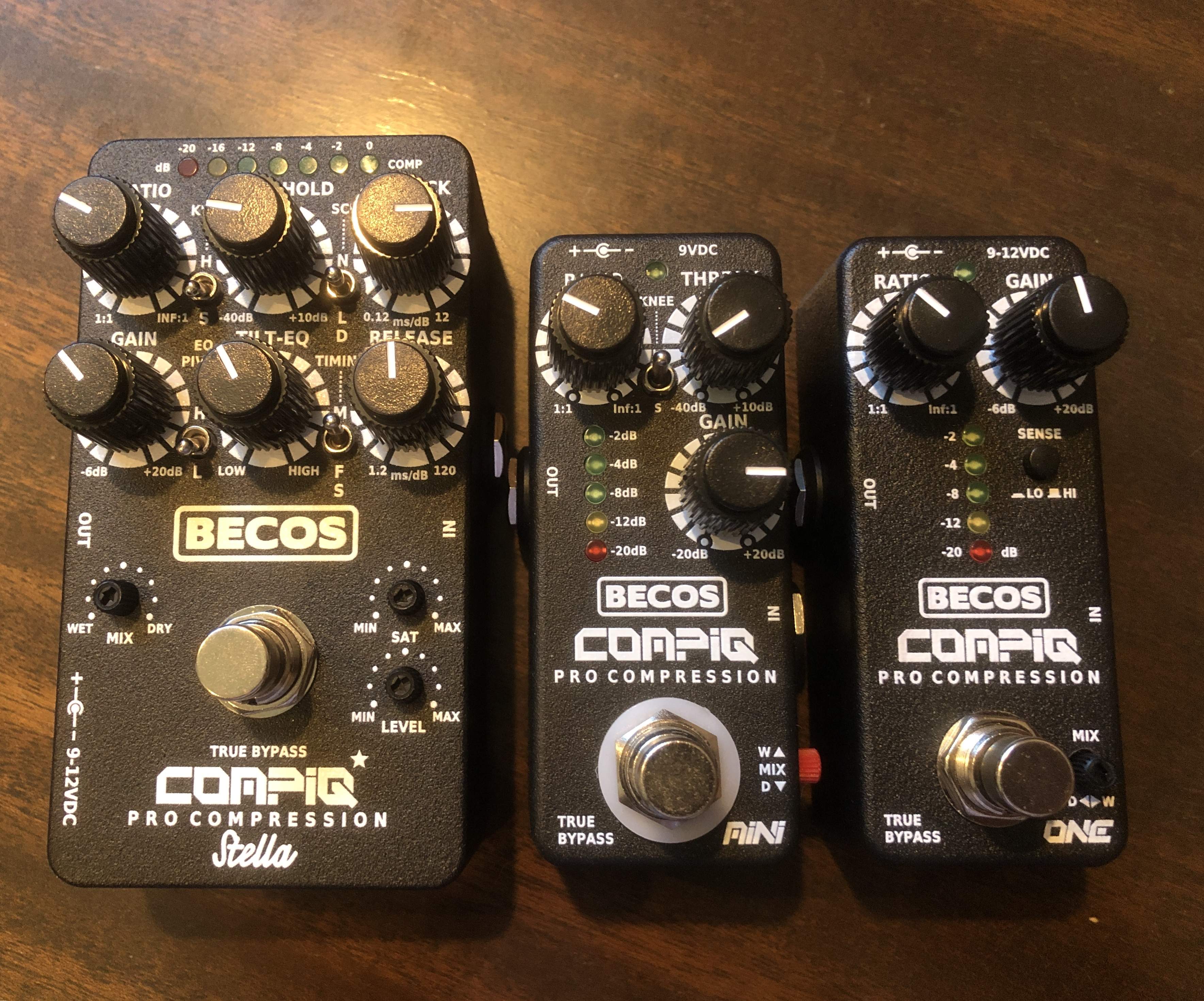
Here's a Becos Family Photo.
Note: The photo shows the Mini Pro prototype prior to inclusion of the Timing switch which is now standard on all shipped.
The folks at Becos in Romania are back at it again with another new compressor pedal. This time, a more simple-to-use mini compressor for those either not needing a lot of controls or preferring less knobs to mess with. But this is no dumbed-down device. No, its a great little compressor that functions well and still includes a five LED gain reduction meter and dry/wet mix parallel compression option.
I am pretty fond of the Becos CompIQ MINI Pro Compressor reviewed earlier. I said it "may be little, it is not short on features. The team at Becos managed to cram a whole lot of versatility into a small form factor." While the Becos CompIQ Mini One doesn't have the same features under the hood it is the same Blackmer® VCA type compressor with FET active circuitry and WIMA audio capacitors. Basically the exact same circuit, just without so many controls.
There are three knobs and one push button on the face of the compressor. There is also an inside trimmer. More on that later.
The Ratio knob sets how much the audio signal is going to be compressed after it passes above the set threshold. It shares the same continuous range as the Mini Pro starting from 1:1 (no compression applied) to Infinite:1 (basically limiting). At 9:00 you are roughly in the space of 2:1 ratio. At noon, more like 4:1. At 3:00 things are pretty squishy at around 10:1 ratio. The full range is useable and at higher settings makes for a pretty good limiter.
The Gain knob is there to make up the gain as you increase compression. As is expected, the higher you turn the gain, the more noise is introduced to the signal. Adjusting wet dry mix (small knob adjacent to footswitch) can help mitigate added noise. It is not an overly noisy compressor, but it is definitely not as quiet as others on the market. There is plenty of gain on tap.
The Wet Dry mix dial mounted on the right side on the top of the pedal adjacent to the foot switch and allows you to blend as much or little of your clean signal with the output compressed signal. In the middle, the mix is 50/50. When set to 100% dry (all the way counter clockwise), the CompIQ Mini One Pro acts like a buffer. This is a very useful design and I really like the dial set between noon and 1:00. I'd say there is enough variability in the range to satisfy anybody.
The Sense button is a type of threshold control. It controls the level at which the compression is applied. Compression is only applied to the portion of the signal that goes above the threshold. There are two preset levels. Switched down is the Lo setting fixed at -40dBu and is suitable for very weak instrument signals. In this setting the signal kicks in immediately. The Hi setting is user controlled by a trimmer inside the pedal with a range of -40dBu to +10dBu. (See picture below showing red trimmer dial in upper left.) With the inside trimmer set to noon it is 30dBu. The Hi setting is more for higher output instruments. I much preferred how the compressor reacted and felt in the Hi setting with all 5 of my basses. But if you have a very weak passive bass, the Lo setting might be just what you need. I would personally rather have an exterior Threshold dial but for the target audience I bet most will never touch the inside trimmer. However, if you do you will be met with a lot of control. It's a trade off. Less dials on the outside, but at least you can manipulate the threshold to some degree.
There is no control of attack and release timing. The Mini One Pro offers dynamic processing of attack and release timing. This means that short transients are handled with faster timings, while steady signals get slower timings. It works well as it reacts to your playing dynamics. The timings are approximately 10-15ms for attack time and 200-220ms for release time. Attack time is the amount of time it takes before the compressor kicks in. Release is the amount of time the compressor takes to "let go", or return to normal audio level.
There are many other compressors on the market that handle attack and release this way including the Keeley Bassist. That brings up a good point. In many ways the Becos Mini One Pro has a lot in common with the Keeley. Differences include the fact that the Becos trades a Threshold dial for a push button and internal trimmer. But you also get a 5 LED gain reduction media that is far superior to the Keeley Bassist's single LED. The Becos also adds the comprehensive Dry/Wet signal dial. The Becos is also smaller. Both have an inherent transparent quality.
The Mini One Pro has a soft compression knee which means it has a subtle application of compression.
This isn't a compressor that is going to impart some sort of flavor or coloration to your tone. It is not a "tone magic" device but does a great job of subtle compression all the way to harder limiting action. Like the previous Becos compressors I reviewed I didn't notice any loss of highs or lows. I had no issues with any of my basses and never had concern about headroom.
Did I miss the amount of controls of the Becos CompIQ Mini Pro (notably the full Threshold Knob, Soft vs. Hard Knee control, and Attack/Release timing switch)? Yes and no. For what it is, the Mini One Pro is a remarkable little tool. I personally like having more control of threshold as I use many different basses. On the other hand, I suspect the target audience is more the set-and-forget crowd. I've really come to like this one. Its simplicity is its strength.
If you are considering the Keeley Bassist, the Becos CompIQ Mini One Pro is also worthy of your consideration. The Mini One Pro is well built, looks great, and performs well. It doesn't really make your tone bigger or fatter but it does compression really well.
The footswitch is true bypass.
The pedal operates with a voltage of 9 - 12 VDC but there is no noticeable difference running at 9 volts vs. 12 volts. Using a barrel longer than 12mm will work much better with Becos compressors.
The retail price of the Becos Mini One Pro $156 which is priced similarly to the Becos Mini Pro at $168 which has more controls. Both are a tremendous value. Hey, sometimes simple is better.
Here's a Becos Family Photo.
Note: The photo shows the Mini Pro prototype prior to inclusion of the Timing switch which is now standard on all shipped.
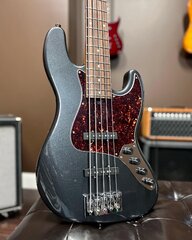
@scubaduba, would you still say the Smoothie is your top choice for an every-day, all-around compressor? I’ve tried the Diamond, FEA DE-CL, Cali76-CB, Whirlwind OC, and the Hyper Luminal, in addition to my Smoothie Opto. For one reason or another, the Smoothie comes out on top every single time for me.

It’s going to be a long wait until November for my Smoothie purchase....@scubaduba, would you still say the Smoothie is your top choice for an every-day, all-around compressor? I’ve tried the Diamond, FEA DE-CL, Cali76-CB, Whirlwind OC, and the Hyper Luminal, in addition to my Smoothie Opto. For one reason or another, the Smoothie comes out on top every single time for me.

@scubaduba, would you still say the Smoothie is your top choice for an every-day, all-around compressor? I’ve tried the Diamond, FEA DE-CL, Cali76-CB, Whirlwind OC, and the Hyper Luminal, in addition to my Smoothie Opto. For one reason or another, the Smoothie comes out on top every single time for me.
I’ll certainly concur that the Smoothie is an all around great comp for my needs. I also like the Keeley and use it as well. Other folks MMV.

deepestend
Commercial User
- Feb 21, 2003
- 6,249
- 8,168
- Disclosures
- Website and Social Media at Sadowsky
I have to say that I’ve kind of gone full circle on comps. I now feel like the boost function was more what I was chasing than the compression and am now on more of a boost chase. Anyone else?
@scubaduba, would you still say the Smoothie is your top choice for an every-day, all-around compressor? I’ve tried the Diamond, FEA DE-CL, Cali76-CB, Whirlwind OC, and the Hyper Luminal, in addition to my Smoothie Opto. For one reason or another, the Smoothie comes out on top every single time for me.
You've tried a lot of great compressors. There are so many great options these days, but I would say the Smoothie is one impressive device.

I have to say that I’ve kind of gone full circle on comps. I now feel like the boost function was more what I was chasing than the compression and am now on more of a boost chase. Anyone else?
I usually don't use comp, but when I do I prefer subtle shades*. My favorite technique is to use parallel compression (wet/dry blend). When set right it allows dynamics/transients to come through, but also provides a nice sumthin' sumthin' that improves how I sit in the mix: isn't really noticeable until I turn it off. Parallel isn't mandatory for subtle comp, but I find it easier to use for that.
I've always considered boost a very different thing. For me, subtle comp is always on, whereas boost would be temporary for solos, louder passages. I get it, some leave boost always on to add warmth (heat up preamp tubes, push a gain stage harder), but I haven't yet found a use for just boost.
Those are my preferences, not saying they're superior in any way. Why boost and not comp? Just curious.
*Every so often I'll use less subtle comp for phat/vintage tones... McCartney, Jamerson, etc. I generally don't leave this always-on.
deepestend
Commercial User
- Feb 21, 2003
- 6,249
- 8,168
- Disclosures
- Website and Social Media at Sadowsky
Those are my preferences, not saying they're superior in any way. Why boost and not comp? Just curious.
*Every so often I'll use less subtle comp for phat/vintage tones... McCartney, Jamerson, etc. I generally don't leave this always-on.
I’m in a little bit of an experimental phase right now. While I 100% conceptually believe in a comp. I’m finding that now that I have one with an indicator (keeley bassist), I’m not actually engaging the actual comp that much. And that’s gotten me to thinking...maybe I always liked the tone fattening/warm aspect of the boost side of the pedal. So, why not use the keeley just as a boost? Doesn’t feel warm enough to me. So...down the rabbit hole. But maybe I need to experiment with blending my comp by putting a boost beforehand for color.
Last edited:

I’m in a little bit of an experimental phase right now. While I 100% conceptually believe in a comp. I’m finding that now that I have one with an indicator (keeley bassist), I’m not actually engaging the actual comp that much. And that’s gotten me to thinking...maybe I always liked the tone fattening/warm aspect of the boost side of the pedal. So, why not use the keeley just as a boost? Doesn’t feel warm enough to me. So...down the rabbit hole. But maybe I need to experiment with blending my comp by putting a boost beforehand for color.
What you need is the Southampton Ictineo. You’re welcome
Sorry folks, back to comps

I've been perusing these great Rick Beato videos lately and this one...combined with the fact that I'm a huge Rush freak....explains why I love the Diamond Bass Comp.
If I had to explain what the Diamond sounds like, it would be this:
If I had to explain what the Diamond sounds like, it would be this:

- Dec 21, 2007
- 15,222
- 45,000
- Disclosures
- Lark in the Morning Instructional Videos; Audix Microphones
I played a MultiComp for a long while (and didn't use it for a while, too). I got a Doc Lloyd. When I A/B'd them (tubesim on the Multicomp) I liked the Doc Lloyd a little better, plus it was quieter. But not at all a dealbreaker - if I hadn't read @scubaduba 's thread and hadn't changed I'd been no less happy with my sound.EBS loyalist here...for probably about 15 years. Is there better out there? Probably, but that part of my chain (first) is pretty perfect for what I look for (and yes, I use tubism).
If I try something else, will I change? Most certainly...but so far, I've been able to control myself when it comes to compression

I've just bought Becos Compiq Mini Pro Compressor, it will arrive mid august. Will try it and share my bass world newcomer thoughts about it.
Here you have a 10€ coupon they send me to share: Invalid Link Removed
Here you have a 10€ coupon they send me to share: Invalid Link Removed


