• TalkBass has been independent since 1998. Add your voice.
    Create a free account to reply to discussions, view embedded media, and browse with fewer display ads.
    Join freeLog in
    Want zero display ads or expanded classifieds tools? Compare plans.

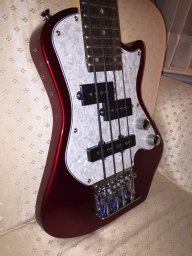
The bargain queen's new bass!

Oh y'all. I've done it. I went to put some new strings on her, and I didn't realize all the screws were basically floating on top of the bridge--when I took the old strings off and there was no more tension, I picked her up to move her to a higher table, and ALL OF THEM FELL OUT! I have no idea which one went where because they just scattered. I felt like Ralphie when he was helping his dad change the tire and all the nuts flew out of the hubcap. I put everything back together, but it's just not right. The intonation is totally off. What can I do other than pay for a setup, which I don't really want to do since it came to me already set up! Help! :(
 
Yep, that'll happen.

You can guess which go where. The E string is usually farthest back for longest string length each following string is shorter than the last. Also, if you have a decent tuner, you can learn to intonate, it's really pretty easy.

How to Adjust Intonation on Bass: 9 Steps (with Pictures)

image.jpeg
 
Oh y'all. I've done it. I went to put some new strings on her, and I didn't realize all the screws were basically floating on top of the bridge--when I took the old strings off and there was no more tension, I picked her up to move her to a higher table, and ALL OF THEM FELL OUT! I have no idea which one went where because they just scattered. I felt like Ralphie when he was helping his dad change the tire and all the nuts flew out of the hubcap. I put everything back together, but it's just not right. The intonation is totally off. What can I do other than pay for a setup, which I don't really want to do since it came to me already set up! Help! :(
As someone who struggles to change a light bulb, IMO, the intonation is the easiest part of a setup. Once the truss rod is set and saddle heights in good shape so you don't have fret buzz and have a comfortable height, then by loosening one at a time and adjusting the length, you can get the intonation set for each string in just a few minutes. If the string heights and intonation are both off, get the heights set first for all strings and then the intonation. Tons of good on-line tutorials and videos on setting up a bass. Truss rod is hard and worrisome part. The rest is really easy. Chin up. No worries.
 
  • Like
Reactions: Forty-Thirty
Yep, that'll happen.

You can guess which go where. The E string is usually farthest back for longest string length each following string is shorter than the last. Also, if you have a decent tuner, you can learn to intonate, it's really pretty easy.

How to Adjust Intonation on Bass: 9 Steps (with Pictures)

View attachment 849994

For novices this guide is simple and informative, but it left out one small detail. (step 10?) Moving the saddles back or forward will change the string height slightly. (higher back toward bridge/lower forward toward neck) So another round of string height adjustment after intoning will completely dial a bass in. Also worth noting that a few further checks in the following days after playing it will result in some subtle changes as the wood gets use to your first adjustments. After a few tweaks it should remain stable. Intoning ones bass is something anyone can do this and it will really help you feel connected to your instrument by doing your own work on it.

 
For novices this guide is simple and informative, but it left out one small detail. (step 10?) Moving the saddles back or forward will change the string height slightly. (higher back toward bridge/lower forward toward neck) So another round of string height adjustment after intoning will completely dial a bass in. Also worth noting that a few further checks in the following days after playing it will result in some subtle changes as the wood gets use to your first adjustments. After a few tweaks it should remain stable. Intoning ones bass is something anyone can do this and it will really help you feel connected to your instrument by doing your own work on it.

Yah mon, it was the simplest one with "pictures" I could find at the moment on the Google.
 
  • Like
Reactions: JIO
Oh y'all. I've done it. I went to put some new strings on her, and I didn't realize all the screws were basically floating on top of the bridge--when I took the old strings off and there was no more tension, I picked her up to move her to a higher table, and ALL OF THEM FELL OUT! I have no idea which one went where because they just scattered. I felt like Ralphie when he was helping his dad change the tire and all the nuts flew out of the hubcap. I put everything back together, but it's just not right. The intonation is totally off. What can I do other than pay for a setup, which I don't really want to do since it came to me already set up! Help! :(
You will figure it out just fine, then you will be on the way to doing your own setups all the time. Or you can take it to a luthier and get it really completely set up and adjusted. It's been a few weeks, so the neck should have settled into your climate nicely by now.
 
  • Like
Reactions: Forty-Thirty
I have two other suggestions which are sometimes overlooked. I always I do this when I tune and intonate my basses to get them as spot on as humanly possible. Please forgive if any of this is old news, but I don't see these mentioned much on TB.

First of all, as you are working on each individual string - key the string slightly sharp and then stretch the string down to pitch. Pull quickly outward on the string with a decent amount of force near the pickups. If they haven't been stretched much, you may pull it way flat, but no matter - keep doing this until it gets stable: over tune a slight pinch sharp and stretch it down to pitch. Doesn't really matter if the string is new or old - the stretching is good for it. If there is any looseness, weakness or wear in the string anywhere - it's better to find out now - rather than breaking a string on a stage somewhere. Keep keying it just slightly sharp and stretching it down to pitch until it holds and stabilizes on each string. This is SOP for me every time I tune any bass, not just when setting intonation. It's how I tune.

Next , when setting the intonation - tune ALL the strings as perfectly as you can get them - and when you adjust any saddle even slightly - go back and tune each string back to exact pitch before you move on to the next string. Any time you change any saddle it affects the tension on the neck ever so slightly and also causes the tuning to change slightly on all the strings. I have seen music store set-up folks do this time and time again. They don't do any double checking on the overall tuning as they move the saddles around from string to string. Then they wonder why it isn't as spot on as it should be when they re-tune the instrument to pitch. So they start over and basically do the same thing again - and it ends up taking much longer than necessary.

I always start with the G string because it pulls the least amount of tension. If you have to move the G string saddle at all, re-tune all the strings on the entire bass before you move to the D string. If you have to do a forward or backward saddle adjustment to the D string, you should immediately re-tune the instrument and go back and re-examine the G string and so on, which will likely now be slightly off. The strings are not on an island here, the saddle adjustments work in concert with the neck tension - which can affect the other strings as a whole. So you have to be patient and keep going over and over the strings, checking the harmonic vs. the note at the 12th fret until each and every one of them is as spot on as possible. This can save some time if you always make sure that the entire bass perfectly in tune before you move on to adjust and intonate the next string.

Also, I know we sometimes like to keep certain types of strings on for multiple years, but if a string is just too worn or has too much corrosion or hardened finger cheese - the only solution for spot on intonation may be installing a new set. Don't blame the bass if faulty or worn strings are the cause.
 
Last edited:
I just jumped on your boat 40-30. Earlier a member posted a link to Rondo's web site for an SG style prototype baritone electric uke and when I looked at it, I realized it can easily be converted to a u-bass, so I bought it for $200. But, it's classic red and I already have a custom red Hofner style u-bass I really like. My thing is none of my basses are the same color, but it looks like I'm going to have to have two reds because the SG red just looks so classic (I'm going to add a black pickguard and proper SG bass bridge).

(Now that I look at the images, they're not so close in color.)

Valkyrie SG 700.jpg

Violin red bass done 700.jpg