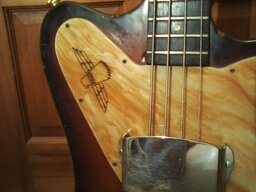
You do have a cruel streak in you.What's the best tone wood for a thumb rest?


TalkBass has been independent since 1998. Add your voice.
Create a free account to reply to discussions, view embedded media, and browse with fewer display ads.
Join free Log in
Want zero display ads or expanded classifieds tools? Compare plans.
You do have a cruel streak in you.What's the best tone wood for a thumb rest?
Needs more knobs.So... here's my latest take on the sometimes-venerated Peavey Combo 300. It was a heavy little beast, so I did a mod... the speaker enclosure is a tad larger now too, so you get a little more air in the lows...
View attachment 3452388
I still need some rubber feet on the bottom of the amp case. But I really do like the sound I get from this little rig, esp with my Epi Thunderbird Classic. It's becoming my star player.

FWIW, pic of 67 TBird w/ original pg and tug bar:It appears the sweet spot on my Chowny CHB-1 is also right behind the neck pickup. Seems to me it's about where I've been playing mostly anyway and now this. Had to see for myself for sure and going to qualify this -
It's the sweet spot for me when both pickups are dimed.
Uncertain if a thumb rest would be an asset for me, as a couple years practice of floating thumb technique (learned about here at TB) means I'm seldom resting my thumb. And also using my thumb + index -middle together .... More and more I'm working not to dig in as was habit, but to let my amp do the heavy lifting.
The thumb rests on the old Starfires are really interesting.
 and with new pg, not drilled for tug bar(which I saved):
 I usually play fingerstyle between the pup cover and the bridge cover with my thumb on the pup cover. Occasionally play just behind the neck heel for really 'fat' lows.
Further to my last post..just tripped on back door step and head butted trhe solid wooden door with mt solid wooded head...gotta go lay down..later guys..cant type well bit blurry
iYou do have a cruel streak in you.

FWIW, pic of 67 TBird w/ original pg and tug bar:View attachment 3452644 and with new pg, not drilled for tug bar(which I saved):View attachment 3452645 I usually play fingerstyle between the pup cover and the bridge cover with my thumb on the pup cover. Occasionally play just behind the neck heel for really 'fat' lows.


You do this often?
(some people pay good money for that kind of sensatio
i
It shows?
The MM pickup has a space that historically sees a thumb-in-residence as I dig in. Sort of becomes a habit to play back there. The string tension is higher, and to my ear, the tone is articulate. As I returned to my bass after these years, found myself playing much closer to the neck. It's that tone I sought and found in the semi-hollowbody. It's a whole different experience in bass. The semi-hollowbody isn't where I go looking for Entwistle Alembic range tones.
Figure between the Stingray and the CHB-1, that's a lot of tonal territory.
Turning 'dem knobs ....
Seems to me if any proper catalogue of preamp settings needs to begin with what is "flat"? And more or less we know there ain't no such thing when every brand has its own tonal colour. Helps to know what that is before twiddling ... The Elf (yeah I know it's not a combo amp, but it's an example I can cite right now) has a native bump in the highs and lows, which makes it appear there is a mid-scoop with the EQ knobs at noon. Add some gain to engage a bit of compression and hey there's some mids. Magic!
Amps are weird. I love it.

Further to my last post..just tripped on back door step and head butted trhe solid wooden door with mt solid wooded head...gotta go lay down..later guys..cant type well bit blurry
When I drove truck(s), the first thing I did getting into a different truck was to familiarize myself with the control layout. (where are the wipers;headlights;dimmer on the floor or on the steering column;how many gears/what pattern). Each brand of car has some things laid out differently from your previous experience. Why should amps be any different? Gives us something to discuss/complain about-and hours of tweaking to achieve that elusive sound 'in our heads'. Or not.... NEXT!You do this often?
(some people pay good money for that kind of sensatio
i
It shows?
The MM pickup has a space that historically sees a thumb-in-residence as I dig in. Sort of becomes a habit to play back there. The string tension is higher, and to my ear, the tone is articulate. As I returned to my bass after these years, found myself playing much closer to the neck. It's that tone I sought and found in the semi-hollowbody. It's a whole different experience in bass. The semi-hollowbody isn't where I go looking for Entwistle Alembic range tones.
Figure between the Stingray and the CHB-1, that's a lot of tonal territory.
Turning 'dem knobs ....
Seems to me if any proper catalogue of preamp settings needs to begin with what is "flat"? And more or less we know there ain't no such thing when every brand has its own tonal colour. Helps to know what that is before twiddling ... The Elf (yeah I know it's not a combo amp, but it's an example I can cite right now) has a native bump in the highs and lows, which makes it appear there is a mid-scoop with the EQ knobs at noon. Add some gain to engage a bit of compression and hey there's some mids. Magic!
Amps are weird. I love it.

Dude... sorry! Ice, right?Further to my last post..just tripped on back door step and head butted trhe solid wooden door with mt solid wooded head...gotta go lay down..later guys..cant type well bit blurry
Dude... sorry! Ice, right?
A catalogue of of pre-ampian 'What is Flat?' would be mighty useful. It's probably a fair bit of work to collate and obtaining that information would be (much) tougher yet. Here, for example, is the work @fdeck did to ascertain flatness on a GK Backline 600: Which amp heads have no baked-in EQ curve?. I like this approach because it bypasses the fickleness of our ears (admittedly both a curse and a blessing).
You are not wrong about the ELF - that ol' gain/compression knob is powerful and needs to be treated with care.
The only "tool" at my disposal is a smrtphne spectrum analyzer, with no real idea what to do with it. With the controls "flat" there's still the native tone of the amp (that's good).
Seems to me "flat" is already figured out for Rumbles too.

It appears the sweet spot on my Chowny CHB-1 is also right behind the neck pickup. Seems to me it's about where I've been playing mostly anyway and now this. Had to see for myself for sure and going to qualify this -
It's the sweet spot for me when both pickups are dimed.
Uncertain if a thumb rest would be an asset for me, as a couple years practice of floating thumb technique (learned about here at TB) means I'm seldom resting my thumb. And also using my thumb + index -middle together .... More and more I'm working not to dig in as was habit, but to let my amp do the heavy lifting.
The thumb rests on the old Starfires are really interesting.
You do have a cruel streak in you.

Further to my last post..just tripped on back door step and head butted trhe solid wooden door with mt solid wooded head...gotta go lay down..later guys..cant type well bit blurry
I wasn't saying it was a bad thing.Yeah, she does, but I knew that upon replying to her post. Sometimes, GP, ya just gotta let folks have some fun!

In revisiting this ^ thread - began to read it when it appeared and fell off when it began to feel more like watching a tennis ball than enlightenment - and in context of this discussion at Combo Club
Just understanding what these knobs on our amps do is a big deal. The doc that came with my amps is probably accurate, yet not particularly illuminating. Navigating a FVM tonestack is hardly intuitive (for example, this household is FVM tonestack-free - I think?)


