
I don't measure things like that. It's simply too loud for my taste. And it gets louder as the amp heats up.So what’s your definition in terms of actual noise?? Is it more than 60db?

Enjoy the benefits of a premium membership!
Upgrade Account
-
TalkBass has been independent since 1998. Add your voice.
Create a free account to reply to discussions, view embedded media, and browse with fewer display ads.
Join free Log in
Want zero display ads or expanded classifieds tools? Compare plans.
You are using an out of date browser. It may not display this or other websites correctly.
You should upgrade or use an alternative browser.
You should upgrade or use an alternative browser.
The Conclusions I've drawn about Micro Bass Heads
- Thread starter Appogee
- Start date
-
- Tags
- bass head comparison
More options
Who Replied?
I appreciate the science! For reference, the ambient noise level in our rehearsal room is 29db, or roughly half that which you measured (remembering that db is a logrithmic scale). 60db is considered to be "normal conversation level" ([Invalid or Expired Link Removed]) and is 1000 times louder than 30 db (source).
Yeah but that level was measured right in front of the fan.
Measuring at 1 meter away it drops to 40.
So unless you plan to hold it up at head height while chatting with the band, I don’t think the fan will be that noticeable.

It helps to measure and provide a factual assessment, otherwise it’s just subjective hyperbole.I don't measure things like that. It's simply too loud for my taste. And it gets louder as the amp heats up.
 e.g.- it’s loud, how loud? about 60dgb, the same as the AC in the house.
You're right. On the gig, it's less of an issue but for rehearsal and practice it was a bit much. But the fan in the Bass Block 800 comes on very soon. I'm sure it's designed to do so but I found it annoying.The fan on my Hartke amp doesn't run until the amp gets really hot. Which, in home practice use is never. In gig use, I don't think fan noise is a factor. In any case, it's not that loud.
Last edited:
I've added it to my personal comparison, and will upload an updated image. It's on the 'larger footprint and taller' end of the comparison.Unless I'm missing it, I don't see the Aguilar 350 in your diagram.
I tried that, but found my Zoom B1 Four and B6 (both of which ouput a line level signal) were too noisy when plugging into the instrument input (ie. before the pre-amp) of my main bass amp.So, what is this fixation on the FX loop?
I use a Zoom B3 sometimes, and old school- plug it right into the front panel.
Going from bass to pedal to FX loop Return seems to provide a much less noisy signal.
Come to think of it, I wonder whether pedal to instrument input that has an active instrument pad option might work. I should try that out.
As explained above.you totally don't want to run your multi-fx to the front of the amp like all we do? but why (provided you have a clean amp)? is it line-level only?
I excluded it on the basis that it's again tending to the bigger/taller footprint than I set out to compare.Is the Orange LBT too big? 27.6 x 25.1 cm, about 3 kg. I have a Terror Bass, but if I didn’t want the tube preamp, the LBT would be my choice.
Explained above, and my general use of other effects is explained in my post before this one.I'm curious why you feel an fx loop is in any way useful at all for bass?
As you surmised, I'm using a multiFX pedal into the FX loop Return of my amp, so the amp basically just makes it all louder, and provides a DI for the desk if needed.
I appreciate your detailed response on when best to use an FX loop vs an amp's pre-amp section etc. It should be pinned somewhere on Talkbass as I reckon it would save a lot of beginners a lot of painstaking research, trial and error

You're right. It's simply the humble opinion of a 68 yr old player who's used amps for over a half century.It helps to measure and provide a factual assessment, otherwise it’s just subjective hyperbole.
When running at full blast, my aircon is 35db where I am sitting about 16ft from the wall vent, and 50db one foot from the wall vent.
Peavey may be missing the opportunity for a profitable new line of multi-function bass heads
I do have a soft spot for Peavey. A 15" Black Widow in a 1000W combo was the first bass amp I owned. And the Minimax 600 is fantastic value as a main head.
I hope they are considering releasing a revised version utilising a larger fan, thermo-throttle controlled. It would move a higher volumer of air, but at lower RPMs, making it much quieter.
Peavey may be missing the opportunity for a profitable new line of multi-function bass heads
I do have a soft spot for Peavey. A 15" Black Widow in a 1000W combo was the first bass amp I owned. And the Minimax 600 is fantastic value as a main head.
I hope they are considering releasing a revised version utilising a larger fan, thermo-throttle controlled. It would move a higher volumer of air, but at lower RPMs, making it much quieter.
Last edited:
When running at full blast, my aircon is 35db where I am sitting about 16ft from the wall vent, and 50db one foot from the wall vent.
Peavey may be missing the opportunity for a profitable new line of multi-function bass heads
View attachment 5164609


Again, I’m not a fan (pun intended) of that particular head, I’m selling the one that I have.
However, I’m just pointing out that 40 dB or even 30 dB from 10 feet away from that head (or another mfg) is not going to obstruct your ability to have a conversation with band members. No more than your houses air-conditioning unit would.
When someone says ‘the fan on an amp is too loud’, I’d like to know what does that mean? Is it 30 dB from 10 feet away or is it 100db? and too often it’s the former, which IMHO is not that big of a deal if you otherwise like a particular amp. That’s my final thought, YMMV.
Last edited:

- Feb 12, 2006
- 61,047
- 5
- 221,002
- Disclosures
- Development Engineer-Mesa Boogie, Development Engineer-Genzler (pedals), Product Support-Genz Benz
not to argue, but a speaker output wouldn't be TRS. im sure you meant standard TS phone jack.
anyways, i agree with you Neutrik is better. Combo is best and should be standard on everything,
and its really not much bigger than a phono. im sure they could have shoehorned it into the Elf.
Not that that was a deal breaker for me as i own two- head and 8" combo.
yes the fans are annoying. not that they're my biggest fans... right?
Combo jacks do not meet the global safety standards depending on the interpretation of the regulations because the voltage of BTL type amps can create the impression of a shock as the metal sleeve of the 1/4" plug is energized. This is a gray area in the regulation and is subject to interpretation, different agencies interpret it differently so when exporting globally it can become a problem when it's disallowed by a region because of a more strict interpretation. It's generally a bigger problem with the higher powered amps.
Then perhaps I am using the term incorrectly relative to the way other Talkbassers use it.
I am referring to the broad sonic palette that I employ when playing bass, which includes choruses, reverbs, delays, distortion, flanger etc, in a duo where such coloration can add a lot to the sonic diversity of the set list.
My setup is bass -> multi FX pedal -> FX Loop in on the amp -> cabinet. Being able to use the same MultiFX pedal with my MBH that I use with my main head is therefore important, and the reason I need to have an FX loop on my MBH.
Setting the MBH EQ for a flat tone should avoid any additional colorisation from the MBH.
Ok, I can simplify the solution for you... you are using the amp as a power amp only through the effects return. On many amps (like the Subway and Magillan models), the aux input does exactly the same thing and they insert the signal as a line level input to the power amp pre master volume control. IF the preamp is balanced output, a tip-sleeve cable needs to be used to negate the summing function that's present on the TRS input.
This opens up a lot more options for you.
Thanks AgedHorse.

I think (?) you may be suggesting that I could potentially plug my multiFX pedal output into the Aux input of a MBH. But that the cable I would need to use would depend on whether the MBH's pre-amp provides a balanced or 'imbalanced' signal to the power stage of the amp(?)
The output from my Zoom B1 Four - which is the pedal I'd most likely use in the use case scenario for an MBH - isn't balanced.
If an Aux-in will substitute for an FX loop return, then the GR Bass Mini One would be the smallest MBH which delivered on my other personal criteria. I'm not sure how I'd determine though whether its Aux could handle the B1 Four's 'imbalanced' signal.
EDIT: ARGH! The GR Bass Mini One does not offer a Ground Lift on its DI. (WHY, Gianfranco Rizzi, WHY?!!!) That means the Phil Jones BP-200 is the smallest available MBH that meets my criteria. Or I might go for the Ag Tone Hammer 350, or TCE TQ500, on the basis that they offer a lot more watts for not a whole lot more footprint.
I understand everything above...Ok, I can simplify the solution for you... you are using the amp as a power amp only through the effects return. On many amps (like the Subway and Magillan models), the aux input does exactly the same thing and they insert the signal as a line level input to the power amp pre master volume control.
...but I don't understand the implications of this part, sorryIF the preamp is balanced output, a tip-sleeve cable needs to be used to negate the summing function that's present on the TRS input. This opens up a lot more options for you.
I think (?) you may be suggesting that I could potentially plug my multiFX pedal output into the Aux input of a MBH. But that the cable I would need to use would depend on whether the MBH's pre-amp provides a balanced or 'imbalanced' signal to the power stage of the amp(?)
The output from my Zoom B1 Four - which is the pedal I'd most likely use in the use case scenario for an MBH - isn't balanced.
If an Aux-in will substitute for an FX loop return, then the GR Bass Mini One would be the smallest MBH which delivered on my other personal criteria. I'm not sure how I'd determine though whether its Aux could handle the B1 Four's 'imbalanced' signal.
EDIT: ARGH! The GR Bass Mini One does not offer a Ground Lift on its DI. (WHY, Gianfranco Rizzi, WHY?!!!) That means the Phil Jones BP-200 is the smallest available MBH that meets my criteria. Or I might go for the Ag Tone Hammer 350, or TCE TQ500, on the basis that they offer a lot more watts for not a whole lot more footprint.
Ha! That made me LOL.Again, I’m not a fan (pun intended) of that particular head...
Last edited:

Your might want to add the Eich T-500 or T-900 to your list.
I gotta ask, what does the "Taste" knob do?

ah. well there is that. oh wellCombo jacks do not meet the global safety standards depending on the interpretation of the regulations because the voltage of BTL type amps can create the impression of a shock as the metal sleeve of the 1/4" plug is energized. This is a gray area in the regulation and is subject to interpretation, different agencies interpret it differently so when exporting globally it can become a problem when it's disallowed by a region because of a more strict interpretation. It's generally a bigger problem with the higher powered amps…
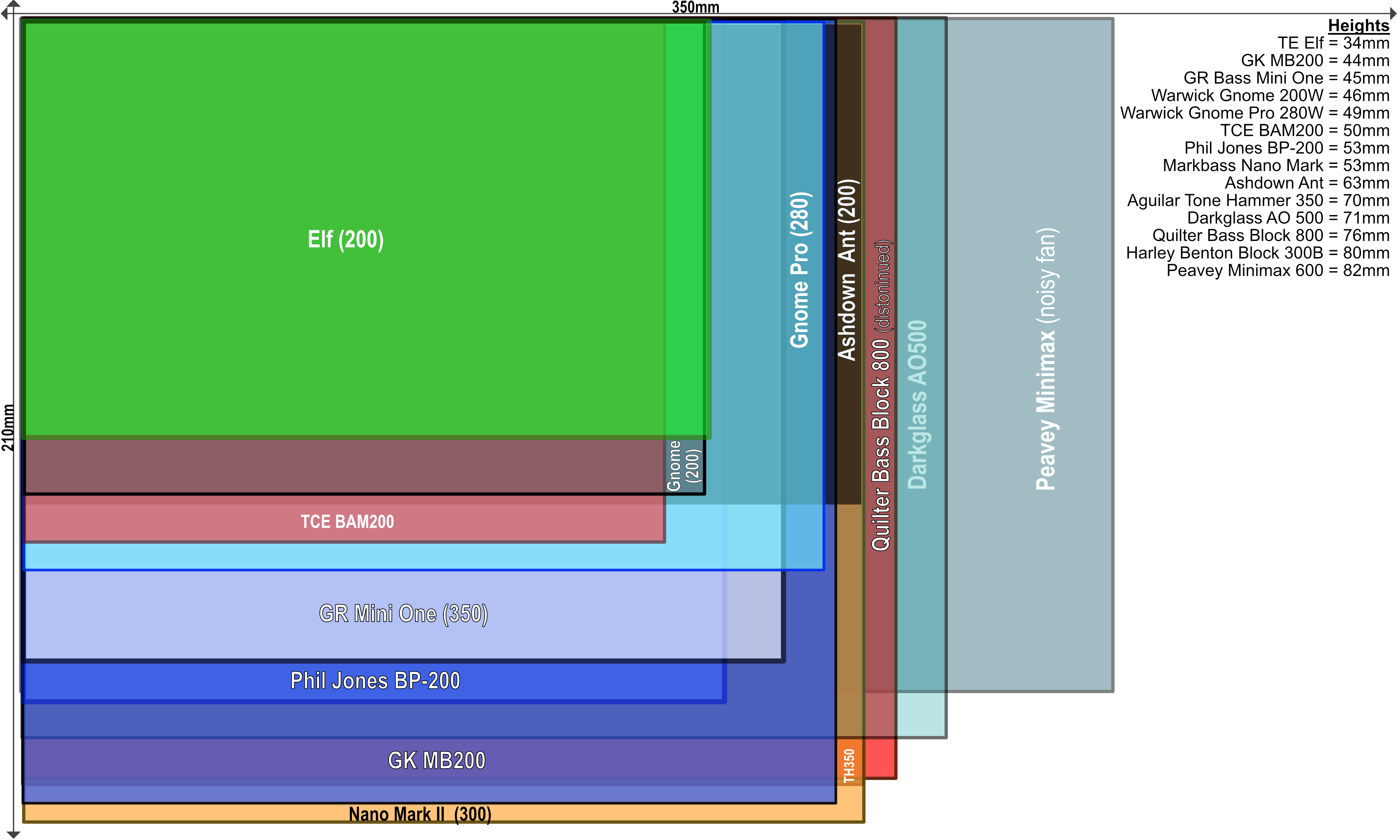
Here's an improved/corrected version of the footprints, for those who found the original helpful.
Amendments include:
Amendments include:
- scale added
- Aguilar TH350 added
- TCE BQ500 removed (dimensions in prior version were incorrect)
- other cosmetic/readability tweaks
- Eich T-500 is too big to fit on the image
Has anyone tried licking it?I gotta ask, what does the "Taste" knob do?
Last edited:

It made mine.Can my Mesa WD-800 make the cut?
Easily
And I didn’t ask….
FX loop isn't even a consideration for me as I rarely use modulation or time-based effects. They are very handy for some but it's the first thing to go to save space, as shown by the products you have listed above.
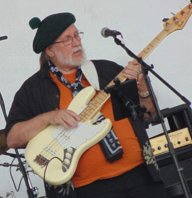
I have two class D heads. Not sure you'd call them Micro, but they are much smaller than my class A/B amps. The first one and the lowest powered one is my Eden TN-226. It's my lowest-powered amp with 226-watts rms into 4Ω. Love the sound, size, and weight of this amp. The sound is every bit as good and as warm as my big Eden WT500/800 amp. It has shelving unit bass and treble EQ's with bass set at 30Hz and treble at ~2.2KHz. It has two semi-parametrics to allow you to pick a particular frequency center and boost or cut it. First one is the Low-Mids control for everything between 30Hz and 300Hz. Second one is the High-Mids control for everything between 200Hz and 2KHz. Also has a shape control good fro bedroom practice but if you turn it up much during performances, you'll dial yourself right out of the mix. A very nice feature is its auto-compressor, which is smooth and musical and capable of just compressing the peaks of your signal to smashing everything flat depending upon the threshold level you dial in.After a lot of researching, measuring and listening, I've reached the following personal conclusions about Micro Bass Heads (MBH).
What I* Want from a MBH
*Note: What I was looking for, and the relative priority I place on each feature, could be very different to what you or anyone else is looking for.
- Smaller is Better. The ideal MBH fits in a back pocket, or at least, the pocket of a bass gig bag.
- Louder is Better. The greater the achievable volume, the more useful an MBH is for a variety of gigging purposes, and the more headroom you have on tap when the lead guitarist goes feral.
- An FX loop is very useful (and for me, mandatory, because I rely on a multiFX pedal to shape different tones for different songs).
- A Balanced/DI Out with Ground Lift is Very Useful. It enables the MBH to plug straight into a FOH desk, leaving the speaker output for stage monitoring.
- A Speakon or combo output is better than a mere TRS out. It just is, and I'm not prepared to hear arguments to the contrary
- Quiet cooling is important. Noone wants a hairdryer in the rehearsal room (well, other than the lead singer
- Aux In could be handy to some (though not mandatory from my perspective).
- Input pad to select between active and passive basses could be handy.
My Assessments of Various MBHs (listed in order of size)
Trace Elliot Elf: the smallest MBH, offering 200W at 4Ohms, 3-band EQ and a DI. But no FX loop, no Speakon out, a combo gain/compressor control that many reviewers feel squashes the signal too much too soon, a noisy fan, and that signature TE tone which you either like or you don't.
Warwick Gnomes: still small, offer an uncoloured tone, 200W at 4Ohms, DI out. The "i" versions provide a USB interface for your DAR, and the i Pro offers 80 more watts. But still no FX loop, and no Speakon output.
TCE BAM200: slightly bigger than the 200W Gnome, and functionally and tonally equivalent.
Ashdown Ant: Relatively small, though bigger than the MBHs listed above. More EQ options, and a Speakon out. BUT no gain control, and no FX loop.
GR Bass Minione: 350W at 4Ohm, Speakon out, DI out, and more EQ options. But no FX loop.
Phil Jones BP-200: Well featured, but no FX loop. D-Class power am, but a single channel Class A pre-amp.
GK MB200: Roughly double the size of the Elf, and well featured, but still no FX loop.
Aguilar Tone Hammer 350: Well-featured, but still no FX loop. (The TH-500 is the first of the Tone Hammers to offer an FX loop, but it's significantly larger.)
Harley Benton Block 300B: Roughly the size of the GK BM200, well featured, but no FX loop.
Quilter Bass Block 800: discontinued. It offered many more watts, and met many other requirements, but still offered no FX loop.
TC Electronic BQ500: It offers more watts than the small BMHs, but still no FX loop.
Nano Mark II: With the largest footprint so far (20cm x 21 x 5.3) it's the first to meet all the requirements I listed. It also offers 300W at 4Ohm. Its only downsides are that it's relatively expensive compared to most of the above MBHs, and provides a MarkBass-coloured tone which you may or may not like.
Darkglass Alpha Omega 500 and Microtubes 500: Both taller than the Nano Mark II, the Darkglass 500s are fully featured, and meet all my criteria. They allso variously offer other nice-to-haves including analog pre-amps, smarts like a choice of cab sims, twin distortion circuits, and atypical approaches to EQing. These all come at an increased cost vs the simpler and smaller MBHs. It could also be argued that they're too big to be fairly compared considered a genuine MBH, relative to the other offerings listed above.
Peavey Minimax 600: Offers 600W and meets almost all requirements, except that it has a very noisy fan (and is the tallest MBH listed here).
Other Contenders
Bergantino Forte D: many more watts of power from this excellent, fully featured and high quality amp. But it's a good deal bigger than the others, and so I think in a different category than the other amps listed above.
Darkglass e500: No doubt a versatile amp, but I am wary of anything that relies on the future availability of an app to provide its core functionality.
---
Here's a diagram showing the footprints and heights of the MBHs I compared.
View attachment 5163654
I hope you find the above interesting and maybe even kind of sort of potentially helpful.

Weight is 4.7-lbs. It is/was also available in a 500-watt version, the TN-501, which in my opinion is far more versatile for just a little more weight. It weighs in at 5.3-lbs. I carry my TN-226 amp and cables in a shoulder bag. Back of both models include one Speakon output plus two 1/4" outputs. There's an 1/8" aux-in jack; 1/8" headphones jack; DI out selectable for mic or line level; ground lift; pre/post selector for the DI; Send and Return FX loop; foot switch; and tuner out. The TN226 is dead quiet because it uses passive cooling and no fan. TN-501 has a quiet constant-on low-rpm fan.
Measurements are 12.6" wide, 3.15" tall, 7.9" deep
And to help put it into perspective for you, here's a shot of my "small venue" set up with a TN-226 and an Eden EX-112 cab. It's a very compact cab because it uses a whizzer cone for the high-mids and highs instead of a separate tweeter horn. Notice how nicely everything fits in a chair?

Just to pick a nit, here's the complete quote from the source:60db is considered to be "normal conversation level" ([Invalid or Expired Link Removed]) and is 1000 times louder than 30 db (source).
It appears to conflate "more intense" with "louder". However, if I understand correctly, 60 vs. 30 dB is 1000 times the SPL, not "louder": IOW, it is a thousand times the other value, but only to a sound pressure measuring device. In terms of loudness as perceived by the human ear, which - as psychophysical studies established - doubles every 10 dB,* 60 is only (about) eight times as loud as 30.To understand how loud 60 dB is, we need to look at how the decibel scale works. It is not a linear scale, but a logarithmic one. This means that if 0 dB represents no sound at all, then 10 dB represents a sound that is 10 times louder. Now, a 20 decibels sound is 100 times more intense than 0 decibels. And so on until a 100 decibels sound is one billion times more intense than complete silence (0 decibels).
So, while a sound at 60 decibels is 10 times louder than one at 50 decibels, it is also 100 times louder than a sound at 40 decibels and 1000 times louder than 30 decibels.
* [This does not take frequency into account: as Equal Loudness Contour curves (revised from the old Fletcher-Munson curves) show, the loudness...picture is complicated by the relationship of frequency with different SPL levels.]
The conclusion I have drawn about MBHs is that as technically remarkable as they are in a vacuum, they just wouldn't be advantageous for me. They might be small and light, but they're still head/cab setups, which I don't like. I'd rather have a small and lightweight, but powerful and full featured, combo amp – which exist these days, for not much money. The convenience advantage of the MBH is only vs. large bass heads, not vs. today's lightweight combo amps.
If I didn't need my own speaker for on-stage monitoring, it would be a different story. But that's never the case for me. I never operate speakerless on stage, using only the P.A.
If I didn't need my own speaker for on-stage monitoring, it would be a different story. But that's never the case for me. I never operate speakerless on stage, using only the P.A.
Good catch! This is how I (vaguely) remember the relationship between SPL and 'perceived loudness', too.It appears to conflate "more intense" with "louder". However, if I understand correctly, 60 vs. 30 dB is 1000 times the SPL, not "louder": IOW, it is a thousand times the other value, but only to a sound pressure measuring device. In terms of loudness as perceived by the human ear, which - as psychophysical studies established - doubles every 10 dB,* 60 is only (about) eight times as loud as 30.
This is a very good point. From my perspective, I mostly want a portable backup amp to get me through if my main head fails, and to also be able to use it for small venues instead of lugging my main amp around.The conclusion I have drawn about MBHs is that as technically remarkable as they are in a vacuum, they just wouldn't be advantageous for me... I'd rather have a small and lightweight, but powerful and full featured, combo amp – which exist these days, for not much money. The convenience advantage of the MBH is only vs. large bass heads, not vs. today's lightweight combo amps.
Last edited:
I owned one. It’s a very good amp, but the flat tone did y work for me with BG.Two words: Acoustic Image.
For EUB and DB it was great.
There is no fan in the amp, so it’s quiet,
but I did a private, outdoor gig with it in the and had to borrow a fan from the person hosting the party to keep the amp from going into thermal shut down.
Never an issue during loud, indoor gigs.

